


 For all latest news, follow the Daily Sun's Google News channel.


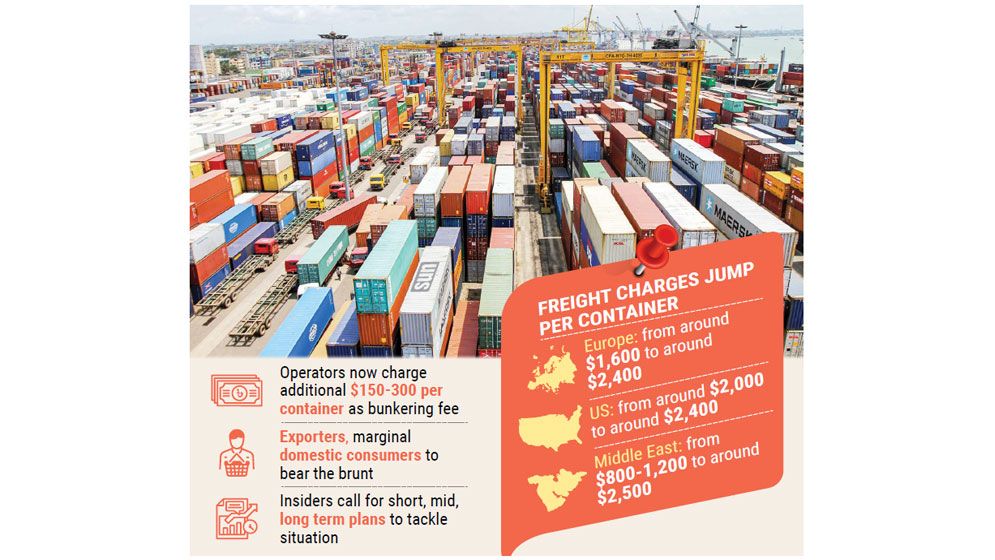
Despite the government’s decision to keep domestic fuel prices unchanged amid the global surge triggered by the war involving the United States, Israel and Iran in the Middle East, rising freight charges on international sea routes are straining the country’s import-export trade significantly.
After the war began on 28 February, the mainline operators – which are shipping goods to destinations including Europe, the United States and the Middle East – have increased the container freight rates.
They have also added additional insurance fees and bunkering charges.
According to the sector insiders, in the wake of the rising fuel oil prices and closure of the Strait of Hormuz, one of the world’s most critical maritime chokepoints that facilitates transit of around one-fifth of global oil and gas, per container freight charges have increased by over 20% to 40%, depending on destination ports.
They also expressed concerns that the involvement of Houthis and the potential disruption of vessel movement through the Red Sea and Suez Canal could deal a further blow to global trade.
The surge in freight costs is expected to have multiple impacts, including higher shipment expenses and rising commodity prices in domestic markets.
While welcoming the government’s move to keep fuel prices steady in April, industry insiders emphasised formulating multi-layered crisis management strategies in anticipation of a prolonged conflict.
Bangladesh Freight Forwarders Association (BAFFA) former Vice President Khairul Alam Suzan said the global rise in fuel oil prices and closure of the Strait of Hormuz have put the international trade under severe strain.
The mainline operators have already raised the freight charges, and rates may increase further this week, he said.
Suzan, also former director of Bangladesh Shipping Agents Association, informed that the mainline carriers have raised the freight charges due to higher global fuel prices while the insurance costs due to elevated risk premiums in the Persian Gulf.
He noted that operators are now charging an additional $150 and $300 for 20 and 40-foot containers, respectively, as bunkering fees.
Freight charges for European destinations have risen to between $2,300 and $2,400 per container, up from $1,600-1,800 previously. For the US ports, rates have increased to $2,200-2,400 from $1,800-2,000 previously, he said.
Similarly, the freight rates for Middle Eastern destinations now stand at around $2,500 against $800–$1,200 previously, said Suzan.
The BAFFA leader observed that the industries reliant on imported raw materials and export of finished goods would be hit hardest, as they must bear freight costs on both ends.
Mohammed Amirul Haque, president of the Bangladesh Cement Manufacturers Association, said the freight charges have increased by over 20% to 40%.
“Prices of all fuels and gases have also risen significantly. As the private sector will not provide subsidies, marginal consumers in the domestic markets and exporters will ultimately bear the brunt of this volatility,” he said.
“Not only freight charges, prices of industrial raw materials have surged as well. The price of raw materials per tonne, like cement clinker, soya beans, wheat and others from Vietnam, has now increased to $18 from $12 previously while $65 from $35 previously for cargos from Brazil,” said Haque, also managing director of Premier Cement and president of LPG Operators Association Bangladesh.
He urged the government to adopt short, mid and long term strategies to manage the ongoing crisis.
Bangladesh Garment Manufacturers and Exporters Association (BGMEA) Director Rakibul Alam Chowdhury said freight charges have increased by $750 to $900 for import and $700 for exports.
“The readymade garment sector is facing higher business costs as it has to pay increased freight charges for both imports and exports. In addition, disruption in fuel oil supply in the country is affecting factory operations and transportation of goods,” he said.
“Since we have prior contact with the buyers, they never pay an additional dollar,” Chowdhury added.