



 For all latest news, follow the Daily Sun's Google News channel.


When Ashraf Hossain Mashud first shipped a small consignment of frozen fish to the UK in early 2010, his target market was modest: Bangladeshi expatriates craving familiar tastes.
The volumes were small, the risks considerable. Yet demand quickly spilled beyond the diaspora, drawing in British consumers and, soon after, buyers in other countries.
Within a year, Mashud had expanded his product range to include frozen vegetable snacks, noodles, tomato sauce, biscuits, shemai and mango pickle.
Fifteen years on, his company exports agro-processed food to 15 countries, including the UK, the United States, Canada, Italy and Australia.
“Initially, my exports were valued at Tk50 lakh. Now it stands at around Tk90 crore annually,” said Ashraf, managing director of Mashud Agro Processing Food Products Ltd, speaking to Daily Sun.
His factories employ about 5,000 people. But despite his success, Ashraf is candid about the structural weaknesses holding Bangladesh back.
“We are lagging behind due to a lack of product branding and price competitiveness in the global market,” he said.
A major constraint, he argued, is dependence on imported raw materials.
“We have to import huge quantities of wheat. It is very tough to be competitive globally when raw materials are imported. The government should provide more facilities for exporters of agro-processed foods and properly support farmers,” he said, adding that meaningful support could make Bangladesh self-sufficient in agro-foods while earning more foreign currency.
Lower electricity tariffs and reduced costs of doing business, he insisted, would also give the sector a much-needed boost.
Ashraf’s experience is echoed across the industry.
Javed Noman, managing director of Bikrampur Potato Flakes Industries, began exporting potato flakes in 2012 to markets including India, Afghanistan, Belgium, Peru, Japan and Saudi Arabia.
“Foreign buyers use potato flakes for fast food and fish feed, while in Bangladesh they are mainly used in bakery items,” he said. His company exports around 1,000 tonnes a year. “The demand is huge in the global market, but competitiveness is a big challenge.”
Like many exporters, Javed fears that those challenges will intensify once Bangladesh graduates from Least Developed Country (LDC) status. “We will lose many benefits,” he warned.
There are more than 250 businesses exporting agro-processed foods from Bangladesh, part of a wider industry that policymakers increasingly view as a potential growth engine.
Industry leaders say the sector plays a dual role: strengthening food security at home while earning valuable foreign exchange abroad. It is already among the country’s top five export sectors and, after ready-made garments (RMG), is widely seen as the most promising avenue for diversification.
Around 40% of Bangladesh’s labour force is engaged in agriculture, which contributes roughly 12% to GDP. By contrast, the processed food sector accounts for about 1.7%, highlighting both its current limitations and future potential.
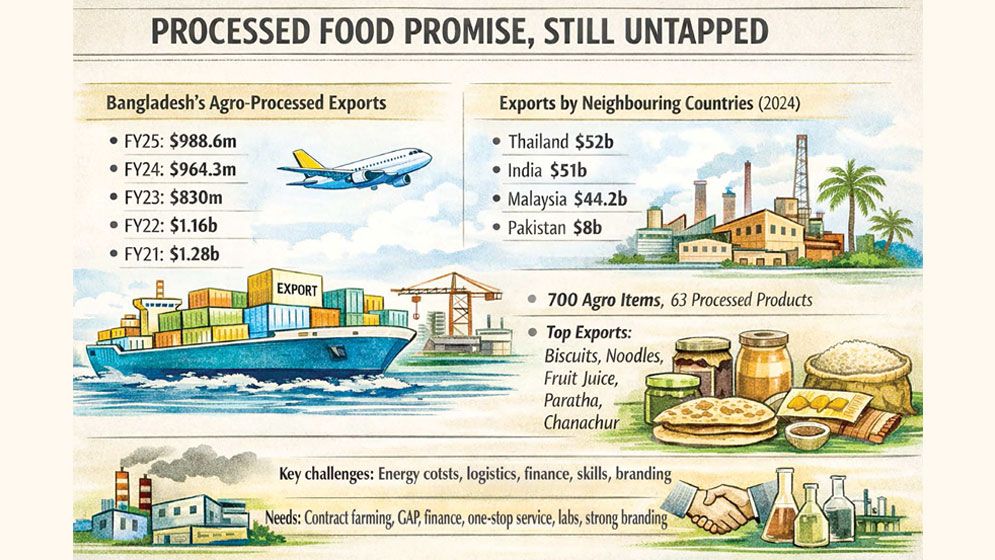
According to the Bangladesh Investment Development Authority (BIDA), the country exports around 700 agricultural products, including nearly 63 basic agro-processed items.
Some 1,000 enterprises produce processed foods, but only about 250 are involved in exports, with just 20 classed as large or medium-sized firms. Even so, the sector employs nearly half a million people.
The state-run agency projects Bangladesh’s packaged food market to grow at an annual rate of 15.01% through 2027, driven by rising demand for halal-certified, organic and ready-to-eat products at home and abroad.
Falling behind regional peers
Despite this promise, Bangladesh remains a small player in global agro-exports. In the 2024–25 fiscal year, agricultural and agro-processed exports together stood at around $1 billion, out of total national exports of $48.28 billion.
Agro-processed foods alone accounted for roughly $400 million, with biscuits, noodles, fruit juice, paratha and chanachur among the top items.
Export Promotion Bureau (EPB) data show a volatile trend: earnings of $1.28 billion in FY21 fell to $1.16 billion in FY22 and then sharply to $830 million in FY23, before recovering to $964.3 million in FY24 and $988.6 million in FY25.
Regional comparisons are stark
Thailand exports agricultural and agro-processed foods worth about $52 billion a year, including $23 billion in processed items alone.
India’s combined exports stand at roughly $51 billion, with $10 billion from agro-processing. Malaysia exports around $44 billion in agricultural goods and $7 billion in processed foods, while Pakistan’s combined figure is about $8 billion, including $2 billion in processed products.
Bangladesh’s lower performance, Ashraf argued, stems partly from limited production.
“The government should take proper initiatives to utilise maximum land for production by encouraging farmers. They must be given all necessary support,” he said.
A booming global market
Globally, the opportunity is vast. Research and Markets estimates the agribusiness market was worth $3.4 trillion in 2024 and could reach $4.4 trillion by 2033.
The processed food market, valued at $143.51 billion in 2020, is projected to grow at an annual rate of 6.6% to $235.67 billion by 2028.
Processed foods span beverages, dairy, meat and poultry, bakery items, snacks and confectionery, with the United States the largest single buyer and Europe accounting for nearly 40% of global demand.
Even smaller countries have leveraged this market more effectively. The Netherlands, despite its size, exports more than $100 billion worth of agricultural products each year. For Bangladesh to approach such levels, industry insiders say, will require strategic planning, technological upgrading and sustained policy support.
Structural bottlenecks
Entrepreneurs and farmers say they are already struggling with multiple constraints.
Electricity is available for only 10-12 hours a day in many areas, pushing up costs and undermining quality, particularly for cold-storage-dependent products.
High interest rates on loans and complex procedures for opening letters of credit to import raw materials further hamper production. Post-harvest losses remain severe: 30%-40% of fruits and vegetables spoil due to inadequate storage and transportation. The workforce is another weak link, with an estimated 60%-70% lacking the skills needed to meet international quality standards and certification requirements.
At present, the government offers a 15% cash incentive on agro-processed exports. Industry insiders warn that this support will be withdrawn after LDC graduation, leaving exporters exposed.
“Without alternative support, the sector may face significant challenges,” one exporter said.
Md Iqtadul Hoque, general secretary of the Bangladesh Agro-Processors Association (BAPA), said the organisation has worked for the sector’s development since its founding in 1998, when it had just 13 members.
Today, BAPA represents 315 exporters supplying processed food to 145 countries. But he cautioned that low-value products such as chips, chanachur and biscuits yield limited returns.
“Entrepreneurs are now shifting towards higher-value products,” he said.
Rising gas and electricity prices, bureaucratic hurdles in obtaining certificates and high transport costs are all squeezing margins, he added. “Due to intense competition, exports are declining.”
Policy priorities and private-sector views
Kamruzzaman Kamal, director of marketing at Pran-RFL Group, one of the country’s largest exporters, described agro-processing as a “key engine for inclusive growth”.
He called for contract farming, good agricultural practices, farmer education, improved access to finance for small and medium producers, streamlined licensing through one-stop services, world-class testing laboratories and a single food authority akin to the US Food and Drug Administration. He also stressed the need for skilled human resources, stronger commercial diplomacy and positive country branding.
“With the right policies and institutional support, it can become the second-largest export earner after RMG,” he said, adding, “Collaboration among government, the private sector and the media is essential.”
Investment gaps and the LDC test
Foreign direct investment remains weak. Bangladesh Bank data show that agriculture and fishing attracted just $57.53 million in FDI in FY25.
Dr Zahid Hussain, former lead economist at the World Bank’s Dhaka office, said boosting exports requires higher production through technology, foreign investment and international expertise. “Product quality must be improved,” he said. “Bangladesh is highly suitable for technology-driven agriculture, but investment is not coming at the expected level.”
He called for better infrastructure, removal of non-tariff barriers and rationalisation of tax rates to attract investors.
Bangladesh is scheduled to graduate from LDC status on 24 November 2026. Exporters fear a sharp loss of incentives.
“We are now getting a 10% cash incentive, down from 20%, and the support deadline expired on December 31, 2025,” said BAPA’s general secretary, urging an extension.
“Large companies may survive, but SMEs risk being forced out. There is still no clarity on alternative support.”
He also called for effective free trade agreements with the Middle East, ASEAN, the EU, the US and African countries.
Dr Khondaker Golam Moazzem, research director at the Centre for Policy Dialogue, said preparation for the post-LDC era must begin now.
Entrepreneurs, he argued, should prioritise quality, technology and skills, while the government supports branding, participation in international exhibitions, transparent pricing and market diversification.
(This report is the first instalment of a 3-part series.)
Read More