



 For all latest news, follow the Daily Sun's Google News channel.


Why is food becoming unaffordable for millions of households in Pakistan?
The outlook for vulnerable communities is concerning. It is estimated that 18 million to 19 million people in Pakistan may need food assistance between January and March 2027
Khaleej Times
Published: 25 Nov 2026, 06:29 PM
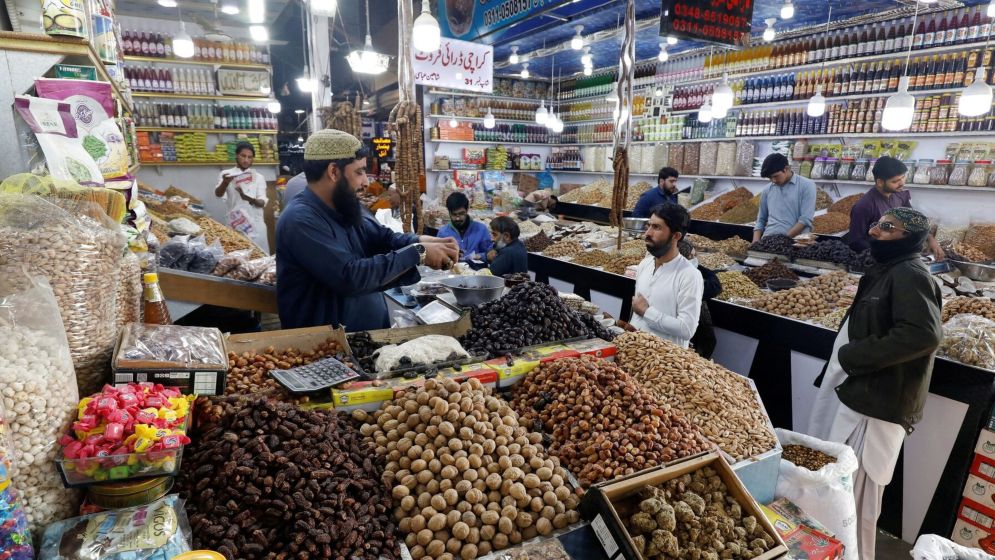
People buy dry fruits at a market in Karachi, Pakistan 1 February 2023. Photo: Reuters
For many households in Pakistan, buying everyday necessities has become an increasingly difficult financial responsibility.
Although food remains available in markets, rising prices have made it harder for families, particularly those on lower incomes, to afford sufficient quantities.
The problem is not simply whether food is available, but
whether ordinary households have the means to buy it.
The latest figures from the Pakistan Bureau of Statistics
(PBS) illustrate the pressure. Its October 2026 price review recorded a 7.74%
year-on-year increase in food and non-alcoholic beverage prices, while prices
rose by 2.26% compared with September.
Some essential commodities recorded considerably higher
annual increases: urban wheat prices rose by approximately 39%, wheat flour by
34.27% and chicken by 20.30%.
The PBS’s latest Sensitive Price Indicator (SPI), covering the week ending 12 November, suggests that short-term price movements have not yet brought substantial relief.
Although the overall index declined by 0.46% compared with
the previous week, it remained 11.21% higher than during the corresponding week
in 2025. Wheat flour alone was still 36.14% more expensive year-on-year.
UN's Food and Agriculture Organisation (FAO) recently
reported retail wheat flour prices had risen sharply in October, reaching
record levels in most of the markets it monitored.
FAO attributed the increases to seasonally tight supplies,
higher production costs and transportation expenses. For households that rely
on wheat flour as a daily staple, these increases can place considerable pressure
on already limited budgets.
Impact on food
security
Food represents a substantial part of household expenditure
in Pakistan. The PBS Household Integrated Economic Survey (HIES) 2024–25 found
that food and non-alcoholic beverages accounted for 36.72% of total household
consumption expenditure, making it the largest expenditure category.
The survey also recorded a deterioration in reported food security. According to PBS social indicators report, the proportion of households experiencing moderate or severe food insecurity rose from 15.92% in 2018–19 to 24.35% in 2024–25.
Severe food insecurity alone increased from 2.37% to 5.04%.
This means, nearly one in four households surveyed experienced moderate or
severe food insecurity during the survey period.
The figures also reveal a significant divide between income groups. Among households in the poorest consumption quintile, 45.97% experienced moderate or severe food insecurity, compared with 8.95% among the richest.
Rural households recorded a higher rate than urban
households, at 26.72% and 20.58%, respectively.
These findings highlight how closely food security is connected to household purchasing power. When a large share of household spending is already devoted to food, rising prices leave less money available for other necessities, including housing, electricity, healthcare and education.
Government
intervention
Wheat is central to Pakistan’s food-affordability problem
because of its importance in everyday consumption. The government has attempted
to strengthen domestic supplies through imports, including a shipment of
approximately 51,000 tonnes that arrived at Karachi Port in late October.
However, additional supply has not immediately resulted in
cheaper flour for consumers. A report published by Dawn on 3 November found
that wholesale wheat prices had declined following the arrival of imported
supplies, but retail flour remained expensive. In Karachi, a 20kg flour bag was
reportedly selling for as much as Rs3,540.
The difference between wholesale and retail prices raises
questions about how quickly lower supply costs reach consumers. Transportation
expenses and existing stocks purchased at higher prices can influence the final
price paid in shops.
The Sindh government has also attempted to reduce costs by lowering its wheat release price from Rs5,000 to Rs4,500 per 40kg on 4 November.
According to Dawn, senior provincial minister Sharjeel Inam Memon said the reduction should lower flour prices by approximately Rs15 per kilogram and instructed flour mills to pass on the benefit.
Whether this has translated into meaningful savings for
consumers, however, remains uncertain.
Threats to wheat
production
While consumers face the immediate consequences of expensive
food, farmers are also dealing with higher agricultural production costs.
A report by Arab News on 3 November found that the price of
a 50kg bag of diammonium phosphate (DAP), a fertiliser used in wheat
cultivation, had increased from Rs14,009 to Rs17,183, a rise of approximately
23%. Some farmers have reportedly responded by reducing their use of DAP or
switching to cheaper alternatives.
The development is significant as Pakistan enters the
2026–27 Rabi season, when wheat is cultivated. If higher production costs
affect farmers’ decisions about fertiliser use or cultivation, the consequences
could extend to future harvests and domestic food supplies.
The government of Pakistan has announced measures to support wheat production, including subsidies for eligible small farmers in Sindh and agricultural assistance in Punjab.
The National Assembly’s Standing Committee on National Food Security and Research discussed fertiliser availability and agricultural support on 3 November.
The effectiveness of these initiatives will depend on
whether assistance reaches farmers and helps offset their rising expenses.
Food insecurity
expected to persist
The outlook for vulnerable communities remains concerning.
In its October 2026 food-security assessment, FEWS NET (Famine Early Warning
Systems Network) estimated that 18 million to 19 million people in Pakistan may
need food assistance between January and March 2027.
The organisation expects crisis-level food insecurity to
persist in parts of Balochistan, Khyber Pakhtunkhwa and Gilgit-Baltistan. High
food prices, weakened household purchasing power, poor harvests and limited
employment opportunities were identified as contributing factors.
This figure represents projected food-assistance needs, not
a confirmed count of people currently experiencing acute food insecurity.
Nevertheless, it indicates the scale of vulnerability that could continue into
the coming months.
FEWS NET also identified coping strategies used by
vulnerable households, including purchasing food on credit, borrowing money,
reducing food consumption and selling livestock or other productive assets.
Although these measures may provide temporary relief, they can leave families
more exposed to future economic shocks.
Ultimately, Pakistan’s food-affordability challenge extends
beyond wheat imports or government price reductions. Even when food is
available in markets, households without sufficient purchasing power may
struggle to obtain what they need. For millions of Pakistanis, the central
issue remains whether they can afford enough food without sacrificing other
essential needs.