



 For all latest news, follow the Daily Sun's Google News channel.


Poland Seeks Indian Investment Beyond Defence
Ahead of Donald Tusk’s India visit, Warsaw is pitching its defence industry, nuclear power plans and EU market access to Indian businesses
StratNews Global
Published: 21 Oct 2026, 04:22 PM
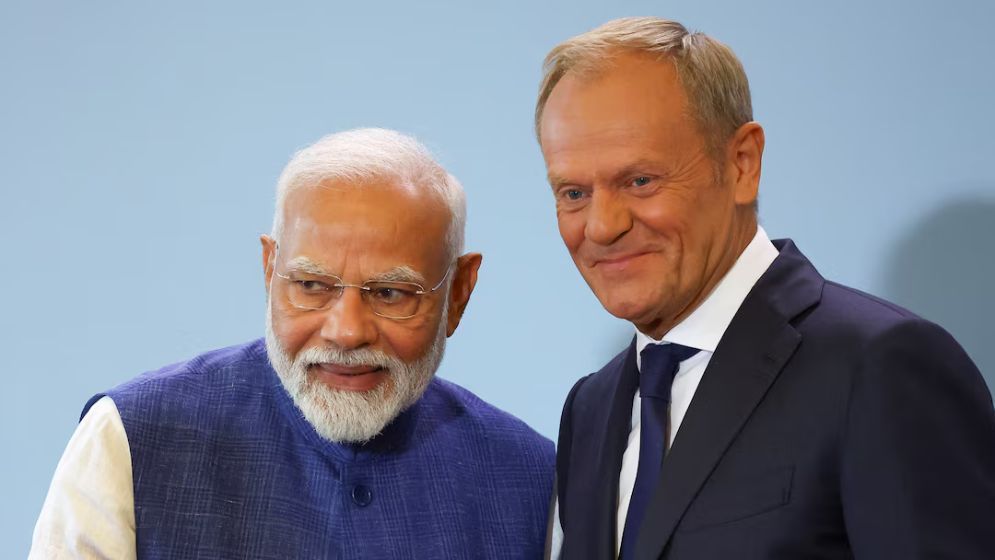
Polish Prime Minister Donald Tusk and Indian Prime Minister Narendra Modi pose after a press conference at the Chancellery of the Prime Minister in Warsaw, Poland, 22 August 2024.Photo: Reuters
Poland is looking to deepen economic ties with India across defence, technology, nuclear power, clean energy and investment, as Warsaw seeks to strengthen domestic industry and attract foreign capital.
Polish Finance and Economy Minister Andrzej Domański told
StratNewsGlobal in Warsaw that Poland wanted to translate closer political
engagement with New Delhi into concrete business agreements.
Domański identified defence, research and development,
technology and energy as key areas for cooperation. He also said Poland could
help Indian companies expand into the European Union by offering a base within
the bloc’s industrial and technological ecosystem.
The push comes as Poland seeks to turn increased defence
spending and its energy transition into drivers of domestic economic growth.
The war in Ukraine has prompted Warsaw to substantially increase defence
expenditure, but Domański said the government wanted that spending to generate
jobs, support research and development, and strengthen Polish companies.
“I really want this money to be spent as much as possible in
Poland,” he said.
The objective, he explained, was to build an industrial
ecosystem around defence rather than simply purchase equipment from overseas.
Investment should support universities, startups, established manufacturers and
domestic technological capabilities, helping make defence spending an engine of
economic growth and tax revenue.
Poland is also looking for international partners to develop
its defence industry and expand export markets. Domański cited Polish defence
company WB Group as an example of the potential for cooperation with India. The
company’s unmanned systems have been used by the Indian armed forces.
“We are searching for export markets for our products, but
we are also happy to have some technological, R&D cooperation,” he said.
For Warsaw, cooperation with India could extend beyond
equipment purchases to joint technology development, research and industrial
partnerships. Domański said Poland wanted closer engagement with Indian
partners while building its own defence manufacturing capabilities.
Energy is another major area for potential investment.
Poland plans to develop large-scale nuclear power plants as well as small
modular reactors (SMRs), alongside investment in onshore and offshore energy,
electricity grids and storage.
“We will develop both large-scale nuclear power plants as
well as SMRs,” Domański said.
The scale of these projects will require substantial
capital, making foreign investment important to Poland’s plans. Domański said
Warsaw was open to equity investments and wanted more participation from Indian
businesses.
He also presented Poland as a possible entry point for
Indian companies seeking to expand in the EU.
“I do believe that Poland can act as a guide for Indian companies that are willing to expand in the European Union,” he said.
He acknowledged that expansion would involve challenges but
argued that Poland offered access to the European market alongside its
industrial and technological base. Closer business ties could also give Polish
companies greater opportunities in India.
Poland’s economic performance provides the backdrop to these
ambitions. Domański said the economy was benefiting from strong consumer
demand, rising wages and investment, supported by improving conditions in the
euro zone. He expressed confidence that growth could remain above 3% in the
quarters ahead.
He said his focus was also on identifying new sources of
growth that could sustain the economy over the longer term. Developing domestic
industrial and technological capabilities was central to that effort.
The war in Ukraine remains a major consideration for
Poland’s economic and security policies. Domański described Russia’s invasion
as “a huge tragedy” and “brutal, unforgivable Russian aggression”. He called
for further sanctions against Moscow and stronger action against sanctions
circumvention, particularly through Russia’s so-called shadow fleet.
He argued that sanctions were putting pressure on the
Russian economy, pointing to weaker growth and higher inflation. On the
prospects for ending the war, he said Ukraine must decide which terms it could
accept.
“This is up to leaders to decide. And then it’s up to
Ukraine to decide what’s acceptable for them. Not us, nor any other country,”
he said.
Domański said Poland wanted to remain part of the peace process
and that an end to the conflict would reduce uncertainty for businesses.
Poland’s proximity to Ukraine and its role as a logistical hub could also
position it to benefit from reconstruction.
Energy security has likewise shaped Poland’s approach to investment.
Domański pointed to gas infrastructure and alternative supplies from Norway,
the United States and Qatar, saying Poland had stopped importing Russian gas
when the war began. He argued that earlier diversification had reduced the
country’s exposure to Russian energy.
For Warsaw, the broader goal is to combine economic growth
with greater energy security and domestic industrial capacity. India is being
courted as both a source of investment and a market for Polish products and
technology.
Defence, nuclear power, clean energy and research offer
avenues for expanding cooperation. The priority now, Domański indicated, is to
turn political engagement between the two countries into tangible commercial
partnerships.