


 For all latest news, follow the Daily Sun's Google News channel.


Ajit Doval goes to Beijing while India prepares for Xi’s visit
Doval’s visit follows a meeting between officials from both sides on 6 August
The Hindu
Published: 23 Aug 2026, 07:27 PM
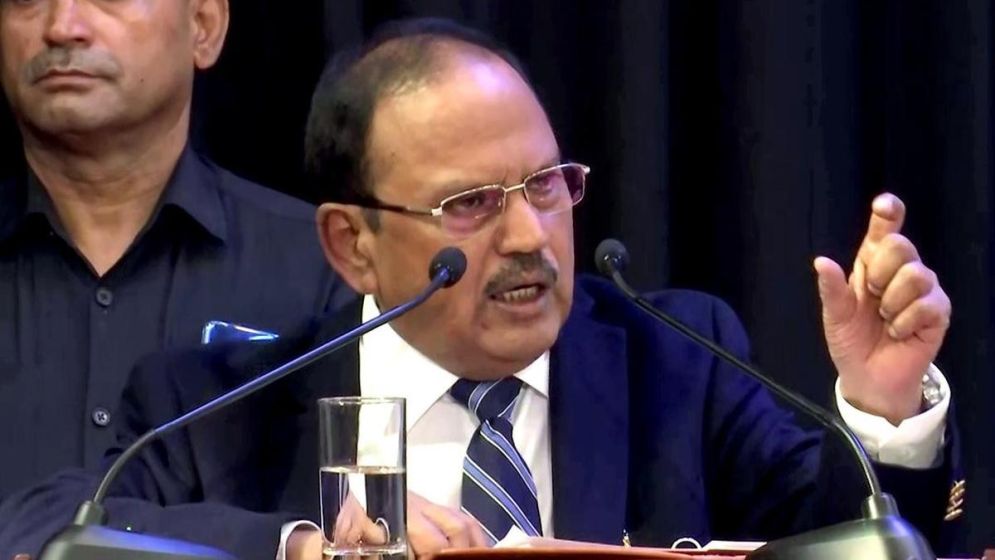
Indian National Security Advisor Ajit Doval. Photo: Collected
India’s National Security Advisor Ajit Doval is expected to visit Beijing on Monday and Tuesday for the 25th round of talks between the special representatives (SRs) on the boundary question, and ahead of a possible visit to India next month by Chinese President Xi Jinping.
Doval’s visit and talks with Chinese Politburo
member and Foreign Minister Wang Yi will also take stock of the broader
bilateral relationship, The Hindu reports.
That the visit is taking place a few weeks before
India’s hosting of the BRICS Summit on 12 September is an indication that both
sides are preparing for a first visit by Xi in seven years, which would also
likely include bilateral talks with Prime Minister Narendra Modi.
A meeting between the two leaders in October 2024 on
the sidelines of the BRICS summit in Kazan, Russia paved the way for the start
of what both sides see as a gradual and steady normalisation in relations. Modi
and Xi last met at the SCO Summit in Tianjin, China, in August last year, when
they both “welcomed the positive momentum and steady progress in bilateral
relations” and “reaffirmed that the two countries were development partners and
not rivals, and that their differences should not turn into disputes.”
Doval’s visit follows a meeting between officials
from both sides on 6 August, under the Working Mechanism for Consultation and
Coordination (WMCC) on border affairs, during which the situation along the
Line of Actual Control (LAC) was reviewed. Both sides also “held detailed
exchanges on issues related to boundary delimitation, border management,
mechanism building and trans border cooperation,” according to a statement.
At the previous round of SR talks when Wang visited
India in August 2025, both sides agreed on “the need to take a political
perspective of the overall bilateral relationship while seeking a fair,
reasonable and mutually acceptable framework for settlement of the boundary
question in accordance with the Agreement on Political Parameters and Guiding
Principles for Settlement of the India-China Boundary Question signed in 2005.
The 2005 agreement marked the conclusion of the
first of a three-stage process to settle the long-running boundary dispute.
Since then, both sides have been negotiating a framework to settle the dispute.
The third stage will involve delimiting and demarcating the boundary on maps
and on the ground.
Recent references to the exchange of views on
“border delimitation” suggest both sides are exploring an “early harvest”
agreement in some areas, pending the agreement of a complete framework.
At last year’s SR talks, both agreed on setting up
an Expert Group under the WMCC “to explore Early Harvest in boundary
delimitation in the India-China border areas”, as well as the “creation of
General Level Mechanisms in Eastern, and Middle Sectors, in addition to the
existing General Level Mechanism in Western Sector.”
Given recent problems in the Western Sector, where
tensions in Eastern Ladakh starting in April 2020 led to a more than four-year
freeze in relations, and in the Eastern Sector, over which both sides this
month traded sharp comments over differences in Arunachal Pradesh amid reports
of border tensions, parts of the Middle Sector in Uttarakhand and Himachal
Pradesh and the Sikkim sector offer possibilities of an early harvest
agreement.
Earlier this month, both sides restarted border
trade through the Nathu La Pass in Sikkim and Lipulekh Pass in Uttarakhand.