


 For all latest news, follow the Daily Sun's Google News channel.


US Missile Moves in Japan Send China Clear Message about the Arrival of A New Era
However, this deployment is only half of the equation as the emerging denial network also extends southward
The Japan Times
Published: 28 Jun 2026, 08:31 PM
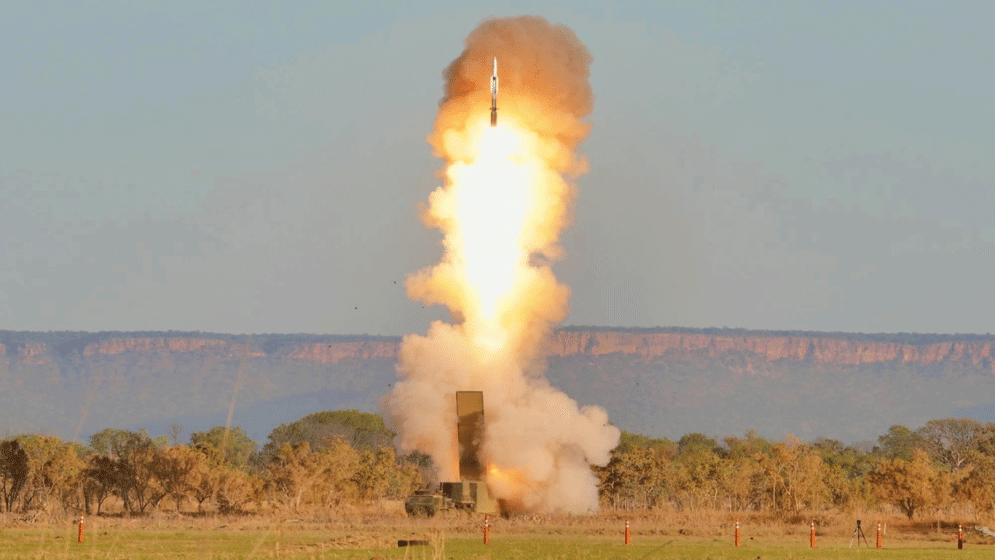
Soldiers conduct the first Typhon midrange capability live-fire exercise outside of the continental United States, firing an SM-6 missile in July last year in Australia's Northern Territory during Exercise Talisman Sabre. Photo: Collected
The US-Japan alliance is entering a new phase in its effort to deter China, one that increasingly relies on dispersed, land-based missiles positioned along the “first island chain”—the string of islands stretching from Japan through Taiwan and the Philippines toward Borneo.
The planned longer-term presence of a US Typhon
midrange missile system in Japan, combined with the fielding of the Navy-Marine
Expeditionary Ship Interdiction System (NMESIS) anti-ship missile and Marine
Air Defense Integrated System (MADIS) air-defence systems by Okinawa-based
units, is creating a distributed network of strike, air-defence and targeting
capabilities that complicates Chinese military operations around Taiwan and
across the western Pacific, according to The Japan Times.
More importantly, these assets are forcing Beijing
to contend with many of the same operational dilemmas that China’s anti-access/area-denial
(A2/AD) strategy—designed to keep rival militaries at bay—was originally
intended to impose on US and allied forces. In doing so, Tokyo and Washington
are beginning to narrow a longstanding asymmetry in land-based conventional
missile forces—one that has gradually favored Beijing since the end of the Cold
War.
The most concrete sign yet of this broader strategic
shift is the mid-October storage plan for the Typhon at a US military base in
Japan. While it’s unclear exactly where the hardware will be stored following
major bilateral exercises, the decision to store it locally breaks with the
established precedent of post-exercise withdrawal.
Together, the Typhon’s capacity to launch Tomahawk
cruise missiles and SM-6 multirole missiles, alongside the mobile anti-ship and
air-defence systems provided by NMESIS and MADIS, creates a layered network of
missile and air-defense capabilities designed to hold Chinese surface vessels
at risk across Japan’s southwestern island chain.
With a range of roughly 1,600 kilometres, the
Tomahawk gives the alliance a land-based strike option capable of reaching
portions of China’s eastern coastline and key military facilities from
positions along the first island chain.
However, this missile architecture is still in its
early stages, and the number of deployed launchers remains limited relative to
China’s massive arsenal, indicating that while the asymmetry is narrowing, it
has not yet reversed.
Analysts say that to achieve a meaningful
operational impact, many more launchers and substantial missile stocks are
needed.
Securing the access necessary for such an expansion,
however, is far from guaranteed. How long this deployment lasts will also
depend heavily on host-nation politics, particularly in Okinawa Prefecture,
where decades of base-related tensions remain an ongoing issue.
Underscoring these domestic frictions, Tetsuo
Kotani, chief research fellow at the Japan Institute of International Affairs,
said that while pre-positioning missile systems may strengthen deterrence, it
could also heighten concerns among local communities that hosting such weapons
would make them priority targets in any future conflict.
Nevertheless, the Japanese government seems more
comfortable hosting US missile systems now than just a few years ago after debates
over strengthening defence capabilities—including missile deployments—have
become “increasingly normalised” within both political discourse and broad
segments of the public, according to Sebastian Maslow, an associate professor
at the University of Tokyo.
The deployments also fit within a longer-term shift
in allied force posture toward Japan’s southwestern islands.
Tokyo has steadily increased its military focus on
the East China Sea, establishing new units and capabilities across the Nansei
island chain amid concerns over China’s growing military activity in the area.
US forces have likewise increased their focus on the region through new
operational concepts emphasising force dispersal, mobility and maritime-denial
capabilities.
Yet the significance of the Typhon’s presence
extends far beyond local politics. Its arrival reflects a much larger
transformation in US military strategy made possible by the collapse of a Cold
War-era arms-control framework, namely the 1987 Intermediate-Range Nuclear
Forces (INF) Treaty. That agreement prohibited Washington from deploying
ground-launched missiles with ranges between 500 and 5,500 kilometers—a
constraint that never applied to China, which was not party to the treaty.
Over the following decades, Beijing built one of the
world’s largest conventional ballistic and cruise missile arsenals, creating a
formidable force designed to keep US forces at bay.
The INF treaty’s 2019 collapse reopened the
deployment door for Washington, with the Typhon’s dispatch to Japan
representing one of the most consequential post-INF developments in the region.
These missile deployments create significant
challenges for Chinese military planners, who must now devote additional
intelligence, surveillance and reconnaissance resources to tracking highly
maneuverable targets.
However, this deployment is only half of the
equation as the emerging denial network also extends southward.
In the Philippines, a parallel US presence anchors
the southern approaches to Taiwan along the Luzon Strait and Bashi Channel. The
latest Balikatan joint military exercises saw the US Army conduct the first
firing of a ground-launched Tomahawk from Philippine soil, while US Marines
deployed NMESIS launchers to the Batanes Islands—just 190 km from Taiwan—to
rehearse sea denial.
Those same drills saw the Ground Self-Defense Force
conduct its first overseas live-fire in northwestern Luzon, targeting a decommissioned
vessel with a Type 88 surface-to-ship missile.
Beyond their tactical value, these exercises
demonstrated a growing degree of interoperability among US, Japanese and
Philippine forces.
By integrating missile units, targeting networks and
operational planning across national boundaries, they are forging a more
closely coordinated regional defense architecture along the first island chain.
Such arrangements could complicate Chinese military operations by creating
overlapping sea-denial capabilities across multiple maritime approaches.
Manila is also modernising its own littoral forces
through acquisitions such as the Brahmos supersonic anti-ship missile system
while expanding defence cooperation with the United States and other regional
partners.
Rather than a seamless barrier, what is emerging
from these combined efforts is a distributed denial architecture designed to
prevent Beijing from concentrating naval forces along any single operational
axis during a crisis.
Yet interoperability and firepower alone are not
enough. The viability of this distributed architecture depends equally on
logistics, including prepositioned fuel and munitions, access to dispersed
operating locations and resilient resupply under contested conditions. Recent
exercises have, therefore, focused as much on sustaining mobile missile forces
as on launching them.
The growing emphasis on dispersed, mobile missile
units also reflects lessons drawn from recent conflicts in Ukraine and the
Middle East, which have highlighted the vulnerability of large, fixed military
platforms to precision strikes.
Beyond their military utility, such deployments also
allow planners to test logistics, command arrangements and the political
sustainability of a forward missile presence.
For regional strategists, the value of this posture
may lie as much in signaling as in firepower, demonstrating that the alliance
is prepared to deploy and sustain such forces along key approaches to Taiwan
and the wider western Pacific.
Consequently, while a single Typhon battery may add
only modest military utility on its own, its presence in southern Japan serves
as a concrete anchor for US security commitments—and a willingness to sustain
them under pressure.
Beyond the immediate signaling value, the Japan
Institute of International Affairs’ Kotani says that deploying long-range
missile systems before a crisis emerges may help avoid the pressures associated
with attempting to introduce them after hostilities have already begun.
Other analysts, however, are less certain that the deployments enhance stability.
Land-based US launchers, even mobile ones, remain
exposed to preemptive strikes, and the legal and political frameworks governing
their use in a contingency remain sensitive in both Japan and the Philippines.
There is also the question of Beijing’s response.
China is likely to answer with more missile deployments, military exercises and
“gray-zone” activities. This means that while a more reciprocal deterrence
environment reduces an asymmetry that has favored China for decades, it also multiplies
the opportunities for miscalculation.
The decision to store Typhon hardware locally is, in
one sense, an administrative decision about where to park a weapons system
between exercises. In another, it is the clearest signal yet that a new
land-based missile deployments era has arrived in the Indo-Pacific.