


 For all latest news, follow the Daily Sun's Google News channel.


Israeli strikes on Lebanon jeopardise Iran truce; talks planned in Pakistan but Hormuz stays shut
Reuters, ISLAMABAD
Published: 09 Apr 2026, 07:18 PM
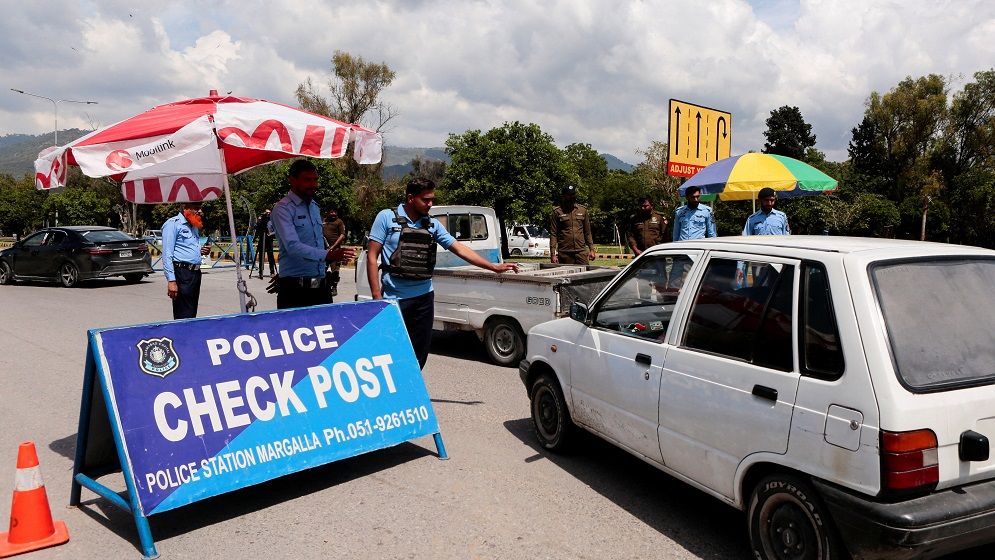
Members of the police inspect a vehicle at a security checkpoint ahead of Iran–US talks in Islamabad, Pakistan, 9 April. Photo: REUTERS
Israel bombed more targets in Lebanon on Thursday, putting
the US-Iran ceasefire into further jeopardy after the biggest Israeli attacks
on its neighbour of the war killed more than 250 people and threatened to
torpedo Donald Trump's truce.
In Pakistan, authorities locked down the capital Islamabad
in anticipation of the war's first peace talks, cutting off all access to a
3-km (2-mile) zone around the five-star luxury Serena Hotel. Both the US and
Iranian delegations are expected to stay at the hotel, which told all guests to
check out until Sunday as it had been "requisitioned" for "an
important event".
But there was no sign Iran had lifted its blockade of the
Strait of Hormuz, which has caused the worst disruption to global energy
supplies in history. Tehran said there would be no deal as long as Israel was
striking Lebanon.
In the first 24 hours of the ceasefire, just a single oil
products tanker and five dry bulk carriers sailed through a strait that
accommodated 140 ships a day before the war.
The spot price that European and Asian refineries pay now for oil rose further to record levels near $150 a barrel, with even higher prices for some products such as jet fuel.
The continued Israeli military campaign in Lebanon could
jeopardise peace talks expected between the United States and Iran over the war
in the Middle East, German Chancellor Friedrich Merz said Thursday.
"We view the situation in southern Lebanon with
particular concern," Merz said. "The severity with which Israel is
waging war there could cause the peace process as a whole to fail, and that
must not be allowed to happen."
There is deep concern also in Washington of a potential
collapse of the ceasefire even before negotiations begin in Islamabad to iron
out the fine details.
There is pressure on Capitol Hill right now to use its power
to rein in the president. But Republicans on Capitol Hill are still insisting
that Lebanon is a separate theatre.
Iran’s parliamentary speaker earlier Thursday warned that Tehran sees
Lebanon as an “inseparable part of the ceasefire” and threatened “strong
responses” to Israeli strikes, coinciding with mounting international calls for
Lebanon to be encompassed in the truce.
Israel says ceasefire does not cover Lebanon
Israel, which invaded Lebanon last month in parallel with the war on Iran to root out the Iran-aligned armed group Hezbollah, says its actions there are not covered by the ceasefire announced late on Tuesday by Trump.
Washington has also said Lebanon is not covered by the
truce, but Iran and Pakistan, which acted as mediator, say it was explicitly
part of the deal. A host of countries, including Britain and France, said the
truce should extend to Lebanon.
A Pakistani source with knowledge of the discussions said
Pakistan was working on a ceasefire for Lebanon, as well as for Yemen, another
country where Israel has hit Iran-aligned forces: "It will be discussed
during the (upcoming) talks and we will settle it."
Israel says it kills Hezbollah chief's nephew
The Israeli military said on Thursday it had killed the
nephew of Hezbollah's Secretary-General Naim Qassem, who had served as his
personal secretary, and struck river crossings in southern Lebanon overnight.
Israel struck Beirut's southern suburbs just before midnight
and at dawn, and hit towns across the south on Thursday morning, Lebanese state
media said.
For its part, Hezbollah, which had initially said it would
pause attacks on Israel in line with the ceasefire, said it was resuming them
on Thursday morning and had fired once across the border and twice at Israeli
forces in southern Lebanon.
Lebanon declared a day of national mourning and shut state
offices, while rescuers worked through the night to free the wounded and the
dead from under the rubble of buildings blasted apart by Israel without
customary warnings to residents to flee.
Outside Beirut's Rafik Hariri University Hospital, a steady
stream of ambulances kept arriving throughout Thursday afternoon, driving past
the emergency room entrance straight to the forensic department.
"We’re picking up body parts for the most part. It's
very rare that we find entire bodies intact," said a rescue worker on
condition of anonymity because he was not authorised to speak to the press.
One woman, between tears, told Reuters she had lost her
entire family in one of the strikes.
Mourning for Khamenei
Iran's deputy foreign minister Saeed Khatibzadeh told BBC
Radio that Israel's strikes on Lebanon were a "grave violation" of
the ceasefire.
"It was a catastrophe, could actually end in more
catastrophe, and this is the nature of this rogue behaviour that we are seeing
from Israel in the whole Middle East."
Inside Iran, where the halt to six weeks of US and Iranian
airstrikes has been portrayed as total victory for the clerical rulers, huge
crowds turned out to commemorate 40 days of mourning for Supreme Leader
Ayatollah Ali Khamenei, killed on the war's first day.
State TV showed crowds in Tehran, Kermanshah, Yazd and
Zahedan, with mourners in black carrying Iranian flags and portraits of
Khamenei and his son and successor Mojtaba. Large commemorative billboards were
displayed and a huge Hezbollah flag hung from one building.
Physical oil prices spike
After six weeks of war, Trump has sought an off-ramp before
the economic consequences derail his presidency.
The ceasefire has curbed a surge in energy price benchmarks,
which are based on contracts to deliver oil a month in the future. But
present-day spot prices paid by refineries around the world are still rising.
Though Europe and Asia have been worst hit so far, the US retail price for
diesel rose to $5.69 a gallon on Thursday, just 13 cents below the all-time
high.
Trump, who announced the truce just before a deadline he had
set to destroy Iran's "whole civilisation" unless it unblocked the
strait, said on Wednesday he would resume attacks unless Iran complies:
"the 'Shootin’ Starts,' bigger, and better, and stronger than anyone has
ever seen before".
Though Trump has declared victory, Washington has not
achieved the aims he announced at the war's outset: to eliminate Iran's ability
to attack its neighbours, destroy its nuclear programme or make it easier for
Iranians to topple their government.
Iran still possesses missiles and drones that can hit its
neighbours and a stockpile of more than 400 kg (900 pounds) of uranium enriched
close to the level for a weapon. Its rulers, who put down a mass uprising just
months ago, survived the superpower onslaught with no sign of organised
opposition.
And they demonstrated their ability to exert control of the
strait despite a massive US military presence in the region.
Iran is pressing for even more US concessions in a final
deal, including the total lifting of sanctions that have crippled its economy
and acknowledgment of its control over the strait, previously freely open to
trade.
Iranian officials say they plan to impose rules on passage,
including a potential fee similar to those charged to access man-made canals.
Iran's Revolutionary Guards published a map with the strait's main shipping
channels marked as unsafe, telling ships instead to sail around islands nearer
the Iranian shore.