


 For all latest news, follow the Daily Sun's Google News channel.


Saudi leader pushing Trump to continue Iran attacks: NYT
Saudi officials, alongside UAE counterparts, are also seriously weighing their options for joining the war should Iran push through on its threat to hit their critical infrastructure in response to potential US attacks on Iranian power facilities
Agencies
Published: 24 Mar 2026, 10:37 PM
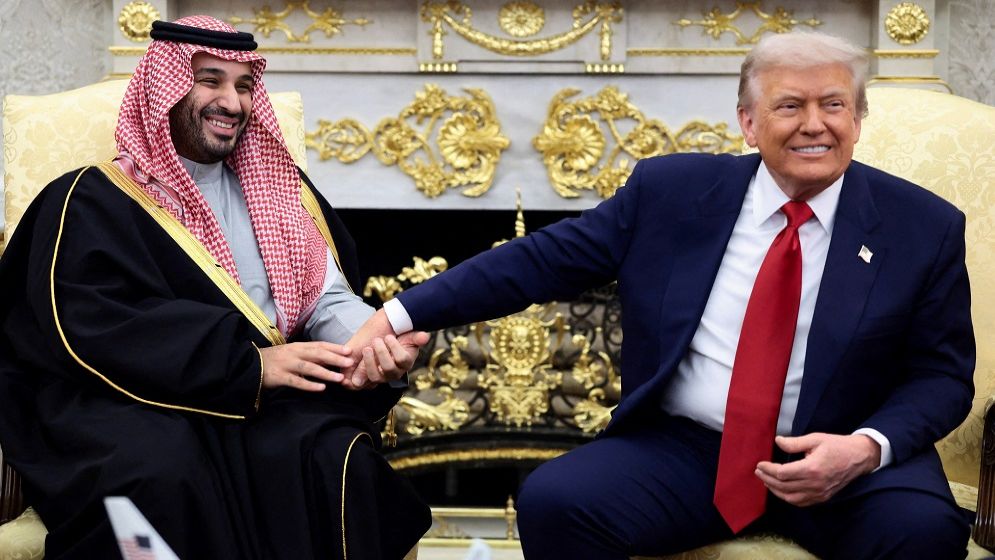
Saudi Crown Prince and Prime Minister Mohammed bin Salman holds US President Donald Trump's hand during a meeting in the Oval Office at the White House in Washington, DC, US, 18 November 2025. Photo: REUTERS
Saudi Arabia’s Mohammed bin Salman has urged US President
Trump in recent conversations to continue military action against Iran, framing
the US-Israeli campaign as a “historic opportunity” to reshape the Middle East,
according to a report.
Later, Saudi officials rejected the idea that the prince
pushed to prolong the war, stressing the Kingdom pushed peaceful resolution even before the conflict began.
The New York Times report, based on interviews with people
briefed by American officials, says Prince Mohammed has, over the past week,
encouraged Trump to intensify military pressure aimed at the collapse of Iran’s
hard-line leadership.
As per the report, the prince also argued that Iran poses a
long-term threat to the Gulf that can only be eliminated by getting rid of the
government.
A separate report from Bloomberg claims Saudi and UAE
officials are seriously weighing their options for joining the war should Iran
push through on its threat to hit critical infrastructure as a tit-for-tat move
following potential US-Israeli strikes on Iranian power facilities.
Regional tensions have escalated since 28 February, when the
US and Israel launched a joint attack on Iran that has killed more than 1,300
people, including then-Supreme Leader Ali Khamenei.
Iran has retaliated with drone and missile strikes targeting Israel and Gulf countries that are home to US military assets.
Saudi, UAE considering ‘red line’ for joining war against Iran
Iran’s biggest Gulf Arab neighbours are considering joining
the US-Israeli war against Iran, and could be pushed to if Tehran attacks their
critical infrastructure, according to several people with knowledge of the
situation.
The Gulf’s most powerful states, Saudi Arabia and the United
Arab Emirates, in particular, are losing patience with Iranian strikes that
have already hit ports, energy facilities and airports, said these people, who
requested anonymity in order to speak freely. But they would only join the war
if Tehran makes good on its threats to attack vital Gulf power and water
infrastructure — a high threshold, the people added.
A day earlier, the Wall Street Journal reported
that Gulf states are moving closer to direct involvement in the war against
Iran.
Officials and sources familiar with the matter cited in the
report said that recent steps by Saudi Arabia and the United Arab Emirates have
strengthened US operational capabilities while stopping short of full military
participation. According to the report, these measures include allowing
expanded access to military bases and targeting Iranian financial networks,
signaling a shift as pressure mounts on Gulf leaders to respond.
Saudi Arabia has agreed to allow US forces to use King Fahd
Air Base, reversing an earlier position that its territory would not be used
for strikes on Iran. The shift follows Iranian missile and drone attacks on key
Saudi infrastructure, including energy facilities and the capital, Riyadh.
Saudi FM Faisal bin Farhan said last week, “Saudi Arabia’s patience with
Iranian attacks is not unlimited,” adding that “any belief that Gulf countries
are incapable of responding is a miscalculation.”
The UAE has also intensified pressure on Tehran, shutting
down Iranian-linked institutions in Dubai and warning it could freeze billions
of dollars in Iranian assets. In a statement, authorities said, “Certain
institutions directly linked to the Iranian regime and IRGC will be closed
under targeted measures after being found to have been misused to advance
agendas that do not serve the Iranian people and in violation of U.A.E. law.”
These steps could significantly restrict Iran’s access to foreign currency and
trade.