


 For all latest news, follow the Daily Sun's Google News channel.


Turkey, Saudi Arabia, Egypt and Pakistan discuss ways for a security pact
Egypt, as the most populous Arab nation, is seen as a pillar of the region because of its military capabilities
Agencies, Ankara
Published: 22 Mar 2026, 10:47 PM
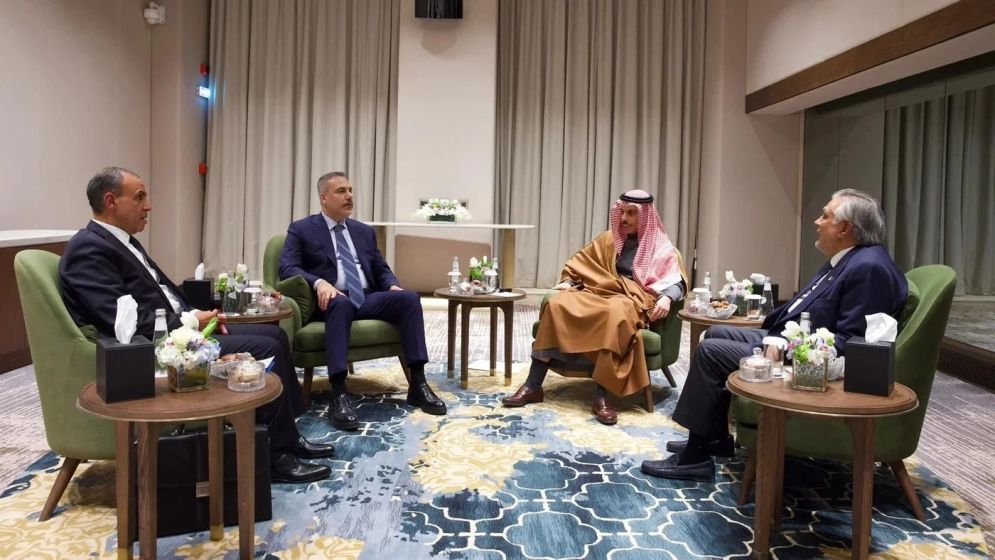
Photo: Collected
Turkish foreign minister says the four countries are exploring how to combine their strengths amid growing regional tensions and the war on Iran
The foreign ministers of Turkey, Saudi Arabia,
Egypt, and Pakistan met in Riyadh on Thursday, on the sideline of a summit of
Islamic countries, and discussed ways to lay out a security pact for the first
time.
Turkey has, since last year, been seeking a security
pact with Pakistan and Saudi Arabia. Earlier this year, a Pakistani minister
said in a statement that such a deal had been in the pipeline for nearly a
year, Middle East Eye reported.
Turkish sources familiar with the issue previously
told Middle East Eye that Ankara was also trying to bring Egypt into the
arrangement. The sources said the agreement would not mirror the guarantees and
commitments of Nato, but would instead serve as a security platform to enable
greater cooperation in the defence industry and broader defence matters.
"We are exploring how, as countries with a
certain degree of influence in the region, we can combine our strengths to
solve problems," Turkish Foreign Minister Hakan Fidan said on Saturday.
"Above all, we have for some time been saying
that the countries of the region should come together, hold discussions and
develop ideas. We emphasise regional ownership."
Fidan added that the countries were discussing the
current situation in the region, including the US-Israeli war on Iran and
Tehran's counterattacks on Gulf countries, and considering what benefits their
joint efforts could bring in addressing such challenges.
"In principle, we need to recognise this:
either we come together and learn to solve our own problems ourselves, or an
external hegemon will come and either impose solutions that serve its own
interests, or do nothing while preventing others from acting," he said.
While Ankara has repeatedly described Israel as the
primary instigator of the war with Iran, a joint statement by the participating
countries in Riyadh on Thursday strongly criticised Tehran for its attacks on
the Gulf.
The statement mentioned Israel only briefly,
referring to its "expansionist" policy in Lebanon.
"We need to learn to trust one another. We need
to act together on certain issues. We need to be able to adopt a common
stance," Fidan said.
He added that Ankara had extensive experience in
international relations when it came to advancing institutional and collective
initiatives, and that countries such as Pakistan, Saudi Arabia and Egypt each
possessed significant capabilities and played important regional roles.
While Ankara has invested heavily in its defence
industry, championing the domestic production of advanced drones, missiles and
jets, Pakistan possesses nuclear warheads, and Saudi Arabia is emerging as an
important hub for advanced technologies.
Egypt, as the most populous Arab nation, is seen as
a pillar of the region because of its military capabilities.
Turkey and Egypt signed a bilateral military
agreement in February to deepen their cooperation in the security field during
Turkish President Recep Tayyip Erdogan's visit to Cairo.
During the visit, Turkish arms supplier Mechanical
and Chemical Industry Corporation (MKE) signed a $350m export agreement with
the Egyptian Ministry of Defence, which included the sale of ammunition and the
establishment of production lines in Egypt.