


 For all latest news, follow the Daily Sun's Google News channel.


Financing key challenge to executing SDGs: CPD
Staff Correspondent
Published: 06 Oct 2015, 12:00 AM
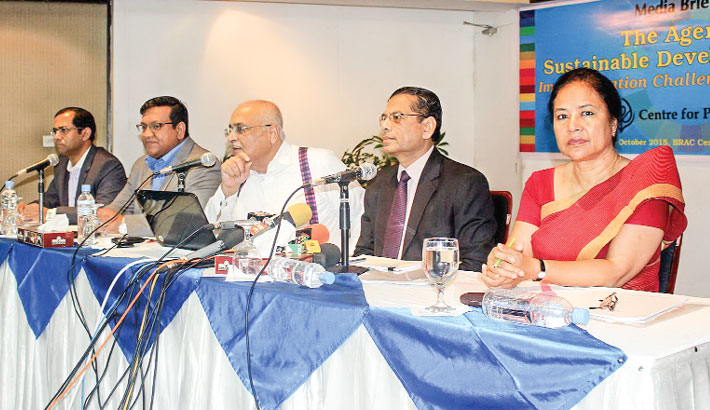
Dr Debapriya Bhattacharya, Distinguished Fellow of CPD, speaks at a press conference on Sustainable Development Goals (SDGs) adopted in the UN General Assembly at Brac Centre Inn in the city on Monday.
Centre for Policy Dialogue (CPD), a private think tank sees financing as the key challenge for Bangladesh to implementing the agenda of Sustainable Development Goals (SDGs) adopted in the UN General Assembly.
The other major challenges the country is going to face are coordinating the SDGs with national planning, ensuring everyone’s participation and accountability, availability of real statistics, monitoring, setting structural strategies and their implementation, according to CPD.
The research body’s observation came at a press conference in the city on Monday following the United Nation’s adoption of SDGs in its general assembly on September 25 to ensure better lives for its 193 member countries by 2030 by implementing 17 targets of SDGs.
Citing a report of inter-government committee’s report, CPD’s distinguished fellow Dr Debapriya Bhattacharya said implementing the SDGs will require five to seven trillion US dollars additional investment across the globe, where the developing nations will need investments of 3.3 trillion to 4.5 trillion US dollars in line with an UNCTAD report.
“But it is clear that international funds or assistance will be available for the job, for which financing should come from the internal resources,” he pointed out. He said Bangladesh is currently spending 2 percent of its GDP for social safety net schemes which should be increased to 3 percent.
Similarly, education expenditure should be raised to GDP’s 6 to 7 percent from the current 2 percent and allocations for women development to 4 percent from 2.6 percent apart from enhancing investments in agriculture and industries.
“But there is no clear direction about how these resources will come,” he said, adding that mobilising resources will be tough for Bangladesh in the context of slow foreign investments.
Mobilising additional resource is going to be really a very tough job for Bangladesh because of GDP’s 1 to 1.2 percent capital flight every year, while private investment remaining stuck in 22.1 percent for the last few years, and the country’s inability to utilise foreign assistance and FDI remain at 0.9 percent, Dr Debapriya said.
CPD also put special emphasis on maintaining political stability for achieving SDGs. In spite of political turmoil, lack of infrastructure and good governance, the country has done well in poverty reduction, child nutrition, primary school enrollment, gender equality, reducing child mortality rate, immunization, HIV control and ensuring safe drinking water.
Still the country is lagging behind in job creation, reducing school drop out rate, increasing literacy and women wages, reducing mortality, uneven development and income inequality, and forestation compared with the previous MDGs, according to CPD’s observation. CPD suggested for keeping the SDGs implementation leadership to Prime Minister’s Office (PMO) as it is linked to at least 14 national plans. Given the confrontational global situation, it thinks that development aspirations revealed in the SDGs are ambitious.
However, the country will be in a better position in 8 targets of SDGs, while it will be in a disadvantageous position in achieving 9 targets.
CPD’s Executive Director Prof Mustafizur Rahman, senior researchers Dr Khondaker Golam Moazzem, Anisatul Fatema Yusuf, among others, were present at the press conference.