



 For all latest news, follow the Daily Sun's Google News channel.


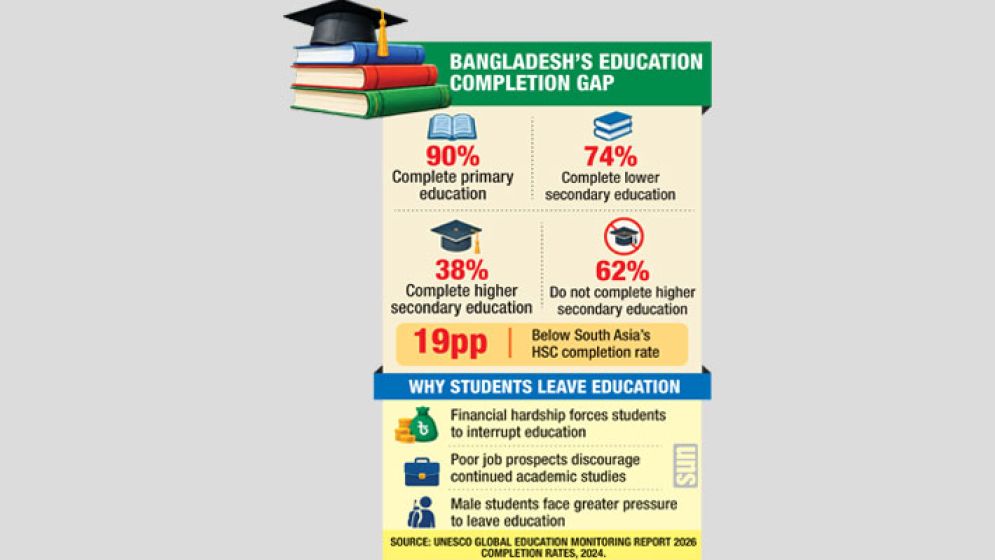
Bangladesh has made remarkable progress in getting children into school, but keeping them there until higher secondary level remains a major challenge, with nearly two-thirds failing to complete Grade 12.
While nine out of every 10 students complete primary education, fewer than four make it through higher secondary level, exposing a widening gap between access to education and the ability of the system to retain learners.
Only 38% of students complete higher secondary education, compared with 90% at primary level and 74% at lower secondary level, according to UNESCO’s Global Education Monitoring (GEM) Report 2026.
The report said that in 2024, around 62 out of every 100 boys and girls of upper secondary school age did not complete this level of education. Bangladesh’s completion rate is 19 percentage points below the South Asian average of 57%.
The figures highlight how the country’s gains in expanding school access have yet to translate into comparable progress in ensuring that students complete their education. Financial hardship, pressure to earn, uncertain employment prospects and weaknesses in the education system are among the factors pushing students out before they reach the end of higher secondary education.
Financial hardship forces students to put education on hold
For many students, the journey through education is interrupted not by a lack of ambition but by an inability to meet the costs of continuing their studies.
Md Hasan Sheikh, a technical student at Boyra Technical and BM College in Charpara, Sonatola upazila of Bogura, enrolled in the institution hoping to acquire practical skills through technical education.
But he could not fill out the form for the HSC examination within the deadline because he did not have enough money to pay the required fees. As a result, he had to put his studies on hold for a year.
Ashadul, a former business studies student at Boda Patharaj Government College in Panchpir Union of Boda upazila, Panchagarh, also failed to complete his higher secondary education on time because of financial difficulties.
He had to leave his area in search of work and could not return in time to sit the HSC examination. His experience illustrates how economic pressure and the need to earn a living can derail students even when they have reached the final stage of their schooling.
Academic pressure and uncertain job prospects
Financial hardship is not the only obstacle. The transition from secondary to higher secondary education also brings academic challenges that many students struggle to overcome.
Muhammad Abdullah Al Mamun, principal of Zohur Chan Bibi Mohila College, told the Daily Sun that many families struggled to bear the education expenses of several children, forcing some to discontinue their studies.
He also pointed to the gap between secondary and higher secondary curricula, particularly the more demanding HSC science syllabus, which many students find difficult to cope with.
Uncertain employment prospects, early marriage, excessive mobile phone use, lack of parental awareness, inadequate teacher training, poor teaching standards and weak institutional supervision also contribute to student dropout, he said.
He stressed the need for greater government support to address these challenges and help students remain in education.
Lack of job-oriented education a major concern
Professor Mohammad Mojibur Rahman of the Institute of Education and Research (IER) at Dhaka University said an unplanned education system and a lack of job-oriented learning opportunities were major reasons students failed to continue their studies through higher secondary level.
Many students spend years in education without acquiring practical skills, while uncertain employment prospects discourage them from investing further time in academic studies, he said.
Families also become reluctant to spend money on education when they see little prospect of a return, often preferring their children to start earning at an early age.
Teacher shortages, complicated recruitment procedures, a lack of qualified teachers and inadequate institutional efforts to retain students are other major challenges, he said.
The low social status and limited financial independence associated with the teaching profession also make it difficult to attract talented people, he added.
He further said the country lacked a clear education philosophy, an effective education commission and a long-term policy framework, leaving persistent structural problems unresolved.
Male students face greater risk of leaving education
The struggle to remain in education at higher secondary level is particularly pronounced among male students, according to a 2025 study.
The study, titled “Reasons for the Decline in the Attendance of Male Students in Secondary Schools and Colleges in Bangladesh and What to Do About It”, was conducted by Kamrul Hasan, a lecturer in accounting at Guimara Government College in Khagrachhari, and published in the Research Journal of Humanities and Social Sciences.
It identified family financial hardship, child labour, pressure to earn money and a lack of job-oriented education as major factors contributing to male students’ disengagement from education.
The study also called for targeted financial assistance, improved teaching quality and wider access to technical and vocational education to encourage students to continue their studies.
Three decades of progress, but a widening completion gap
Bangladesh has made substantial progress in expanding access to primary and lower secondary education over the past three decades, the UNESCO report noted.
The primary education completion rate increased from 34% in 1990 to 90% in 2024, while the lower secondary completion rate rose from 23% to 74% during the same period.
However, the country has struggled to achieve comparable progress at the higher secondary level, where the completion rate stood at just 38% in 2024.
Although Bangladesh’s upper secondary completion rate has grown faster than the South Asian average since 2015, the country still trails the regional average of 57% by 19 percentage points.
Deutsche UNESCO-Kommission+1
The figures underline the need to shift the focus of education policy beyond getting children into classrooms to ensuring that they remain in education and acquire qualifications and skills relevant to employment.
Education experts stress that greater investment, qualified teachers, improved teaching standards and wider access to job-oriented and vocational education are essential to reducing the number of students leaving the system before completing higher secondary education.
Board studying what happens to students who leave
The Bangladesh Inter-Education Board Coordination Committee is conducting a study to identify what students do after leaving the general education stream without completing higher secondary education.
The findings are expected by this December, after which the committee will submit recommendations to the education ministry, said Professor Syed Akhtaruzzaman, chairman of the Board of Intermediate and Secondary Education, Dhaka, and president of the committee.
Speaking to the Daily Sun, he said many students were pursuing alternative career paths, including diploma courses in nursing, marine studies and technical education, while others were seeking opportunities abroad.
Such students are often counted as dropouts because their alternative educational pathways are not adequately reflected in the conventional education system, he said.
The government wants to introduce trade-based courses and certification to help these young people acquire practical skills and secure employment, including opportunities to work abroad as skilled workers.
The committee will share its findings with the ministry to help formulate appropriate measures, he added.