


 For all latest news, follow the Daily Sun's Google News channel.


Wage board formed; PM directs security for RMG production
Daily Sun Report, Dhaka
Published: 02 Nov 2026, 12:00 AM
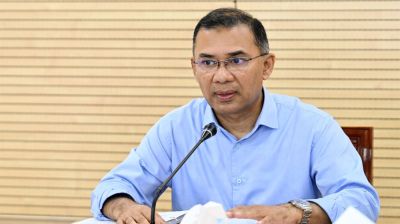
Prime Minister Tarique Rahman on Sunday directed law enforcement agencies to ensure uninterrupted production in garment factories and the safety of lives and property, hours after the government formed a six-member minimum wage board for the readymade garment (RMG) sector.
Workers demanding a Tk30,000 monthly minimum wage had clashed with police in Dhaka and Gazipur, torching two vehicles and a jhut (fabric offcuts) godown.

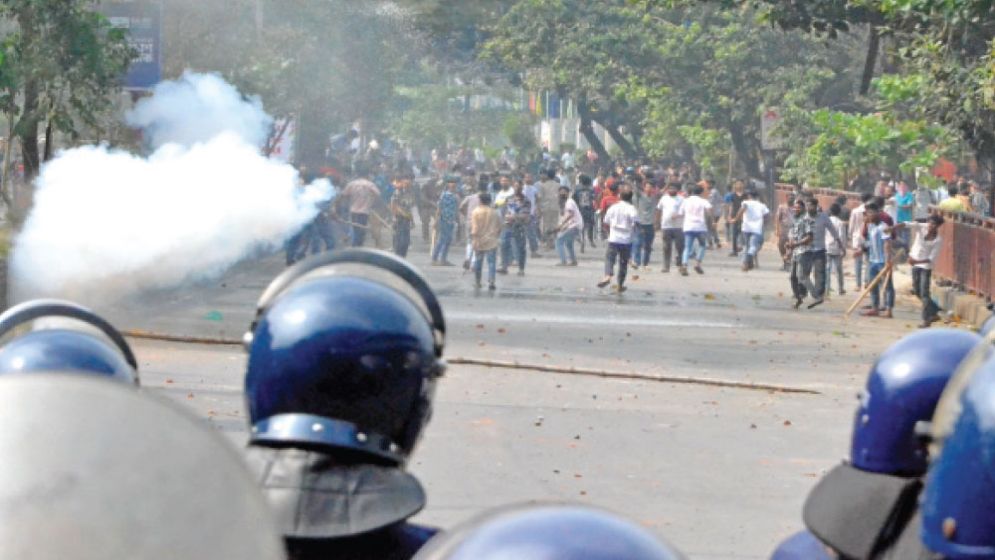
Police fire tear gas to disperse garment workers hurling bricks and stones during clashes at Mirpur-10 in the capital on Sunday, turning the area into a battleground. (Inset) A police vehicle burns after being set ablaze during the clashes at Mirpur-11. -DAILY SUN Photo
Labour and Employment Minister Ariful Haque Choudhury briefed reporters at the Secretariat on Sunday night after the prime minister held an emergency meeting with ministers and advisers.

He said the government would counter, politically, any attempt to destabilise the garment sector ahead of December.
The meeting, held earlier in the evening, discussed the current unrest, its causes and the steps needed to resolve it. Sources at the Prime Minister’s Office had said six or seven ministers and advisers, including the home minister and the labour adviser, were summoned.
Factories shut
The Bangladesh Garment Manufacturers and Exporters Association (BGMEA) said data collected up to 11:30am showed 318 factories closed across five industrial areas, leaving 702,255 workers without work. The data covered 2,134 factories, of which 1,816 remained operational.
In the Dhaka Metropolitan Police (DMP) Mirpur area, 68 of 320 factories were closed, affecting 51,625 workers. In Gazipur and Mymensingh, 225 of 836 were closed, affecting 525,360 workers. In Savar, Ashulia and Zirabo, 25 of 441 were closed, affecting 125,270 workers. None of the 537 factories in Narayanganj and Chattogram was closed.
Later, sources said about 530 factories were closed in industrial areas including Mirpur, Ashulia and Gazipur. Police separately said about 280 factories had been declared closed for the day.
Wage board formed
The Ministry of Labour and Employment’s wage board branch published a gazette on Sunday through two separate notifications, issued under the Bangladesh Labour Act, 2006 (as amended in 2026).
The board is headed by Senior District and Sessions Judge Sheikh Ashfaqur Rahman. Its other members are Dr Mosleh Uddin Ahmad, a professor of public administration at Dhaka University; Asif Ayub, joint secretary general of the Bangladesh Employers’ Federation; Anwar Hossain, president of the Bangladesh Jatiyatabadi Sramik Dal central committee; ABM Shamsuddin, a BGMEA director; and Babul Akhter, general secretary of the Bangladesh Garments and Industrial Workers Federation.
The chairman has been asked to begin proceedings in consultation with the employers’, workers’ and neutral members.
“We have formed a six-member Minimum Wage Board in accordance with the Labour Act,” Minister Ariful said at a press conference at the Secretariat around 11:30am.
“The board’s activities would begin today as a meeting would be held as soon as possible to discuss and decide on the minimum wage for workers.”
He urged workers to return to their workplaces, saying their demand for a wage board had been met.
He suggested a vested quarter was seeking to bring workers onto the streets in an orchestrated plot to create instability ahead of December.
“There might be external instigation behind the workers’ street protests,” he said.
About 4 million people work directly in the sector, which accounts for 81% of annual exports, valued at $48 billion.
BGMEA warns of closures
BGMEA members warned they might shut factories under Section 13(1) of the Bangladesh Labour Act if unrest and violence continued even after the wage board’s formation. The warning came at an emergency meeting in the capital attended by more than 230 members.
BGMEA President Mahmud Hasan Khan urged workers’ organisations and federations to play a responsible role in controlling the movement.
He called on the government to enforce the law without discrimination against whichever side, worker or owner, took the law into its own hands. “Factories are opened in the morning, but we have to shut them again an hour later,” he said. “We want a permanent solution to this problem.”
He said no final decision was taken at the meeting. Worker federations had been asked to ensure responsible behaviour among their members, and the government, particularly the home minister, had been urged to send a strong message that action would be taken against anyone engaging in violence.
He proposed that wage board members appear jointly before the media to urge patience until the board completes its work, and said the board must be allowed to work independently.
Employers, opposition urge restraint
Bangladesh Knitwear Manufacturers and Exporters Association (BKMEA) President Mohammad Hatem said, “We warmly welcome the government’s decision to form a new wage board for the garment sector.”
He said, “We understand the pressure our fellow workers are under as the cost of living rises. At the same time, the challenges are real: the global slowdown, the energy crisis, steadily rising production costs and falling export orders at factories. For us, ensuring workers’ fair dues and keeping factories running are equally important.”
He added, “When workers survive, the industry survives; when the industry survives, workers survive.”
Opposition Leader and Jamaat-e-Islami Ameer Shafiqur Rahman urged all concerned to show restraint.
“The unrest in the country’s largest export sector is deeply concerning, which is already facing mounting economic challenges,” he said in a Facebook post.
He cited unreliable power supply, high energy prices, rising production costs, global uncertainty, export order cancellations and workers’ rising rents, prices and medical costs.
He called on the government to act urgently on the industry’s power crisis.
“Failure to act could push the country’s fragile economy to the brink of collapse. There is no room for delay,” he said.
Mirpur clashes
Workers blocked the Mirpur-10 intersection around 8am, and clashes broke out around 11:15am after police tried to clear the road.
Eyewitnesses said police repeatedly asked the workers to leave, but they hurled brickbats at the officers.
Police chased them with batons, fired tear gas shells and sound grenades, and used a water cannon. The workers dispersed but regrouped and threw bricks from different directions.
Around 12:30pm, protesters set fire to a police vehicle beneath the Mirpur-11 metro rail station, burning the station’s water line. Metro rail services at Mirpur-10, Mirpur-11 and Pallabi stations were suspended from noon to 2:30pm, according to Khalid Hasan, a security guard at the station.
Md Hanif, inspector (operations) at Pallabi Police Station, said the protesters left the road around 1pm, after which traffic returned to normal.
Gazipur arson
In Kaliakoir, workers of Karani Knit Composite, Knit Asia and other factories in Ratanpur took positions on the highway at Safipur Bazar in the morning. Around 11:30am, a pickup van was set on fire in the Palli Bidyut area and five or six vehicles were vandalised. Eyewitnesses said firefighters could not reach the spot because of the protests.
A jhut godown of the factory Tropical in Chandra Palli Bidyut was then set alight. Eyewitnesses said workers obstructed a Kaliakoir Fire Service unit, and Station Officer Md Tariqul Islam confirmed it could not reach the scene. The godown was gutted before the fire was doused. It was not immediately known who set the fires.
Police said around 28 people, including three journalists, were wounded. Jahangir Alam, Gazipur correspondent of Dipto TV, was among them; attackers snatched his camera, wallet and other valuables.
Amzad Hossain, superintendent of Industrial Police-2 (Gazipur), said more than 100 factories declared a holiday for the day. Border Guard Bangladesh (BGB) personnel were deployed in Gazipur and Dhaka and will remain until 7 November, according to BGB Headquarters.
Savar and Ashulia
Most factories in Savar and Ashulia operated normally in the morning, but workers at several factories in Nishchintapur stopped work.
Around 10:45am, workers staged a sit-in on the Abdullahpur-Baipail road in front of a Sharmin Group factory in Narasinghapur, chanting slogans for higher pay. Sharmin Group declared a holiday around 11:45am, followed by Ha-Meem Group, New Age and others.
Md Mominul Islam Bhuiyan, superintendent of Industrial Police-1 (Ashulia zone), said factory authorities had closed 177 factories for the day.
Khairul Mamun, legal affairs secretary of the Bangladesh Garments and Sweater Workers Trade Union Centre, said workers told him that factory authorities had not spoken to them about their demands.
“When holidays are declared without information, workers become angry and take to the road,” he said, urging quick talks.
11 detained
DMP’s Detective Branch said it had detained 11 activists of the Awami League, Jubo League and Chhatra League, all banned, for allegedly mixing with the protesters in an attempt to commit arson and sabotage.
Mohammad Rakib Khan, deputy commissioner of DB Mirpur Division, said those held in Mirpur-10 were grassroots leaders from Barishal, Patuakhali, Cox’s Bazar, Gaibandha and other districts.
He alleged that Alif Molla, nephew of fugitive Mirpur MP Elias Molla, was the coordinator and had brought them to Dhaka.
“More than 100 leaders and activists were present during the movement. Drives are under way to identify and detain them,” he said.