


 For all latest news, follow the Daily Sun's Google News channel.


HSC, EQUIVALENT EXAM RESULTS
English, ICT failures drag pass rate to 22-year low
Daily Sun Report, Dhaka/Chattogram
Published: 01 Nov 2026, 12:00 AM
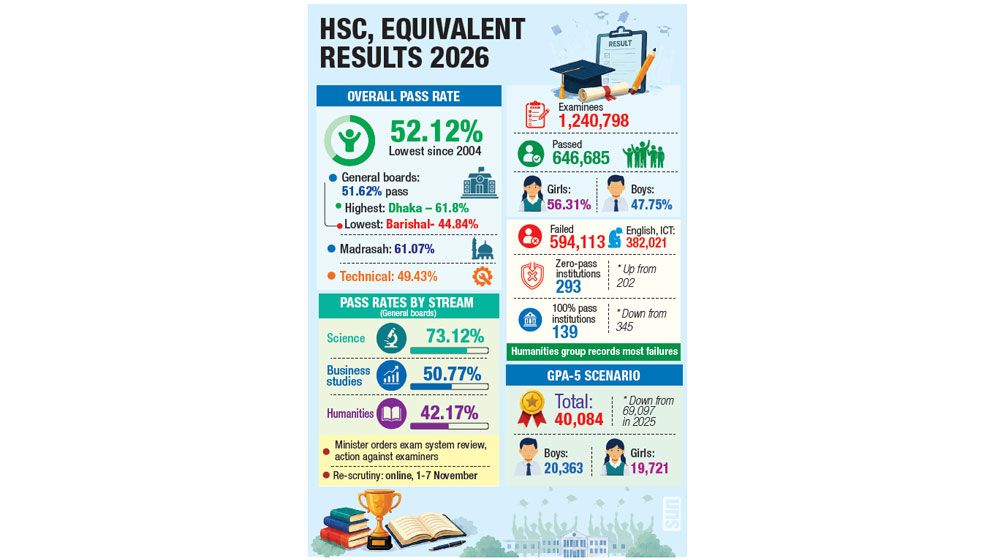
The overall pass rate in this year's Higher Secondary Certificate (HSC) and equivalent examinations fell to 52.12%, the lowest since 2004, when 47.74% of candidates passed.
Education Minister Dr ANM Ehsanul Hoque Milon announced the results at around 11am on Saturday at the conference room of the Secondary and Higher Education Division at the Secretariat in Dhaka. The results were released simultaneously across the country.
The rate is 6.71 percentage points lower than last year's 58.83%. Of the 1,240,798 candidates who sat the examinations under the 11 boards (nine general, one madrasah and one technical), 646,685 passed and 594,113 failed.
Dhaka leads, Barishal last
Among the nine general education boards, Dhaka recorded the highest pass rate at 61.80%. Chattogram followed with 52.07% and Mymensingh with 51.44%.
Sylhet was fourth with 50.90% and Cumilla fifth with 48.04%. Dinajpur recorded 45.98%, Rajshahi 45.06% and Jashore 44.92%. Barishal posted the lowest rate, at 44.84%.
The Bangladesh Madrasah Education Board recorded a pass rate of 61.07% in the Alim examinations. Of 93,471 registered candidates, 89,321 appeared. Some 29,269 of 50,374 male examinees passed, as did 25,278 of 38,947 female examinees.
Under the Bangladesh Technical Education Board, 50,889 of the 102,947 candidates who sat the HSC (BM/BMT), HSC (Vocational) and HSC (Diploma in Commerce) examinations passed, a rate of 49.43%. Of those who passed, 33,099 were male and 17,790 female. The female pass rate was 61.64%, against 44.68% for males.
GPA-5 numbers nearly halve
A total of 40,084 students achieved GPA-5, down by 29,013 from 69,097 in 2025. The nine general boards accounted for 35,948 of them, the madrasah board for 3,250 and the technical board for 886.
Boys outnumbered girls among top scorers overall, with 20,363 male and 19,721 female GPA-5 achievers. In the technical board, however, 706 of the 886 GPA-5 achievers were female and 180 were male.
Girls nonetheless outperformed boys on pass rates. Of the 646,685 successful candidates, 356,528 were female and 290,157 were male. The female pass rate was 56.31%, against 47.75% for males.
Institutions
Of the 9,390 institutions that sent candidates to the examinations, 139 recorded a 100% pass rate, down by 206 from 345 in 2025. The number recording a zero pass rate rose by 91, from 202 to 293.
English and ICT
Of the 594,113 candidates who failed, 382,021 failed in English and Information and Communication Technology (ICT). Some 243,528 failed in English and 138,493 in ICT.
Among the three main groups under the general boards, Humanities recorded the highest number of failures. Of 607,735 Humanities candidates, 256,311 passed. In Science, 200,074 of 273,000 candidates passed, while in Business Studies 84,864 of 167,000 passed.
Chattogram: lowest in 21 years
The Chattogram board's pass rate of 52.07% was the lowest since 2005, according to Mohammad Abul Kalam in Chattogram. It compares with 52.57% last year and with 89.44% in 2021, the highest rate in the 2005-2026 period. In 2020, all HSC students were awarded results based on their earlier JSC and SSC performance because of the Covid-19 pandemic.
An analysis of the 21 years shows considerable fluctuation rather than a steady trend. The average pass rate over the period was about 68.13%. The number of GPA-5 achievers under the board fell 52%, to 2,929 from 6,097 in 2025. The highest figure was 13,720 in 2022.
Of 96,335 candidates who appeared under the board, 50,166 passed and 46,169 failed. A total of 22,114 failed in only one subject, about 22.95% of all candidates, compared with 24,654 a year earlier.
Board officials attributed the decline mainly to weaker performance in English and ICT, particularly among humanities students and those from the hill districts.
Board Controller of Examinations Professor Parvez Sajjad Chowdhury said, “Students performed relatively poorly in English and ICT. Many colleges do not have teachers for ICT, leaving students to prepare for the subject on their own. This is a major problem.”
He added that some colleges relied on part-time teachers to teach ICT. “Even after studying English for 12 years, many of our students remain weak in the subject. They lack proficiency in English,” he said.
Of the 280 colleges under the board with candidates in this year's examinations, three recorded a zero pass rate and ten recorded pass rates of up to 10%. Six colleges achieved 100%. The zero-pass institutions are in remote parts of Chattogram, Rangamati and Khagrachhari.
City colleges perform strongly
Colleges in Chattogram city recorded a combined pass rate of 66.20%. Government Haji Muhammad Mohsin College topped the list of leading institutions, with 1,625 of 1,701 candidates passing (95.53%) and 635 GPA-5 achievers, the highest among them.
Chattogram College recorded 94.49%, with 977 of 1,034 candidates passing and 627 securing GPA-5. Chattogram Government City College recorded 91.01%, with 1,742 of 1,914 passing and 297 achieving GPA-5.
Chattogram Cantonment Public College recorded 97.33% with 259 GPA-5 achievers, and Government Commerce College 97.10% with 189. Chattogram Government Girls' College recorded 92.06% with 153 GPA-5 achievers, and Bakolia Government College 83.43% with 123.
Among colleges in the three hill districts, Lakers' Public School and College recorded 84.88%. Of its 205 candidates, 174 passed and five secured GPA-5.
Re-scrutiny and review
Candidates dissatisfied with their results can apply for re-scrutiny online from today until 7 November, according to the Bangladesh Inter-Education Board Coordination Committee. No manual applications will be accepted. The Dhaka Education Board has published detailed instructions.
Education Minister Milon said the government was taking steps to review the entire examination system after several inconsistencies emerged in the evaluation of answer scripts and the publication of results. He said examiners found responsible for major discrepancies in evaluating scripts would face disciplinary action.