


 For all latest news, follow the Daily Sun's Google News channel.


Tips or traps? Digital scams target stock traders
Fake trading apps, fraudulent investment groups pose growing threats to capital market

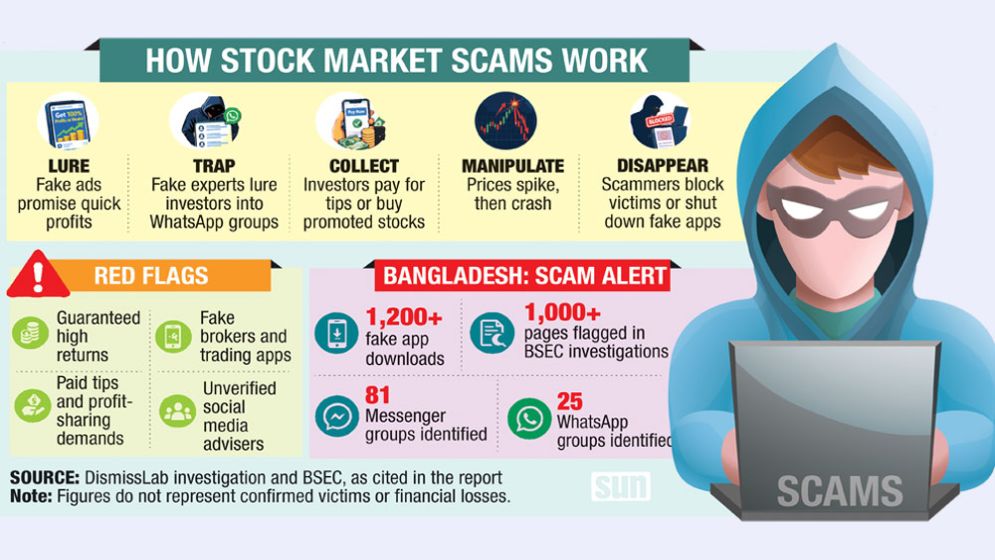
The promise is tempting: a hot stock tip, a quick profit and a chance to make easy money. But for many investors drawn into social media investment groups, the dream of striking it rich can turn into a costly trap.
It often begins with an attractive Facebook advertisement or an invitation to a WhatsApp group, where self-proclaimed market experts offer tips on shares supposedly poised for a rally. Some charge fees for their advice, while others demand a cut of the profits.
Reassured by glowing testimonials, conversations with fellow group members and promises of lucrative returns, investors put their savings into recommended stocks.
Prices may initially climb, reinforcing their confidence. But when the shares suddenly plunge, the advisers often become unreachable, leaving investors blocked or removed from the groups.
What appears to be a shortcut to stock market success is increasingly becoming another avenue for financial fraud, where scammers are exploiting investors’ appetite for quick profits through fake trading apps, fraudulent social media groups and the misuse of reputable brokerage firms’ identities.
For investors already grappling with falling share prices, weak corporate fundamentals and market volatility, these digital traps have added a new layer of risk.
The threat is not confined to Bangladesh. Across global financial markets, technology-enabled investment scams, cyberattacks and the growing misuse of artificial intelligence are raising fresh concerns over investor protection.
Market stakeholders say investors now face a double challenge: identifying genuinely promising securities while steering clear of increasingly sophisticated digital fraud.
From Facebook ads to WhatsApp groups
A 30 September 2025 report by fact-checking and investigative organisation DismissLab exposed digital fraud targeting Bangladesh’s capital market.
Following a month-long investigation, the organisation found that at least 15 Facebook pages had run hundreds of advertisements in September directing users to WhatsApp groups. At least 20 such groups had a combined membership exceeding 3,000.
Some groups misused the names and identities of City Brokerage Limited (CBL) and BRAC EPL Securities. Representatives of both institutions denied any connection with the groups and said they had reported the matter to the authorities.
The investigation also found that a fake trading application had been downloaded at least 1,200 times.
However, the findings do not establish how many investors fell victim to the schemes or how much money they lost.
According to DismissLab, fraudsters exploit the names and logos of legitimate brokerage houses and investors’ interest in the stock market to gain credibility.
For inexperienced investors, distinguishing fake trading platforms from genuine applications can be difficult.
Limited technical knowledge, the lure of quick profits and the misuse of trusted institutional identities make them particularly vulnerable.
BSEC flags suspicious pages and groups
On 9 September 2025, the Bangladesh Securities and Exchange Commission (BSEC) identified 11 Facebook pages, profiles and groups allegedly involved in spreading misleading stock market information and fraudulent investment offers, warning investors against such activities.
The list included Shokher Share Bazar, BD Stock Exchange (DSE & CSE), Momin DSE, Ashakaa Rasul Noomani, Share Market Success Strategies, Bazar Bishleshon, Ashikur Rahman Ashik, Anika Sarah (Consultancy Asset management), Public Business Club, Planned Investment and Caleb Wright.
Of these, three were pages or personal profiles and eight were groups.
It remains unclear whether all the accounts have since been shut down or whether legal action against their operators has been completed.
BSEC spokesperson Abul Kalam said stock market research and investment advice require relevant regulatory approvals and qualifications.
Investors relying on unverified claims of expertise or promises of profits on social media expose themselves to substantial financial risks, he warned.
He said investigations had identified 81 Messenger groups, more than 1,000 Facebook pages and 25 WhatsApp groups, among other social media channels, at different stages.
Action was being taken against some pages accused of misleading investors through false information, while efforts to identify and curb such activities continued.
The regulator had also acted against similar online fraud in the past, he added.
Global threats from AI and investment scams
A report by the International Organization of Securities Commissions (IOSCO) estimated that global losses from relationship investment scams, commonly known as “pig butchering”, could reach US$75 billion.
However, actual losses worldwide remain unknown, and the estimate does not represent a confirmed total.
In such scams, fraudsters build relationships with potential victims through social media, messaging platforms or dating applications before persuading them to invest through fraudulent trading platforms.
They initially display fabricated profits to encourage larger deposits before cutting off communication when victims attempt to withdraw their money.
The growing use of AI, fake identities and deepfake technology is making these schemes more convincing and harder to detect.
To raise awareness, investor education activities were held across 16 jurisdictions on five continents during World Investor Week 2026.
BSEC Chairman Masud Khan said investor awareness and protection efforts must continue throughout the year rather than being limited to World Investor Week programmes.
He said initiatives were under way to expand open-end mutual funds, introduce licensed mutual fund agents and financial advisers, reform initial public offering (IPO) policies, introduce direct listing regulations and develop new investment products.
These measures could diversify investment opportunities and improve market efficiency, he said.
However, Masud Khan stressed that new investment products alone would not strengthen the capital market.
Good corporate governance, credible financial reporting, effective regulatory oversight and swift action against fraud were equally essential to restoring investor confidence, he said.