


 For all latest news, follow the Daily Sun's Google News channel.


NEW 9-POINT CHARTER
Hefazat softens stance on women, revises several demands
Daily Sun Report, Chattogram
Published: 05 Oct 2026, 12:00 AM
Hefazat-e-Islam Bangladesh has revised several demands, including its stance on women, in its new nine-point charter compared with the 13-point demands it announced in 2013.
A comparison of the two charters shows that several positions on the social conduct of men and women, statues, media and constitutional matters have been dropped or revised.
The new charter places greater emphasis on justice, Qawmi education, the role of Islamic scholars in state affairs and issues concerning the Tablig Jamaat. Some core demands, including stronger anti-blasphemy laws and recognition of Ahmadis as non-Muslims, remain unchanged.
Hefazat leaders said the revisions do not represent an ideological shift but are aimed at updating the organisation’s platform. They said some demands were dropped because the present government was already addressing them.
Sources said the revision process began after the fall of the Awami League government, underwent further changes during the interim administration and was finalised after the BNP government took office in February.
A committee led by Hefazat Secretary General Maulana Muhammad Sajedur Rahman drafted the nine-point charter, which Ameer Maulana Muhibbullah Babunagari presented to Prime Minister Tarique Rahman during his visit to Fatikchhari on 9 August.
Key changes
Hefazat dropped its 2013 demand to restore “faith and trust in Allah” in the Constitution, instead calling for no law to be enacted that conflicts with the Quran and Sunnah.
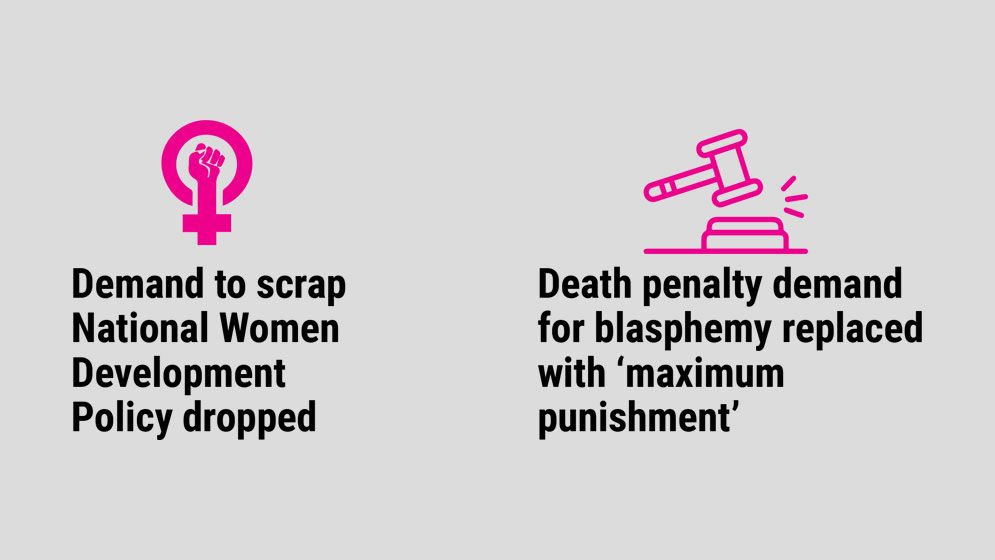
Its demand for the death penalty for blasphemy has been revised to call for the “maximum punishment” for the offence.
The previous demand for cancellation of the National Women Development Policy and the secular education policy has been dropped. The new charter instead calls for compulsory Islamic education for Muslim students from primary to higher secondary levels.Several demands opposing public statues, foreign culture and media depictions of religious attire have also been dropped or revised. References to the Shahbagh movement and bloggers have been removed.
The new charter expands its demand for justice to casualties from the 2013 Shapla Chattar operation, the 2021 anti-Modi protests and the 2024 mass uprising.
On the Chattogram Hill Tracts, Hefazat has narrowed its earlier demand concerning missionary activities while adding a call to ban Hizb ut-Tawhid and retaining its demand to declare Ahmadis non-Muslims.
Asked about the changes, Hefazat Secretary General Maulana Muhammad Sajedur Rahman said the revisions concerning women did not mean the organisation had abandoned its core Islamic principles.
“Islam is fundamentally liberal regarding women. While upholding core Islamic principles, we believe in women’s modesty,” he said.