



 For all latest news, follow the Daily Sun's Google News channel.


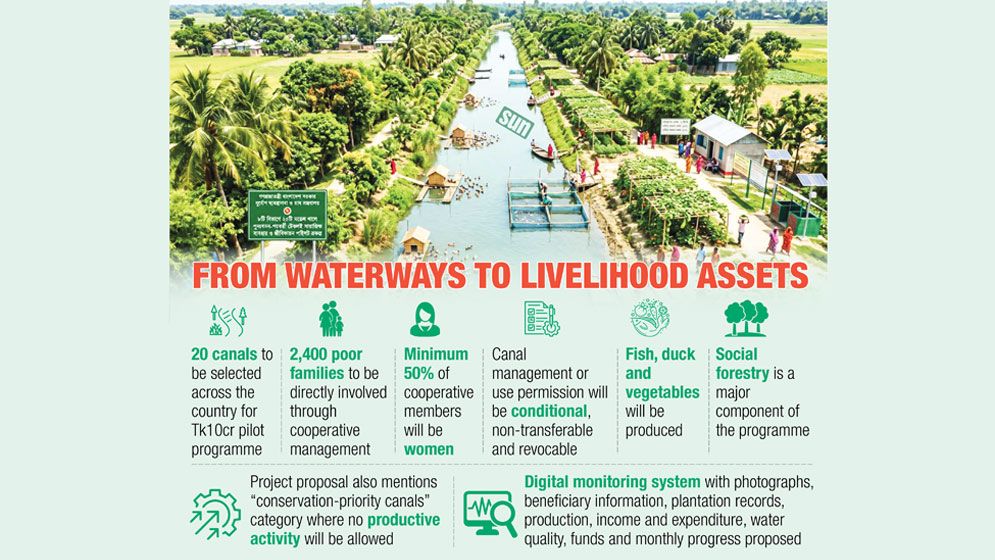
The government plans to turn 20 recently re-excavated public canals into “model canals” that combine water conservation with livelihood generation, social forestry, employment and disaster-resilient economic activities.
A draft concept paper prepared by the Ministry of Disaster Management and Relief proposes a pilot programme in eight divisions, with three canals each in Dhaka, Chattogram, Rajshahi and Khulna, and two each in Rangpur, Sylhet, Barishal and Mymensingh.
The proposal estimates that the 20 canals would cover around 60km and directly involve about 2,400 poor families through cooperative-based management.
Disaster Management and Relief Minister Asadul Habib Dulu recently said the government intended to implement model canal projects in every division, initially selecting 20 canals on a pilot basis. Sharif Jamil, member secretary of Dhora and Buriganga Riverkeeper, told the Daily Sun that the main objective of restoring canals is to ensure natural water flow and prevent pollution.
“If the model project is not hampering the main objective of the canal excavation then it is good. We have ensured that the main objective is not hampered by the project,” he said.
Proposed activities
Under the draft, suitable canals would be used for a combination of social forestry, fish farming, controlled duck rearing, seasonal vegetable cultivation along the banks and, where appropriate, navigation. Not every canal would host every activity; use would depend on water flow, carrying capacity, environmental condition, public use, navigation needs and local circumstances.
The draft also proposes a separate category of “conservation-priority canals” where no productive activity would be allowed. Public access would be maintained for water collection, bathing, boat movement and other lawful uses.
Fish cultivation would be allowed using locally appropriate, approved species. The number of ducks would not be fixed uniformly but set according to water-holding capacity, flow, quality, environmental risks, public use and technical advice from the Department of Livestock Services. Duck rearing could be reduced, suspended or stopped in the event of disease outbreaks or deteriorating water quality.
Social forestry would involve planting water-tolerant, fruit-bearing, medicinal and forest species along suitable banks. Numbers and types of trees would be determined by field-level assessments. The initiative would be aligned with the government’s wider tree-plantation target, with emphasis on the survival of planted trees rather than the number of saplings.
Cooperatives and beneficiaries
The 2,400 beneficiary families would manage the canals through cooperatives, with women making up at least half of the members.
Beneficiaries would mainly be drawn from existing lists under the Employment Generation Programme for the Poorest (EGPP) and the Department of Social Services, along with families affected by river erosion, poor families with members with disabilities and other locally verified extremely poor households. National ID verification would be used to prevent duplication.
The draft states that no permanent ownership or tenancy rights would be created for beneficiaries or cooperatives. Any management or use permission, where legally permissible, would be conditional, non-transferable and revocable.
Funding and coordination
The paper proposes an initial government investment of up to Tk10 crore. No new allocation is proposed for the excavation itself. The money would cover infrastructure and management support, production inputs, social forestry, training and technical assistance, health and disease prevention, environmental protection, monitoring and evaluation, transport and administration.
The draft describes the intended financial cycle as: government investment, employment, production, income, revolving fund, self-reliance and reduced dependence on government support.
The disaster management ministry would act mainly as a coordinating agency and would not take over the statutory responsibilities of other bodies. The ministries of Land, Water Resources, Fisheries and Livestock, and Environment, Forest and Climate Change, the Bangladesh Water Development Board, the Local Government Division, LGED, the Department of Cooperatives and the Finance Division would be involved.
District administrations would finalise the canals and obtain clearances, while upazila administrations would oversee beneficiary selection, cooperative formation and implementation.
Before selecting a canal, authorities would have to verify land records and classification, government ownership, existing leases, encroachment, boundaries, ongoing projects, water flow and capacity, public use, navigation, environmental risks and local disputes. Where canals were re-excavated by the BWDB, LGED or another agency, formal consent or a handover document would be required before any activity begins.
Monitoring and exit
The ministry proposes a digital monitoring system recording canal locations, photographs, beneficiary details, plantation records, production, income and expenditure, water quality, revolving funds and monthly progress. Beneficiaries’ personal information would not be publicly disclosed. A four-tier grievance mechanism would run from the union parishad or cooperative to the upazila, the district and a ministry monitoring cell.
Government support would be scaled back over time. Initial assistance would build capacity and establish production, with operating costs later met from cooperatives’ own income and revolving funds.
A third-party evaluation after 12 months would assess financial sustainability, actual income, employment, environmental impact, women’s participation, cooperative performance and the effectiveness of public investment. Any expansion would depend on its findings and require separate consideration of financing capacity, agency views, budget availability and approval.
The paper also includes an exit mechanism. A canal found unsuitable could see activities modified or stopped, with government-owned assets recovered and reused. In case of closure, the proposal calls for advance written notice, completion of an ongoing production cycle where appropriate, settlement of revolving funds and recommendations for alternative programmes for affected beneficiaries.
The government’s wider canal excavation programme already includes projects for drainage improvement, irrigation, surface-water conservation and environmental restoration.
The reporter can be reached at [email protected]