



 For all latest news, follow the Daily Sun's Google News channel.


10 lakh farm households need emergency agri aid: FAO
Daily Sun Report, Dhaka
Published: 02 Sep 2026, 12:00 AM
Around 10 lakh agricultural households, representing about 50 lakh people, are estimated to need emergency agricultural assistance in Bangladesh during the June-November 2026 period, according to the latest report by the Food and Agriculture Organization of the United Nations (FAO).
The estimate is 2 lakh higher than the 8 lakh households identified as needing emergency agricultural assistance in the FAO’s September 2025 assessment.
The findings come from the FAO’s 14th round of Data in Emergencies Monitoring (DIEM-Monitoring), an emergency agriculture support assessment based on computer-assisted telephone interviews with 6,143 households conducted from 20 April to 27 May this year, covering all eight divisions and 64 districts.
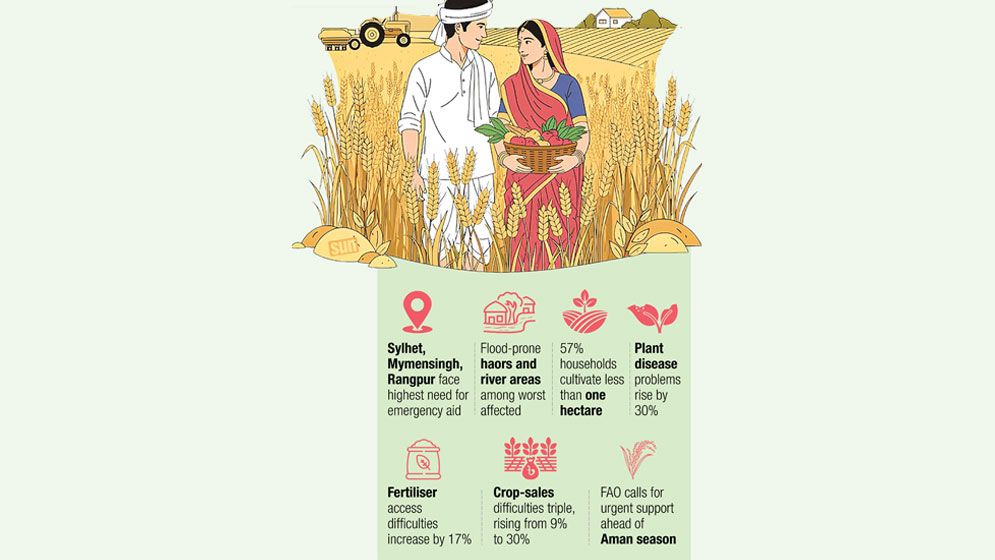
The latest assessment found that the highest proportions of agricultural households in need of emergency agricultural assistance (AgHiN) were in Sylhet, Mymensingh and Rangpur.
In terms of the estimated number of households requiring assistance, Chattogram and Rangpur recorded the highest figures, followed by Dhaka, Rajshahi, Mymensingh, Khulna, Sylhet and Barishal.
The situation was particularly severe in river-system areas, haors and flash-flood hotspots, reflecting increased exposure to flooding and waterlogging as the monsoon intensified.
The FAO said households in need were disproportionately resource-poor smallholders.
Some 57 percent cultivated less than one hectare, while 60 percent belonged to the lowest wealth tercile.
Their dependence on casual farm labour, casual off-farm labour and low-capital self-employment further limited their ability to finance agricultural production and withstand economic and natural shocks.
Economic shocks affected 84% of the households in need, while exposure to natural hazards reached 16%, six percentage points higher than in the previous round.
The financial strain was also reflected in household coping strategies. Some 67% reported purchasing food on credit, while 66% reduced health expenditure and 30% cut spending on agricultural inputs.
The FAO warned that reduced spending on inputs could undermine households’ ability to purchase seeds, fertiliser, feed and other productive inputs, potentially affecting future production and income.
Crop producers also faced growing production and marketing difficulties. Plant disease problems increased by 30 percentage points, while difficulties accessing fertiliser rose by 17 percentage points.
At the same time, difficulties selling crops increased sharply from 9% in the previous round to 30%, mainly due to low selling prices.
The assessment also found that the main income sources of many households remained insecure and irregular. Casual off-farm labour was the most common main source of income, while only around 16% of households in need reported crop, livestock or fishery production as their main source of income.
Income pressure was also significant, with 33% reporting that their main income was lower than during the same period in a typical year.
Against this backdrop, crop inputs remained the leading assistance priority, reported by 72% of households in need.
Demand for cash assistance, however, surged from 16% to 57% — an increase of 41 percentage points from the previous round.
The FAO said the increase may reflect acute seasonal needs arising from recent shocks, including monsoon floods, food inflation and reduced household income.
Livestock feed was identified as a need by 51% of households, while 33% reported a need for veterinary services.
The FAO said the findings underscore the need for a seasonally timed package of assistance ahead of the Aman cultivation period, combining crop inputs with cash support, animal-health services and water-management assistance.
It also recommended investment in drainage, storage, aggregation and market access to help households protect the upcoming Aman crop, reduce post-harvest losses and secure better returns. Recommended Stories