



 For all latest news, follow the Daily Sun's Google News channel.


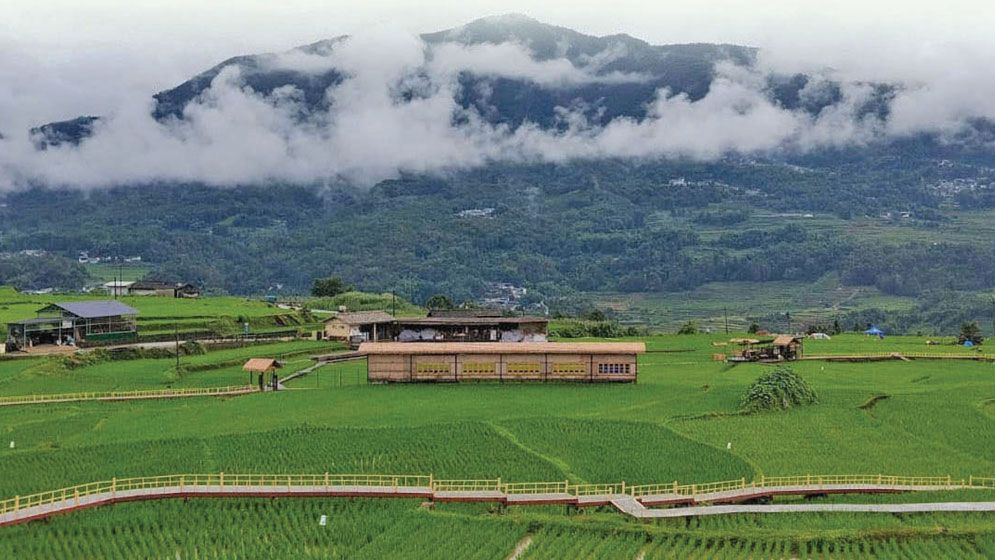
The journey began in Kunming. Leaving behind the bustle of the city, the train moved westward as the scenery changed to high mountains, deep valleys, green forests and cloud-covered hills. Settlements appeared on mountain slopes, farmland stretched across valleys, and winding roads climbed the hillsides. The farther we travelled, the clearer it became that seeing this part of China on a map and experiencing it firsthand were two very different things.
During the seven-day journey through Baoshan, Longling and Tengchong, the experience went beyond tourist attractions. It offered glimpses of people's daily lives, local food culture, hotel hospitality, mountain communities, old-town heritage and the coexistence of modern infrastructure with nature. Coffee, Dendrobium orchids and hot springs each offered material for separate stories. But the larger story was how people live alongside nature and how that relationship has shaped a distinctive tourism culture.
From Kunming to the land of mountains
Our destination that morning was Baoshan. After breakfast at around 8:30am, we walked for about 20-25 minutes to the station with around 13 journalists from Myanmar, Laos and Vietnam.
After baggage screening, passport verification and ticket confirmation, we boarded the high-speed train. Our assigned carriage was No. 5.
The efficiency of China's transport infrastructure was evident from the outset — punctuality, clean stations, disciplined passengers and high-speed rail connectivity. Digital displays showed the next station, temperatures inside and outside, and the train's speed, which reached 155 kilometres per hour at one point.
Rail connectivity with Baoshan is relatively recent. The city joined China's railway network with the opening of the Dali-Baoshan section on 22 July 2022. Built through mountainous and geologically challenging terrain, the route has 34 bridges and 21 tunnels, which together account for nearly 87 per cent of the line's total length.
People living in the mountains
One of the first things apparent in Baoshan is the close coexistence of nature and human settlements. Houses are built along mountain slopes, farmland lies below, and dense greenery stretches into the distance. Modern buildings can be seen in the city, but nature quickly takes over beyond it.
According to official statistics, Baoshan had a population of about 2.374 million at the end of 2025, of whom around 1.413 million lived in rural areas. Mountains, agriculture and rural life therefore remain central to the region's character.
The distinctive taste of Yunnan
In Yunnan, food is more than a means of filling one's stomach; it is an important part of local culture. Our experience with local food in Tengchong was particularly memorable.
One of the city's well-known foods is Ersi (rice noodles), made from rice and served in soup or with various ingredients. According to local sources, people in Tengchong have traditionally started their mornings with a warm bowl of Ersi.
Another popular dish is Da Jiu Jia (stir-fried rice noodles), prepared with fried Ersi, eggs, vegetables and other ingredients. Several dishes were placed on the table at the same time, with everyone sharing them and taking small portions.
For a visitor, this style of dining offers a glimpse into the social character of meals in the region, where food is shared and enjoyed together rather than served as individual portions.
Green landscapes on the way to Longling
As we travelled from Baoshan towards Longling, the mountains became denser and the greenery more expansive. Trees covered the hillsides, small villages appeared along the roads, and roadside shops sold agricultural products.
According to official information, Longling has a forest coverage rate of about 67.89 per cent. Much of the area is mountainous, and the natural environment is closely connected with daily life.
We also explored Baoshan's coffee industry, including the Baoshan Specialty Coffee Industrial Park and a coffee-processing facility. The mountain-grown product has become closely connected with the lives and culture of local communities.
Heshun: Six centuries of living history
Heshun in Tengchong offers another image of old China. The ancient settlement has a history of more than 600 years. During the Hongwu period of the Ming Dynasty, people from different parts of China settled here. Its strategic location along an ancient trade route helped it develop into a centre of trade, culture and human exchange.
Walking along its stone-paved paths, through traditional gateways and past old wooden houses and historic courtyards, one can almost feel that time has slowed down.
The influence of Han Chinese culture, local border-region traditions and centuries of interaction with South and Southeast Asia has given Heshun a distinctive architectural and cultural character.
Its old buildings are not simply relics of the past. They tell the story of a community shaped by trade, migration and cultural exchange, while showing how historical identity can survive alongside the modern world.
Final scene: Mountains outside the window
On the return journey, the mountains appeared again, sometimes through the train window and sometimes along the road. Clouds hung over mountain slopes, dense forests covered the hills and small houses were scattered across them.
The journey from Kunming to Baoshan and through Longling and Tengchong left the impression that Yunnan is much more than a tourist destination. It is a region where modernity and tradition, cities and villages, mountains and people's everyday lives continue side by side.
The high-speed railway has created new connections across the mountains, while old towns, local food and traditional ways of life continue to preserve a link between the past and the present.
(This is the final instalment of a five-part series on China, exploring its history, culture, development and changing face through the writer’s experiences during his recent visit.)