


 For all latest news, follow the Daily Sun's Google News channel.


Banks buy securities as credit demand drops
Soaring investment income fuels bank profits, but lagging private credit signals broader economic weakness

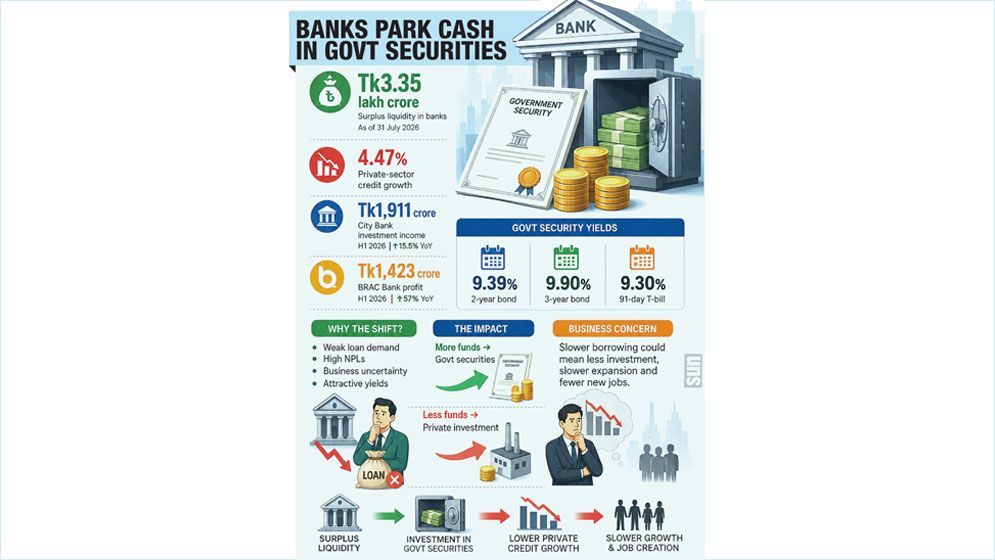
Faced with weak credit demand and limited productive investment opportunities, banks are increasingly funneling surplus liquidity into government Treasury bills and bonds rather than private sector lending.
While this safe-haven strategy is boosting bank profits, sector insiders warn it reflects broader economic stagnation, threatening new investment and industrial expansion.
The shift is evident in first-half 2026 financial results, where higher yields on government securities drove significant earnings growth across the sector.
City Bank, for example, reported Tk1,911 crore in investment income from government bills and bonds in H1 2026, a 15.5% year-on-year increase of Tk257 crore compared to the Tk1,654 crore earned in the same period last year.
Alongside higher investment and commission income, lower provisioning expenses helped City Bank’s profit cross Tk500 crore for the first time in the first half of a year.
BRAC Bank emerged as the top earner in H1 2026, posting a consolidated profit of Tk1,423 crore, up 57% year-on-year.
Higher investment income played a significant role in the bank’s profit growth, while stronger earnings from its core business also contributed to overall profitability.
Jamuna Bank also recorded growth in earnings per share (EPS) during the first six months of 2026.
Its EPS stood at Tk4.03, up from Tk3.31 in the same period a year earlier, representing a 21.75% increase.
Growth in investment income was one of the key factors behind the bank’s higher profit, allowing it to generate additional earnings from its investment portfolio alongside its core banking operations.
Pubali Bank secured the second spot with a profit of Tk685 crore, up 19%, followed by City Bank with Tk527 crore, representing a 75% increase.
Higher investment income was one of the key factors behind City Bank’s profit growth, as increased earnings from investments boosted its overall income.
Banks that reported higher profits during the period included NRBC Bank, Al-Arafah Islami Bank, Prime Bank, SBAC Bank, NCC Bank, Uttara Bank, UCB, City Bank, EBL and Shahjalal Islami Bank.
Banks that reported lower profits included Dhaka Bank, Mercantile Bank, Islami Bank Bangladesh, AB Bank, Bank Asia and Rupali Bank.
Weak credit demand, rising surplus liquidity
Sector insiders attribute the growing investment in government securities largely to a slowdown in new investment across the economy.
Entrepreneurs are showing little interest in new investments due to electricity and gas shortages, law-and-order concerns, business uncertainty and other challenges.
Many businesses are struggling even to operate their existing factories, they said.
Even the central bank’s Tk60,000 crore incentive package at subsidised interest rates has failed to generate the expected response from borrowers.
Overall, private-sector credit growth fell to a historic low of 4.47% at the end of the 2025-26 fiscal year.
Syed Mahbubur Rahman, managing director of Mutual Trust Bank, growing surplus liquidity and limited investment opportunities are forcing banks to settle for lower returns.
“Many banks are placing their funds with the central bank’s Standing Deposit Facility (SDF) at a rate of just 7.5%, while submitting lower bids at Treasury bill and bond auctions,” he said. “Consequently, yields on government securities are declining.”
Rahman cautioned that cutting the central bank’s policy rate will not be a quick fix for sluggish credit demand.
“Lowering the policy rate alone won’t boost loan demand unless broader underlying issues are resolved,” he warned. “Instead, it risks dragging down deposit rates. In fact, banks are already trimming lending rates simply because they can’t deploy excess funds elsewhere.”
Govt borrowing costs also falling
As banks increasingly turn to government Treasury bills and bonds, the government’s cost of borrowing is also falling rapidly.
According to Bangladesh Bank data, the government raised Tk5,000 crore through an auction of two-year Treasury bonds last Thursday at an interest rate of just 9.39%.
Earlier, on 8 July, the government had raised Tk4,000 crore through bonds of the same maturity at 9.70%. The rate was 10.40% in June this year and 12.20% in June last year.
A similar trend is visible in three-year Treasury bonds. The government raised Tk500 crore last Thursday at an interest rate of 9.90%.
The rate was 10.10% on 8 July, 10.52% in June and 13.06% in June last year.
Interest rates on Treasury bills have also declined. On 3 August, the government raised Tk3,000 crore through 91-day Treasury bills at an interest rate of 9.30%.
It also raised Tk2,500 crore through 182-day bills and Tk2,000 crore through 364-day bills at 9.53%.
In contrast, the average interest rates on 91-day, 182-day and 364-day Treasury bills were 11.94%, 11.98% and 12.01%, respectively, in June last year.
What does it mean for the economy?
Central bank initiatives to spur investment are failing to gain traction due to broader macroeconomic weakness and a growing crisis of confidence, according to M Masrur Reaz, chairman of Policy Exchange Bangladesh.
“Banks are exercising extreme caution in lending due to high non-performing loans (NPLs),” Reaz said. “Instead, everyone is channeling surplus liquidity into bills and bonds. As a result, surplus funds in the banking sector reached roughly Tk3.35 lakh crore as of July 2026.”
Reaz noted that long-standing repayment failures by several banks and non-bank financial institutions have reshaped depositor behavior.
“Depositors are no longer looking just at interest rates; they want absolute assurance that they can withdraw their money when needed,” he added. “This shift in trust is actively altering fund flows across the sector.”