


 For all latest news, follow the Daily Sun's Google News channel.


Bangladesh among worst hit by LNG shock: IEA
Strait of Hormuz disruptions, soaring fuel prices force power rationing
Daily Sun Report, Dhaka
Published: 24 Jul 2026, 12:00 AM
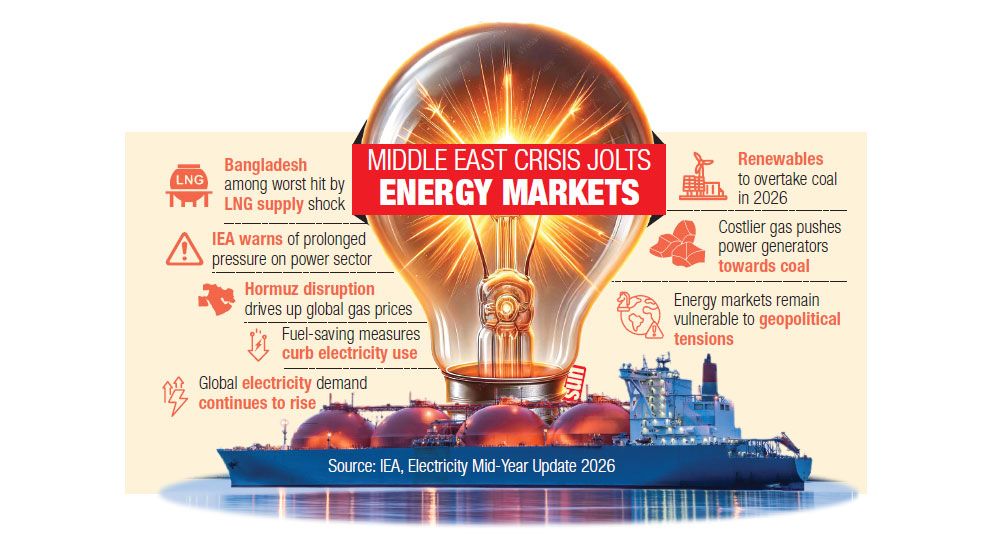
Bangladesh has emerged as one of the countries hardest hit by the ongoing Middle East conflict.
According to the International Energy Agency’s (IEA) Electricity Mid-Year Update 2026, soaring liquefied natural gas (LNG) prices and supply disruptions through the Strait of Hormuz have forced the nation to implement fuel conservation measures, curbing local electricity consumption even as global power demand surges.
The Paris-based energy watchdog highlighted that price-sensitive emerging economies, particularly Bangladesh and Pakistan, are acutely vulnerable to these supply shocks.
Higher import costs and continued market volatility are expected to keep Bangladesh’s power sector under heavy pressure throughout the year.
In contrast, global electricity consumption continues to accelerate, driven by industrial expansion, rising air conditioning use, electric vehicle adoption, and the rapid expansion of data centres.
The report projects global electricity demand to grow by 3.6% in 2026 and 3.8% in 2027, up from 3% in 2025.
Global electricity consumption is expected to reach 30,700 terawatt-hours (TWh) by 2027, compared with 28,600 TWh in 2025.
The agency said disruptions to LNG shipments through the Strait of Hormuz have pushed natural gas prices in Asia and Europe to their highest levels since the 2022-23 energy crisis, sharply increasing electricity generation costs and prompting emergency energy-saving measures in several countries.
Although additional LNG supplies, particularly from North America, have helped ease market tightness, elevated gas prices have prompted several Asian and European countries to switch from natural gas to coal for electricity generation.
At the same time, the rapid expansion of renewable energy has strengthened electricity supply security in many countries, cushioning the impact of the latest fuel price shock.
The IEA said renewable energy is on track to become the world’s largest source of electricity generation in 2026, overtaking coal after reaching near parity in 2025.
Electricity generation from renewable sources is expected to grow by more than 8% this year, increasing its share of global power generation from 33% in 2025 to 37% by 2027.
Solar power will continue to drive the expansion of global electricity supply.
The report projects that solar photovoltaic (PV) generation will surpass wind power in 2026 to become the world’s second-largest renewable source of electricity after hydropower. Global solar generation is expected to increase by around 600 TWh this year, matching the record annual growth achieved in 2025.
Among major economies, China’s electricity demand is forecast to grow by 5.5% in 2026, supported by strong manufacturing activity and expanding electric vehicle charging infrastructure.
India’s demand is expected to rebound by 7% following weather-related weakness last year, while demand growth is projected to remain close to 2% in both the United States and the European Union.
However, the agency warned that electricity consumption in price-sensitive LNG-importing countries, including Bangladesh and Pakistan, will remain constrained by high fuel costs and supply disruptions.
The report also cautioned that weather conditions could significantly alter the outlook. A stronger-than-expected El Niño event later this year could further increase electricity demand by boosting cooling needs while reducing hydropower and wind generation in some regions, leading to greater reliance on fossil fuel-based power.
Despite the rapid expansion of renewable energy, global carbon dioxide emissions from electricity generation are expected to rise by about 1% in 2026 before stabilising in 2027.
The increase is partly attributed to a shift from natural gas to coal in several countries following the spike in gas prices.
The disruption in LNG markets has also driven up wholesale electricity prices.
Average spot electricity prices in the European Union and Japan rose by more than 30% year-on-year during the second quarter of 2026, while prices remained broadly stable in the United States and increased by less than 10% in India, according to the report.
The IEA said major economies have largely adapted to the loss of LNG supplies through diversified sourcing and expanded renewable generation. However, it warned that global energy markets remain vulnerable to further geopolitical shocks as military tensions in the Middle East persist.
The report also highlighted that the growing share of renewable electricity is increasing the frequency of negative wholesale power prices in some markets, underscoring the need for greater grid flexibility through battery storage, demand response and other balancing technologies.