


 For all latest news, follow the Daily Sun's Google News channel.


Operating costs to dwarf dev as experts warn of grim imbalance
Under the current circumstances, the government should reduce expenditure in non-productive sectors and lower its dependence on borrowing.

The critical engines of Bangladesh’s long-term economic growth are facing a severe squeeze, as the upcoming budget reveals a stark disparity between skyrocketing state running costs and dwindling development investment.
According to the draft budget document prepared by the Finance Division, the outlay for the 2026-27 fiscal year (FY27) will expand to a massive Tk938,000 crore – marking a single-year surge of nearly Tk148,000 crore.
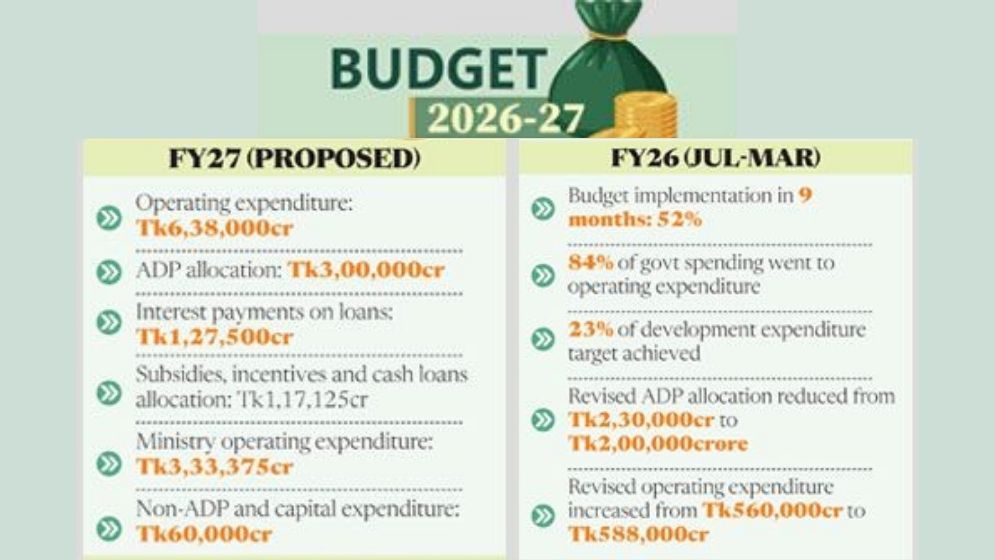
However, the blueprint exposes a deep structural imbalance: operating expenditure is set to jump by Tk78,000 crore to a staggering Tk638,000 crore, effectively more than doubling the total allocation for the Annual Development Programme (ADP), which sits at Tk300,000 crore.
Independent economists have sounded the alarm over this trajectory, describing the fiscal layout as highly imbalanced and warning that a continuous pivot toward non-productive spending threatens to erode the economy’s long-term capacity.
Dr Zahid Hussain, former lead economist of the World Bank’s Dhaka office, told the Daily Sun, “If government operating costs and spending on non-productive sectors continue to rise without a corresponding increase in revenue earnings, the country could fall into a debt trap.
Under the current circumstances, the government should reduce expenditure in non-productive sectors and lower its dependence on borrowing.”
To finance this ambitious spending plan, the government has set an aggressive revenue collection target of Tk695,000 crore.
The remaining deficit will require heavy borrowing, with plans to pull Tk116,000 crore from foreign lenders and Tk127,000 crore from domestic banking sources.
Analysts warn that this uncontrolled drift into recurrent expenditure leaves little room for infrastructure, public investment, and job creation.
Data from the finance ministry details where the bulk of this operating capital is consumed.
A massive share is swallowed by public sector salaries, allowances, pensions, gratuities, and spiralling debt interest payments.
It also covers heavy subsidies on electricity, fuel oil, and agricultural inputs like fertilizers and seeds, alongside cash incentives for exports and remittances.
Furthermore, everyday bureaucratic costs, including vehicle procurement, office maintenance, and publicity, are bundled under this umbrella alongside vital social safety net programmes such as old-age, widow, and disability allowances.
Breaking down the Tk638,000 crore operating budget, the Finance Division has earmarked Tk333,375 crore for direct ministry expenditures.
Non-ADP and capital expenditure is estimated at Tk60,000 crore, whilst interest payments on loans demand Tk127,500 crore.
Subsidies, incentives, and cash loans account for another Tk117,125 crore.
The structural vulnerability has been building throughout the current FY26.
Initiated by the previous interim administration, fiscal management shifted to the newly elected BNP government for its final four months.
However, just 11 days into the new administration’s tenure, conflict erupted in the Middle East, driving international fuel prices skyward and landing the government with an unexpected Tk40,000-50,000 crore spending burden.
Dhaka has already approached development partners for emergency financial assistance to buffer the shock. The Finance Division’s latest quarterly implementation report highlights the strain: just 52% of the current fiscal year’s Tk790,000 crore target was achieved during the first nine months.
Between July and March, total spending reached Tk408,426 crore, but a staggering 84% – Tk342,133 crore – went entirely to operating costs.
Conversely, development spending has withered.
The ADP allocation for the current year, originally set at Tk230,000 crore, was slashed to Tk200,000 crore in the revised budget.
Meanwhile, operating costs were revised upward from Tk560,000 crore to Tk588,000 crore. Actual development execution was painfully sluggish, with only Tk57,054 crore spent in the first nine months – a mere 23% of the target.
With fiscal pressures mounting, experts are urging a strict transition to austerity.
Dr Zahid Hussain questioned how the administration intends to efficiently execute such an expansive budget even if funding is secured, arguing that policymakers must abandon “borrow-and-spend” tactics.
“The proper use of allocated funds, along with ensuring transparency and accountability, should be the main objective of the new budget,” he noted.
Dr Fahmida Khatun, executive director of the Centre for Policy Dialogue (CPD), acknowledged that the new administration faces political imperatives to meet its election manifesto pledges.
“The question now is where the revenue will come from,” she observed, pointing out that the National Board of Revenue (NBR) has consistently missed its collection targets for a decade.
“Any unnecessary operating expenditure or wasteful spending should be strictly controlled,” Fahmida added, emphasising that expanding the budget size is meaningless without addressing structural efficiency.
“Improving the efficiency of public expenditure and implementing structural reforms in the revenue sector are the most important priorities under the current economic conditions.”
The reporter can be reached at: [email protected]