


 For all latest news, follow the Daily Sun's Google News channel.


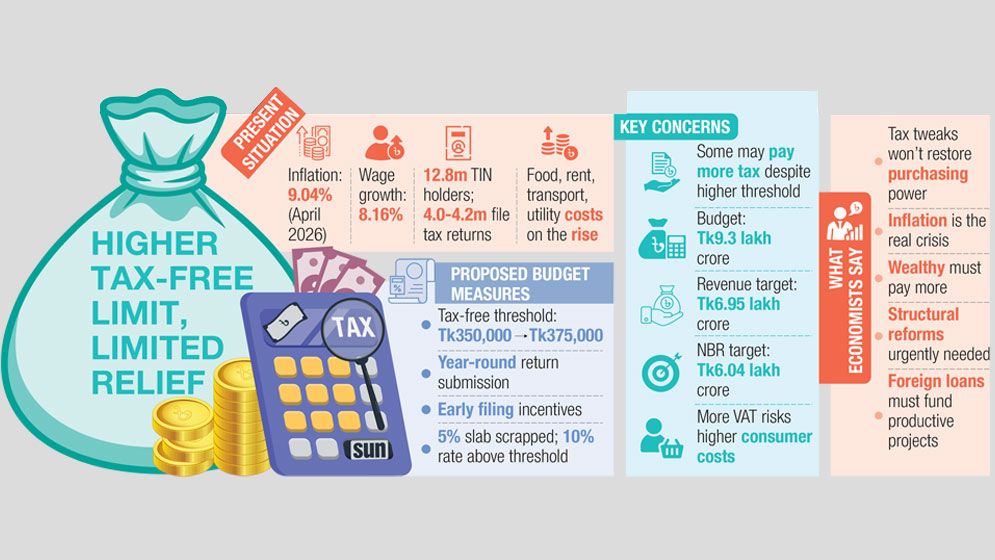
Millions of Bangladeshi taxpayers may soon receive modest relief when Finance Minister Amir Khosru Mahmud Chowdhury tables the national budget for 2026-27 fiscal year (FY27) in parliament on 11 June – but economists warn that a small tweak to the tax-free income threshold is unlikely to repair household finances battered by four years of stubborn inflation.
The government is understood to be considering raising the tax-free income threshold for individual taxpayers from Tk350,000 to around Tk375,000.
Officials say they are also looking at allowing returns to be filed throughout the year, with incentives offered for early submission.
On paper, both measures look taxpayer-friendly. In practice, their benefit may be considerably narrower.
The core problem is that wages have simply not kept pace with the cost of living.
Bangladesh Bureau of Statistics data show inflation running at 9.04% in April, against average wage growth of just 8.16%.
For 51 consecutive months since February 2022, workers have been falling behind – earning nominally more whilst affording progressively less.
Food, rent, transport, education and healthcare costs have all climbed; savings have shrunk.
Mustafa K Mujeri, former chief economist at Bangladesh Bank, argues the government should have moved sooner.
“Raising the tax-free threshold would benefit both small and middle-income taxpayers,” he told the Daily Sun.
“I was surprised it was not increased earlier. Rather than putting additional pressure on lower-income taxpayers, the government should focus on collecting more taxes from higher-income groups.”
Bangladesh currently has roughly 12.8 million TIN holders, though only four to 4.2 million file returns each year.
The proposed threshold increase would directly affect that filing population – but a separate proposed change could quietly claw back much of the gain.
The government is reportedly also considering scrapping the existing five% minimum tax slab and replacing it with a flat ten% rate on income above the threshold.
For a taxpayer earning Tk450,000 a year, that could mean an annual tax bill rising from Tk5,000 to Tk7,500 – a 50% increase, despite the supposedly more generous threshold.
Former National Board of Revenue (NBR) chairman Mohammad Abdul Majid put it bluntly.
“Some taxpayers may move out of the tax net altogether. But those who remain within it will still face the double burden of rising living costs and higher tax payments,” he said, adding, “The government’s priority should be to reduce inflation and provide relief to ordinary people.”
The timing of these changes matters. The government is preparing what would be one of Bangladesh’s largest-ever budgets – estimated at around Tk9.3 lakh crore – and has set an ambitious revenue collection target of nearly Tk6.95 lakh crore, with the NBR expected to deliver Tk6.04 lakh crore of that total.
That would represent a rise of more than 20% on the revised target for the current fiscal year.
The challenge looks steep.
Revenue growth reached only 12.4% during the first eight months of the current year, even as the NBR faced a target that already required 36% year-on-year growth.
If that trajectory holds, next year’s collection would need to surge by nearly 40% to meet the proposed figure – a bar that most economists regard as extremely difficult to clear when consumer spending remains under pressure.
Middle-income households stand to feel the squeeze most acutely.
Unlike lower-income groups, they receive little support through social safety-net programmes, yet they are increasingly reliant on savings, additional work or borrowing simply to manage rising utility bills and food costs.
Dr Zahid Hussain, former lead economist at the World Bank’s Dhaka office, argues that the budget debate is obscuring deeper structural difficulties.
“Many of the current challenges are structural,” he said, adding, “Simply increasing government spending will not create jobs if businesses cannot get gas, electricity or a predictable investment environment.”
He also flagged growing pressure on the external accounts, noting that a significant share of new foreign borrowing is now being used to service existing external debt.
Remittance inflows and reserves remain relatively stable for now, but future borrowing, he stressed, should be directed towards productive projects capable of generating returns, export earnings and employment.
The reporter can be reached at: [email protected]