




 For all latest news, follow the Daily Sun's Google News channel.


‘Anti-business culture’ key drag on industrial expansion, investor faith
Economists argue the problems are structural and go beyond any single policy failure.

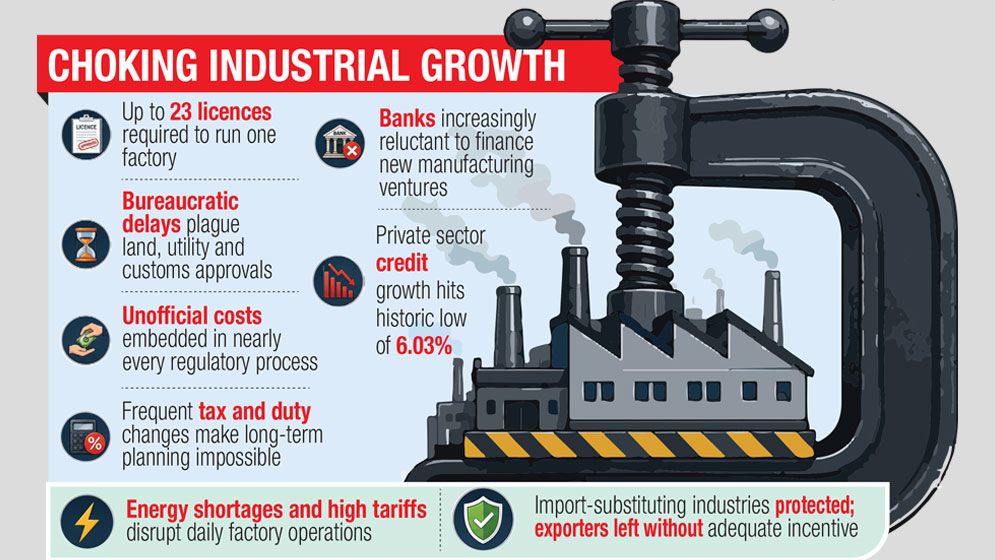
Local industries are buckling under what business leaders and economists are calling an “anti-business culture” – a stubborn mix of bureaucratic overreach, regulatory chaos and rising costs that is quietly strangling investment and industrial growth.
The warning signs are mounting.
Around 400 garment factories have shut over the past three years. Some 65 accessories and packaging units have closed since June 2025 alone.
Private sector credit growth has slumped to a historic low of 6.03%.
And entrepreneurs, particularly small and medium-sized enterprises, say the system increasingly works against them.
“To expand industries and grow the economy, we must create more entrepreneurs. But the current trade licence system remains a major barrier for new entrepreneurs,” said Abul Kasem Khan, former president of the Dhaka Chamber of Commerce and Industry and vice chairman of AK Khan & Company.
He has proposed a shift to a single unified licence and a five-year tax exemption for young entrepreneurs, arguing that trade licence renewals should be as straightforward as paying a utility bill.
Kasem, who also chairs Business Initiative Leading Development (BUILD), pointed out that manufacturers currently require up to 23 separate licences to operate – an administrative burden he described as inexcusable.
“Deregulation is the most effective tool to reduce the grey economy and bring businesses into the formal sector,” he said, noting that nearly half the country’s economy remains informal.
BUILD plans to hold a policy summit later this year to set out private sector priorities for building a trillion-dollar economy.
The complaints are widespread. Industry stakeholders describe a regulatory gauntlet involving land approvals, utility connections, environmental clearances, customs processing and tax compliance – all frequently delayed and laden with unofficial costs.
High interest rates, a surge in non-performing loans and banks’ growing reluctance to finance new manufacturing ventures are tightening the vice further.
In the garments accessories and packaging sector, BGAPMEA president Md Shahriar said the shutdown of 65
factories reflects a severe liquidity crunch, with delays in back-to-back letter-of-credit payments and the recent restructuring of several Islamic banks adding to the sector’s woes. “Expansion has completely stalled,” he said.
The country’s flagship garment industry is faring little better.
BGMEA president Mahmud Hasan Khan cited an acute energy crisis, rising input costs – partly driven by geopolitical tensions in the Middle East – and unpredictable policymaking as key structural threats. Infrastructure bottlenecks and climbing logistics costs are adding to the strain.
Bangladesh Chamber of Industries President Anwar-ul Alam Chowdhury Parvez said the crisis has deep roots.
Working capital shortages that began during the COVID-19 pandemic were then compounded by gas supply disruptions, currency depreciation and weak demand, pushing many firms towards default classification.
He called on Bangladesh Bank to restructure working capital facilities, convert overdue LC obligations into long-term subsidised loans, and bring lending rates down to a more sustainable 11%-12% range.
Economists argue the problems are structural and go beyond any single policy failure.
Dr Zaidi Sattar, chairman of the Policy Research Institute of Bangladesh, identified what he called an “anti-export bias” baked into industrial policy – import-substituting industries enjoy substantially higher protection than exporters receive in incentives, a distortion he said has contributed to stagnation in non-garment export sectors.
Currency depreciation and tariff structures have compounded matters by hiking import costs and undermining competitiveness.
Dr M Masrur Reaz, chairman of Policy Exchange Bangladesh, urged a joined-up export-led growth strategy cutting across trade, investment, tax and industrial policy.
“Relying on high tariff protection is not a strategy,” he said, calling for stronger institutional coordination, with investment growth, consumer welfare and export diversification placed at the centre.
Experts across the board are pushing for sweeping institutional reform: an independent commercial judiciary, full digitisation of licensing, taxation, customs and land systems, and strict deadlines for regulatory approvals.
They also want discretionary administrative powers curtailed and stronger accountability mechanisms introduced.