




 For all latest news, follow the Daily Sun's Google News channel.


Incessant monsoon rains and a ferocious upstream surge since late April have submerged Boro paddy fields across the country’s northeastern haor region, destroying crops on more than 46,730 hectares of farmland and plunging thousands of smallholder farmers into acute distress.
The devastation, which unfolded between 26 April and 2 May, has consumed 10.27% of the region’s total Boro paddy fields across seven districts, according to the Department of Agriculture Extension.
Sunamganj bore the single largest absolute loss, with 14,371 hectares – roughly 8.70% of its paddy fields – going under water, followed closely by Netrokona at 11,522 hectares, the worst-affected district by proportion at a staggering 28.06%.
Kishoreganj lost 9,045 hectares (8.65%), Habiganj 8,750 hectares (18.64%), Moulvibazar 2,160 hectares (7.90%), Sylhet 510 hectares (1.36%), and Brahmanbaria 372 hectares (1.15%).
Agriculture Minister Mohammad Amin Ur Rashid sought to temper alarm, saying that roughly 80% of the region’s paddy had already been harvested before the flooding struck, and that his ministry had pre-positioned harvesting machines, labourers, and hired trucks to rush workers to areas facing shortages.
“Some crops have been damaged, but Alhamdulillah, it is not a large amount – I can assure you of that,” the minister said.
He added that the prime minister had authorised government support for affected farmers over the next three months.
For the farmers who lost what little remained in the fields, however, the damage is anything but negligible — and agro-economist Dr Jahangir Alam warned that the wider consequences for the country’s food supply should not be understated.
“This season, higher irrigation and paddy costs had already burdened Boro cultivation, and the flooding in the haor and surrounding areas may have reduced total Boro production by around 10%,” he said.
Dr Jahangir Alam nonetheless cautioned against panic-driven imports, arguing that rice shipments exceeding one million tonnes would be unnecessary, though a measured volume of imports could help curb inflation, bolster Open Market Sales, and stabilise government food assistance programmes.
On a broader meteorological front, the Bangladesh Meteorological Department has warned that one to two low-pressure systems may develop over the Bay of Bengal in May, with at least one potentially intensifying into a cyclone, compounding the anxieties of farming communities already reeling from the floods.
The department further cautioned that a severe heatwave of between 40 and 41.9 degrees Celsius may sweep across the country this month, alongside two to three days of violent thunderstorms with hail – a grim outlook for farmers racing to salvage whatever crops remain.
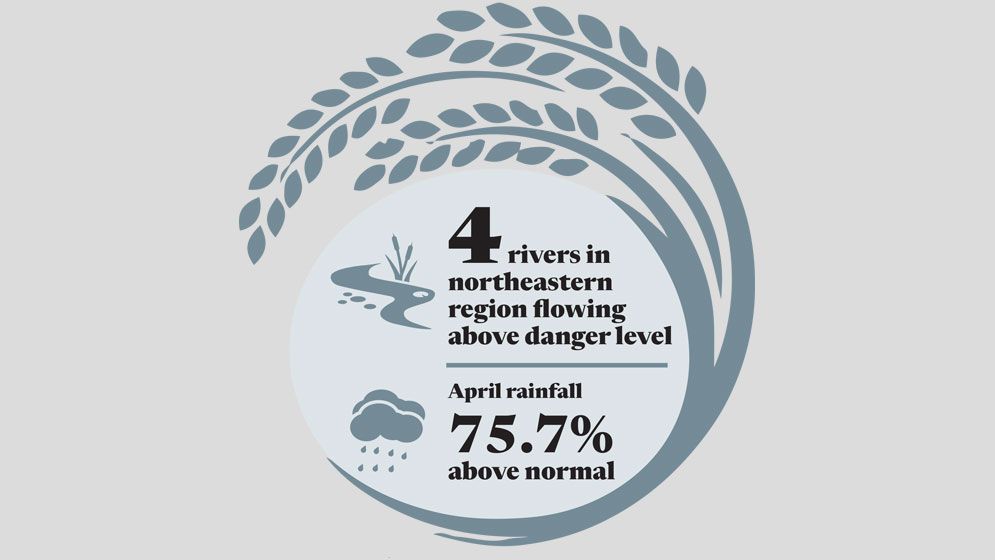
April had already delivered a punishing prelude, with rainfall nationwide running 75.7% above normal, though river levels across the country are expected to stabilise in May barring isolated heavy downpours in the north, northeast, and southeast.
The reporter can be reached at: [email protected]