


 For all latest news, follow the Daily Sun's Google News channel.


US envoy urges swift implementation of trade pact
Energy imports, digital investment emerge as key pillars of deeper Bangladesh-US economic ties
Daily Sun Report, Dhaka
Published: 29 Apr 2026, 12:00 AM
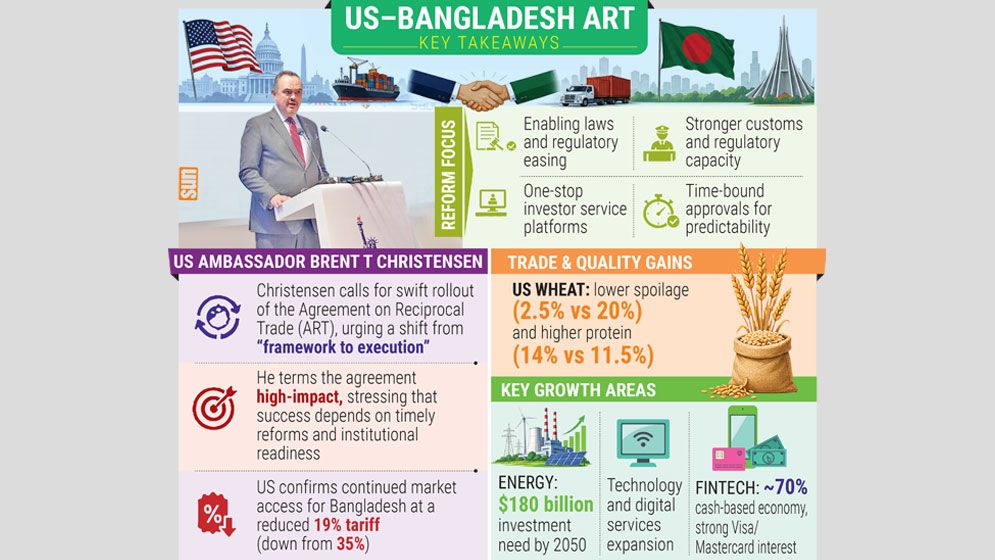
United States Ambassador Brent T Christensen has called for swift and coordinated implementation of the newly concluded Agreement on Reciprocal Trade (ART), urging Bangladesh to move decisively from policy framework to execution to realise its full economic potential.
Describing the pact as a high-impact framework capable of reshaping the country’s trade trajectory, the envoy said its success would depend on timely reforms and institutional readiness.
Speaking at a high-level luncheon and policy dialogue hosted by the American Chamber of Commerce (AmCham) in Dhaka on Tuesday, Christensen said the ART ensures continued access for Bangladeshi exports to the US market at a competitive 19% tariff, reduced from 35%, while laying the foundation for a more balanced bilateral trade relationship.
The agreement, concluded on 9 February 2026, has sparked debate in Bangladesh, with critics raising concerns over asymmetry and long-term economic balance.
‘Now we need action’
Shifting focus from negotiation to implementation, the ambassador said the real benefits of the agreement would only materialise through coordinated execution.
“We have a strong framework. Now we need action,” he said, stressing that policy implementation and administrative efficiency would determine outcomes on the ground.
He outlined five priority actions for Bangladesh: enacting enabling legislation to operationalise the ART, removing regulatory bottlenecks that discourage investment, strengthening customs and regulatory capacity to handle higher trade volumes, establishing one-stop service platforms for investors, and introducing time-bound approval mechanisms to improve predictability.
Reaffirming Washington’s commitment, Christensen said the United States was ready to invest and collaborate throughout the implementation phase.
Calling for greater private sector engagement, he added: “I encourage you to reach out, to share challenges, and to work with us on finding and implementing solutions.”
Trade, energy and long-term commitments
Christensen said the agreement was grounded in commercial fundamentals rather than aid dependency.
Under its provisions, Bangladesh has committed to purchasing US$3.5 billion worth of US agricultural commodities, including wheat, soybeans, cotton and corn.
“Quality matters,” he said, noting the higher protein content and lower spoilage rates of US wheat.
He said wheat imported by Bangladesh’s Ministry of Food from other sources had recorded spoilage rates as high as 20%, compared with 2.5% for US wheat. Protein content, he added, had increased from 11.5% to 14%. “I call that high value, and I’m proud that Bangladeshis will be able to enjoy high-quality US agricultural commodities as a result of this agreement,” he said.
He also highlighted Bangladesh’s commitment to import $15 billion worth of US energy products over 15 years, adding that rising domestic demand could push actual imports beyond the projected target.
Energy and technology as growth drivers
The envoy identified energy and technology as two strategic pillars for deeper bilateral cooperation.
With Bangladesh projected to require around $180 billion in energy investment by 2050, he noted the significant role already played by US firms such as Chevron, Excelerate Energy and GE Vernova in supporting national power supply and infrastructure.
On the digital economy, Christensen cited Bangladesh’s growing connectivity base, more than 100 million internet users and 160 million mobile subscribers, as a strong platform for growth in advanced services.
He said major US companies, including Starlink, Google Pay, Oracle, Microsoft and Augmedix, were expanding their footprint in Bangladesh, creating opportunities in digital infrastructure, e-commerce and high-value employment.
He also pointed to strong potential in financial technology, noting that nearly 70% of transactions in the country remain cash-based.
“American companies like Visa and Mastercard see massive potential in Bangladesh’s financial services sector,” he said, adding that wider digital access to financial services could transform economic participation.
“When people can access financial services digitally, small businesses can expand across borders, farmers can access credit, and families can save and invest more effectively.”
He added that stronger digital financial systems would make the country’s financial ecosystem “more modern, more efficient, and more secure,” while enabling broader economic inclusion.