


 For all latest news, follow the Daily Sun's Google News channel.


Govt, opposition unite in rare move to tackle energy crisis
Daily Sun Report, Dhaka
Published: 24 Apr 2026, 12:00 AM
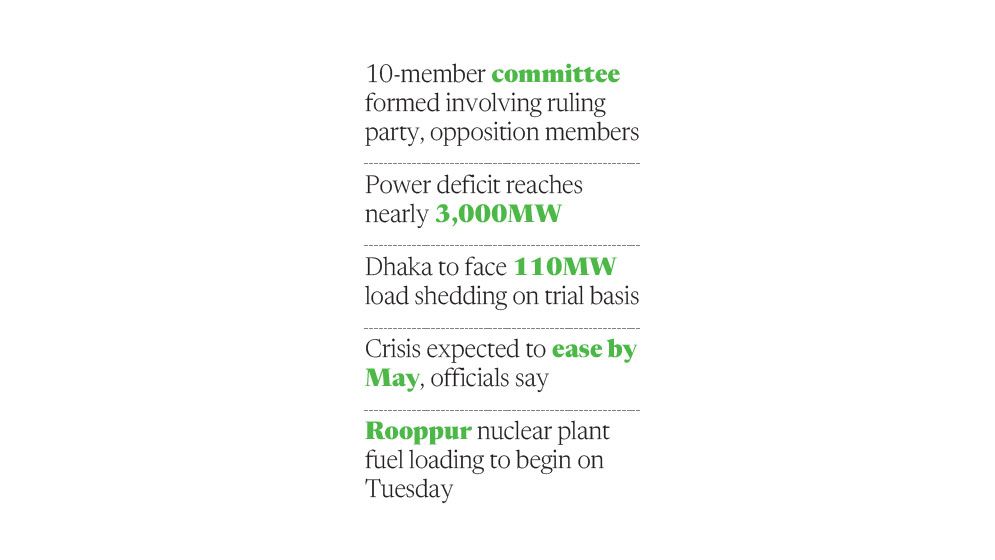
Bangladesh’s parliament witnessed an unusual show of consensus on Thursday as the government and opposition agreed to form a high-powered 10-member parliamentary committee to tackle the country’s worsening energy crisis, triggered largely by global fuel disruptions linked to the US-Iran tensions and wider Middle East instability.
Taking the floor in parliament, Prime Minister and BNP Chairman Tarique Rahman announced the proposal to establish a joint committee comprising equal representation from the ruling party and opposition, with Energy Minister Iqbal Hassan Mahmood Tuku as chair.
“We decided to form the committee with 10 members, with five members each,” he said, adding that “BNP is ready to sit across the table with anyone to discuss any issue for the sake of the people.”
He said the initiative came in response to a proposal from Bangladesh Jamaat-e-Islami Ameer and Leader of the Opposition Dr Shafiqur Rahman, who had earlier urged the government to take “visible and effective steps” to address the fuel and electricity shortages affecting citizens nationwide.
The prime minister named five representatives from the ruling side: Energy Minister Iqbal Hassan Mahmood Tuku, State Minister for Energy Aninda Islam Amit, Lakshmipur-4 MP ABM Ashraf Uddin, Manikganj-2 MP Moinul Islam Khan, and Shariatpur-3 MP Miah Nuruddin Ahmad Apu.
He also urged the opposition to submit its nominations immediately so the committee could begin work without delay.
“These ten individuals will be able to sit together and discuss the issues. If there are any suggestions, those will reach the government through this committee, and if the government finds any of them realistic, it will certainly take steps to implement them,” he said.
Dr Shafiqur Rahman welcomed the initiative, calling it a positive political development.
“We hope the parliament will become the centre for resolving all national problems. This marks a new journey for the House, and we will soon submit names,” he said.
Hours later, the opposition submitted its proposed list, naming Jamaat MPs Saiful Alam (Dhaka-12), Abdul Baten (Dhaka-16), and Nurul Islam (Chapainawabganj-3), alongside NCP MP Hasnat Abdullah (Cumilla-4) and Khelafat Majlish MP Mohammed Abul Hasan.
Parliament Speaker Hafiz Uddin Ahmad welcomed the development, saying cooperation between political parties could resolve even the most difficult national challenges.
“Your speeches have generated significant hopes and aspirations among the people… if the government and the opposition continue to move forward in such a spirit of cooperation, it would be possible to resolve any problem of the country,” he said, expressing hope that the opposition would soon finalise its nominees as Parliament is set to be prorogued at the end of the month.
Power crisis deepens amid fuel disruptions
While political consensus is being forged, the country’s energy situation remains under severe strain.
Officials from the Power Division said the crisis has reached its worst level due to rising demand and disruptions in LNG imports caused by instability in the Middle East and concerns around the Strait of Hormuz.
At a press briefing in Dhaka, Joint Secretary (Planning-1) Umme Rehana said the situation has worsened significantly this summer.
“We usually face load shedding crisis in summer, but this year load shedding is a bit higher because of the Middle-East war and closure of the Strait of Hormuz,” she said.
She noted that current demand stands at nearly 17,000MW, while generation is around 14,000MW, leaving a deficit of approximately 3,000MW. On Wednesday, demand reached 15,767MW against generation of 13,681MW.
In another update, officials said demand had also peaked at around 16,000MW with generation at 14,126.35MW, leaving a shortfall of 2,086MW.
State Minister for Power, Energy and Mineral Resources Anindya Islam Amit told Parliament that the government has been forced to introduce “experimental load shedding” in Dhaka to manage the shortfall.
He said the measure aims to ensure uninterrupted electricity for irrigation while also reducing disparities between urban and rural areas.
The government expects the situation to improve by May as alternative fuel sourcing and increased generation come online. “Increasing production and fuel sourcing from alternative markets could help reduce load shedding in the coming weeks,” Umme Rehana said.
She also highlighted structural constraints, noting that gas remains the dominant fuel source, generating 12,154MW – around 43% of total electricity. However, supply limitations persist.
“If they could have given us 1,200 mmcfd of gas, then we could produce 7,200MW of electricity at a lower cost. But they can give us only 850 to 900 mmcfd of gas,” she explained.
Hydropower contributes only 230MW, roughly 1% of total generation.
Rooppur nuclear project reaches key milestone
Amid the ongoing energy crunch, Bangladesh’s first nuclear power project is entering its final pre-commissioning stage.
The Rooppur Nuclear Power Plant is set to begin fuel loading for Unit-1 on 28 April, following approval from the Bangladesh Atomic Energy Regulatory Authority (BAERA).
Officials confirmed that after extensive safety reviews, the commissioning licence has been issued, marking a critical milestone in the country’s energy diversification efforts.
A senior project official said the first unit, with a capacity of 1,200MW, is expected to begin supplying electricity to the national grid at around 30% capacity approximately four months after fuel loading.
Output will gradually increase, with full commercial operation expected within 10 months, once all safety and performance tests are completed.