


 For all latest news, follow the Daily Sun's Google News channel.


FY27 budget under fiscal strain
GOVT SCRAMBLES FOR FUNDS AS RISING DEFICIT, WEAK REVENUES CONSTRAIN CHOICES

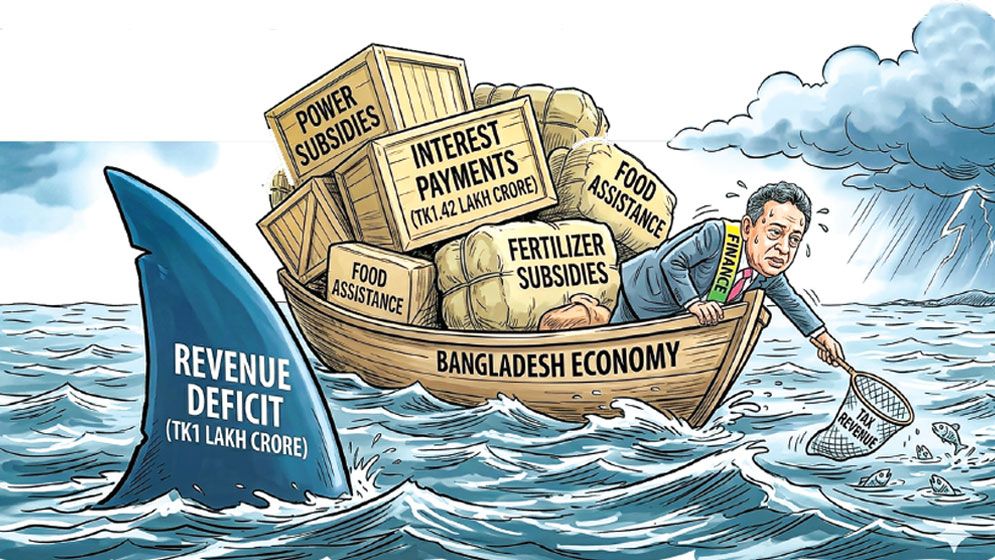
Amid mounting economic pressure, a widening revenue deficit and tightening conditions from international lenders, the government is preparing an ambitious national budget for the 2026–27 fiscal year.
Initial projections from the Finance Division put the proposed budget at around Tk9,30,000 crore, with a deficit of approximately Tk2,35,000 crore.
The scale of the deficit has intensified concerns over how the government will mobilise funds in an increasingly constrained economic environment.
Officials say pressure from external debt repayments, weak revenue collection, high inflation and prolonged stagnation in investment have significantly narrowed fiscal space. As a result, borrowing has become the primary tool to bridge the gap.
The government plans to borrow about Tk119,000 crore from domestic sources and Tk1,16,000 crore from external sources, an increase of roughly Tk35,000 crore, or 17.5%, compared to the current fiscal year.
To reduce the burden of high-interest domestic borrowing, policymakers are increasingly turning to foreign loans, with external borrowing expected to rise by more than 84%.
Economists warn that rising debt, IMF-linked conditions and volatility in the energy market have placed the economy in a complex position, requiring disciplined fiscal management and structural reform.
Talking to the Daily Sun, Dr Zahid Hussain, a former lead economist, said borrowing alone would not be sufficient to manage the situation.
He stressed the need for a clear assessment of balance-of-payments pressures and the broader macroeconomic framework.
He noted that rising import costs, slowing export earnings and risks to remittance inflows are intensifying pressure, while revenue shortfalls, subsidies and increased social spending are adding further strain.
He also cautioned that tightening development spending could slow economic activity, at a time when growth has already weakened in recent months. Structural reforms, he said, are becoming increasingly urgent.
The economist emphasised expanding the tax net, modernising the tax system, ensuring transparency and taking firm action against tax evasion.
He also highlighted the need to create an investment-friendly environment, prioritise essential spending, reduce wasteful expenditure and improve the efficiency of external debt management.
Echoing similar concerns, Dr Mustafizur Rahman, distinguished fellow at the Centre for Policy Dialogue, said that avoiding a debt trap must remain a key priority.
“While borrowing is necessary under current pressures, the focus should be on strengthening revenue mobilisation,” he added.
Rising pressure of external debt repayment
The burden of external debt repayment is emerging as a major risk.
According to the Economic Relations Division, Bangladesh received $3.05 billion in loans and grants between July and February, while repaying about $2.9 billion during the same period.
Total external debt servicing is now projected to reach $4.7 billion in the current fiscal year, exceeding earlier estimates.
A Finance Division report noted that repayment pressure will continue to rise due to maturing loans, currency depreciation and the expiry of grace periods.
The weakening of the taka against the US dollar has further increased repayment costs in local currency terms, the report added.
Major budget share to go for interests, subsidies
A significant share of the upcoming budget is expected to go towards interest payments, subsidies and incentives.
Around Tk259,000 crore, nearly 27.85% of the total budget, is likely to be allocated to these sectors.
Interest payments alone may reach Tk142,000 crore, including Tk115,000 crore for domestic debt and Tk27,000 crore for external obligations. Subsidy allocations are also projected to remain high, with Tk37,000 crore for electricity, Tk6,500 crore for LNG, Tk27,000 crore for fertiliser and Tk9,600 crore for food assistance programmes.
Revenue shortfall another constraint
Revenue shortfall remains one of the most pressing constraints.
According to the latest data, the National Board of Revenue recorded a deficit of nearly Tk100,000 crore in the first nine months of the current fiscal year, the highest on record, surpassing last year’s full-year shortfall of Tk92,626 crore.
To meet rising expenditure, the government has increasingly relied on bank borrowing. Between July and early April, borrowing from the banking system reached Tk112,761 crore, exceeding the annual target.
With fiscal pressures mounting on multiple fronts, economists say the success of the upcoming budget will depend not only on its size, but on the credibility of reforms and the government’s ability to restore balance to the economy.