


 For all latest news, follow the Daily Sun's Google News channel.


Energy-saving appliance demand surges amid power crisis
Bangladesh’s home appliance market, estimated at around Tk30,000cr annually, is seeing strong competition among local and global brands

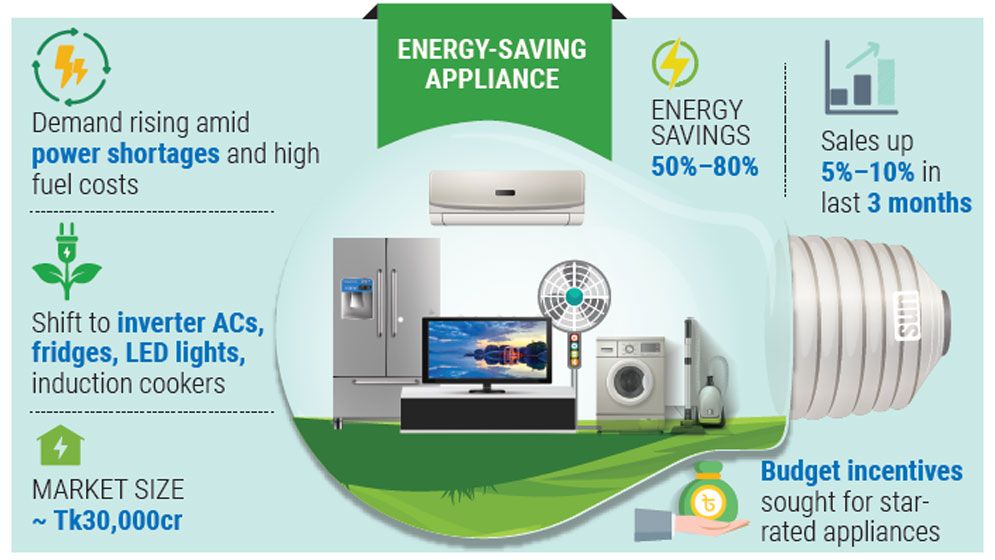
As power cuts stretch longer and fuel costs climb higher, a quiet transformation is underway in Bangladeshi homes: energy-saving appliances are no longer a luxury – they are becoming essential.
From inverter air conditioners to induction cookers and solar-powered home systems, households and businesses are rapidly embracing power-efficient technologies to cope with rising electricity shortages and soaring gas and fuel prices.
Retailers and manufacturers say the shift has accelerated in recent months, turning what was once a niche, premium segment into one of the fastest-growing areas in the consumer market.
The industry insiders said people are no longer buying these products for comfort alone, they are buying them to survive the energy crisis.
A market reshaped by crisis
Bangladesh’s energy challenges are not new, but they have deepened amid volatile global fuel markets.
Fresh geopolitical tensions in the Middle East, including the US and Israel’s attack on Iran on 28 February, have added new uncertainty to global energy supplies, pushing prices higher.
Against this backdrop, consumers are making more calculated choices.
Appliances with inverter technology, smart energy controls and eco-friendly designs are now in high demand, as buyers focus on long-term savings rather than upfront costs.
The country’s home appliance market – estimated at around Tk30,000 crore annually – is seeing strong competition among local and global brands such as Walton, Vision Electronics, Minister Hi-Tech Park, Singer Bangladesh, Samsung and LG, all racing to expand their energy-efficient product lines.
Inverter technology takes centre stage
For manufacturers, inverter technology has become the key selling point.
PRAN-RFL Group Director (Marketing) Kamruzzaman Kamal said energy efficiency is now embedded in nearly all of the company’s appliances.
“Our smart appliances are designed to consume less power while delivering better performance. This is no longer optional—it’s what customers expect,” he said.
According to him, products like washing machines, induction cookers and rice cookers can cut energy costs by up to 50%.
The catch, however, remains the upfront cost.
“Many customers hesitate at first, but once they understand the long-term savings, the decision becomes easier,” Kamal added.
Walton Hi-Tech Industries PLC Chief Business Officer Zoheb Ahmed said the company’s inverter-based appliances can reduce electricity use by as much as 70% to 80%.
He attributed growing demand not only to energy savings but also to added features such as AI and IoT integration, improved durability and strong after-sales service.
At Minister Hi-Tech Park Electronics, sales are already reflecting the shift.
“Our inverter ACs can save around 75% electricity, and despite slightly higher prices, demand is rising steadily,” said Md Jual Rana, manager (Brand Marketing & Communications).
He noted that a 1.5-tonne inverter AC, priced at about Tk48,900, can run for under Tk1,000 a month in electricity if used eight hours daily, an increasingly attractive proposition for cost-conscious consumers.
Sales of such products have grown by 5% to 10% in just the past three months, he added.
From gas to electric
The shift is not limited to cooling appliances. In kitchens, too, change is underway.
With LPG prices rising and supply often unreliable, many households are moving to electric cooking solutions.
Ayesha Khanom, a resident of Demra, said she recently abandoned LPG for an induction cooker.
“We pay Tk2,100 to Tk2,200 for a 12kg cylinder, even though the official price is lower, and still don’t get it on time,” she said. “Switching to electric was the only option.”
Calls for policy support
Industry leaders say the momentum could be even stronger with the right policy backing.
With the national budget for the 2026-27 fiscal year set to be announced on 11 June, stakeholders are urging the government to introduce incentives for energy-efficient appliances, making them more affordable for a wider population.
Habib Bhuyian, country manager of Excelerate Energy, warned that continued reliance on expensive spot LNG could strain the economy.
He called for a broader demand-side strategy, including incentives for star-rated appliances, staggered office and school hours, and standardisation of e-rickshaws alongside solar-powered battery systems.