





 For all latest news, follow the Daily Sun's Google News channel.


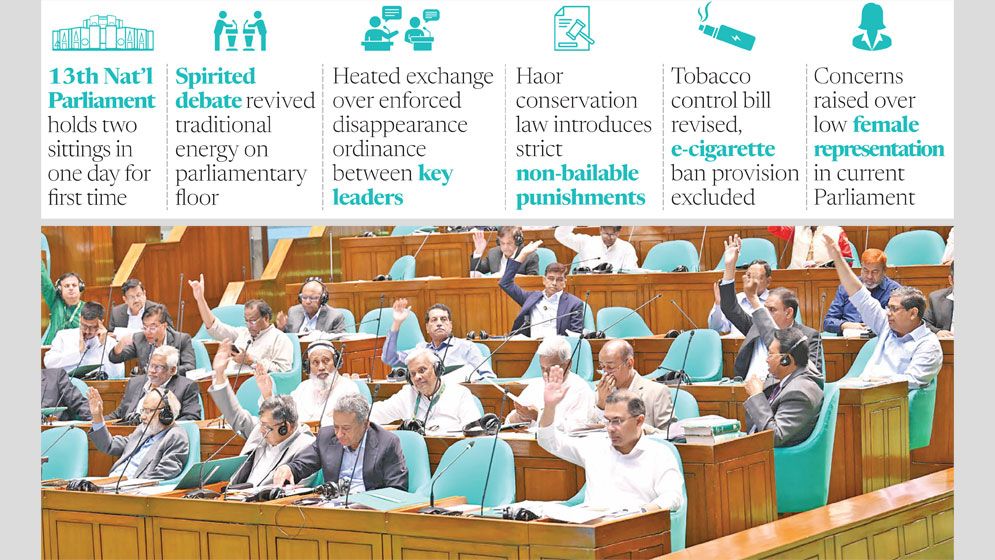
The national parliament witnessed unusually vibrant and energetic proceedings on Tuesday, as members from both treasury and opposition benches engaged in spirited debate on the President’s address, signalling a revival of traditional parliamentary dynamism.
For the first time in the current 13th Parliament, two sittings were held in a single day – one beginning after 10:30am and another after 3:30pm – in a bid to meet constitutional obligations to convert ordinances issued during the tenure of the Prof Muhammad Yunus-led interim government into permanent legislation.
The sessions were marked by sharp exchanges, constructive criticism and an intense legislative drive. In total, 14 bills were passed unanimously in a single day – an unprecedented pace – bringing the total number of ratified ordinances to 22 so far in the ongoing session.
Legislative momentum gathers pace
The House passed eight bills during the first sitting and six more in the second, all through voice votes and without amendments or extended debate.
Among the key pieces of legislation adopted were the Bangladesh Haor and Wetland Conservation Bill, 2026; the International Crimes (Tribunals) (Amendment) Bill, 2026; the Public Procurement (Amendment) Bill, 2026; and the Code of Criminal Procedure (Amendment) Bill, 2026.
Additional measures included amendments relating to civil courts, registration laws and several medical universities, alongside the Commercial Court Bill, 2026 and legislation concerning energy supply and rural development academies.
Ministers from across portfolios presented the bills, including Water Resources Minister Shahiduddin Chowdhury Anee and Law Minister Md Asaduzzaman.
In the absence of the health minister, Home Minister Salahuddin Ahmed tabled several health-related bills, before Health Minister Sardar Md Sakhawat Husain later joined proceedings.
Finance Minister Amir Khosru Mahmud Chowdhury, Energy Adviser Iqbal Hasan Mahmud Tuku and State Minister for Local Government Mir Shahe Alam presented further bills during the afternoon sitting.
Officials indicated that additional sittings, including on Friday, if required, may be convened to ensure all ordinances are processed within the stipulated timeframe.
Debate on President’s address
Members from both sides participated in the debate on the thanksgiving motion, including BNP MPs Md Kamruzzaman Ratan, Abu Sayeed Chand, Rafiqul Islam Jamal and Md Jalal Uddin, alongside representatives from Jamaat-e-Islami, Khelafat Majlis and independent MP Rumeen Farhana.
While treasury bench members praised the President’s speech, opposition MPs refrained from doing so, instead highlighting local development concerns and governance issues affecting their constituencies.
Tobacco law revised
The ‘Smoking and Tobacco Products Usage (Control) (Amendment) Bill, 2026’ was tabled in revised form, reflecting recommendations from a 13-member parliamentary committee tasked with reviewing 133 ordinances.
Significantly, the revised bill excludes provisions that would have banned e-cigarettes and emerging tobacco products – measures originally included in the 2025 ordinance issued on 30 December.
The ordinance had introduced stricter regulations, including expanding the definition of public places, banning tobacco sales within 100 metres of schools and hospitals, increasing fines for public smoking from Tk300 to Tk2,000, and mandating 75% graphic health warnings on packaging. The committee recommended retaining 98 ordinances without change while proposing amendments to others.
Freedom fighters ordinance sparks dissent
Another revised ordinance – the National Freedom Fighters Council (Amendment) Ordinance, 2025 – was placed despite a formal note of dissent from opposition members of Jamaat-e-Islami on the review committee.
The ordinance redefines the term “freedom fighter” (Bir Muktijoddha) and introduces new categories, including associates of the Liberation War and their families.
Despite objections, the government signalled its intention to proceed with the measure.
Heated exchange over enforced disappearance law
Tensions escalated during discussion of the International Crimes (Tribunals) amendment, when Law Minister Md Asaduzzaman referenced the government’s plan to repeal the Enforced Disappearance Prevention and Redress (Amendment) Ordinance, 2025.
He argued that enforced disappearance had already been incorporated into the definition of crimes against humanity, urging opposition members to scrutinise the bill carefully.
This prompted a sharp response from Opposition Leader Shafiqur Rahman, who raised a point of order, stating: “We would speak on the Enforced Disappearance Prevention and Redress (Amendment) Ordinance in the appropriate time when it comes.”
In reply, the minister defended his remarks, saying questions had been raised outside Parliament regarding the government’s commitment to prosecuting such crimes.
Speaker Hafiz Uddin Ahmad intervened, reminding members to confine their comments to parliamentary proceedings and avoid being influenced by external discourse.
Stronger protections for haors and wetlands
The Bangladesh Haor and Wetland Conservation Bill, 2026 introduces stringent penalties—including up to two years’ imprisonment or fines of up to Tk10 lakh—for offences involving the destruction or misuse of wetlands.
Crucially, offences under the law are designated as cognisable, non-bailable and non-compoundable.
The legislation also empowers the government to declare protected areas and mandates consultation with relevant authorities and stakeholders before such declarations. Development projects affecting haors must now obtain approval from the Haor and Wetland Development Department.
Procurement reforms retained
The Public Procurement (Amendment) Bill preserves key reforms introduced in May 2025, including mandatory electronic government procurement (e-GP), removal of the 10% price cap on tenders, and disclosure requirements for beneficial ownership.
Concerns over representation and governance
In her address, Barrister Rumeen Farhana offered a personal reflection, thanking her party for not nominating her in the last election.
“Now I realise how many people from Teknaf to Tetulia stood by me with love, prayers and support. If I had contested within a party boundary, I would not have had the opportunity to understand this,” she said.
She also raised concerns about the balance of power between the President and Prime Minister and expressed frustration over the low number of women directly elected to Parliament.
“Women were at the forefront of the 2024 mass uprising. But why aren’t those women in this Parliament?” she asked.
Farhana further criticised the appointment of individuals with political affiliations to key institutional roles, including the governor of Bangladesh Bank and vice-chancellors of public universities.
Historical claims and protests
Mufti Mohammad Abul Hasan of Sylhet-5 claimed that Zakiganj and Kanaighat upazilas were the first and second liberated areas of the country during the 1971 Liberation War, calling for official recognition of their status.
He stated that Zakiganj was liberated on 21 November 1971 under the leadership of Ziaur Rahman, followed by Kanaighat on 22 November.
Meanwhile, remarks by State Minister Mir Shahe Alam triggered protests from opposition MPs after he credited BNP with key historical milestones, including 1971, 1990 and 2024, while criticising Jamaat-e-Islami.
Opposition members demanded that what they described as “false” statements be expunged from the record.
The Speaker again intervened, urging members not to disrupt proceedings and to present their arguments in an orderly manner.
The reporters can be reached at: [email protected] and [email protected] Recommended Stories