



 For all latest news, follow the Daily Sun's Google News channel.


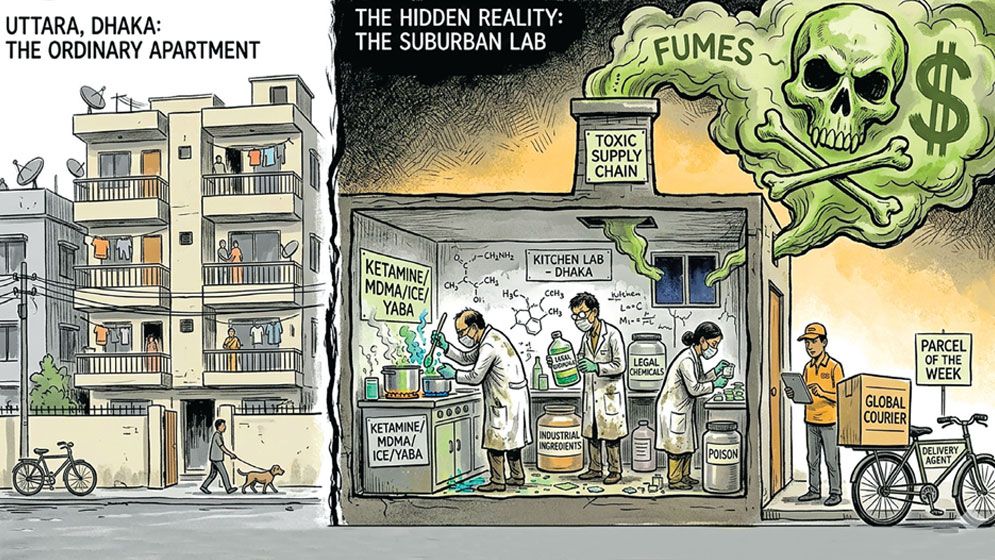
Bangladesh’s long-standing struggle against narcotics has reached a critical turning point as international syndicates shift from traditional cross-border smuggling to establishing domestic manufacturing hubs.
Law enforcement officials warn that the country – once primarily a transit corridor for illicit substances – is now grappling with a surge in “kitchen labs” and a sophisticated digital marketplace that has made synthetic drugs more accessible than ever before.
Senior officers from the Department of Narcotics Control (DNC) and the police suggest that this shift represents a fundamental change in the local drug trade.
Rather than relying solely on shipments from abroad, foreign nationals, acting in collusion with local syndicates, are increasingly producing narcotics within the country for both domestic consumption and international export.
Since 2019, the DNC and the Rapid Action Battalion (RAB) have dismantled a series of makeshift laboratories across the capital and its fringes.
Notable raids include operations in Uttara on 25 March and 19 February this year, as well as busts in Vatara and Wari in January. Earlier precedents were set by discoveries in Uttara in June 2021 and Jigatola in March 2019.
These facilities have been found producing a dangerous cocktail of synthetic substances, including Ketamine, MDMA, Crystal Meth (Ice), Kush, and Yaba.
Speaking on condition of anonymity, a DNC deputy director told the Daily Sun that intelligence suggests further labs are operational in Savar and Gazipur.
“We are currently gathering precise intelligence on these locations before moving in to conduct raids,” the officer stated.
The challenge for authorities is compounded by the nature of the ingredients used. “Some raw materials for synthetic drugs are easily obtainable as they are classified as legal industrial chemicals,” another DNC official explained.
“This allows producers to operate under the radar without triggering traditional oversight.”
The digital frontier
The evolution of the trade is not limited to manufacturing; the marketplace has also moved into the shadows of the internet.
DNC Director General Hasan Maruf highlighted a recent case involving three Chinese nationals arrested in Uttara on 25 March.
The trio had allegedly established a lab to convert liquid Ketamine into powder form, which was then smuggled abroad via courier services. To evade the financial trail, they reportedly processed payments in cryptocurrency via the “TRON” network.
Sources within the DNC noted that international syndicates are increasingly bypassing physical street corners in favour of encrypted apps and social media platforms. These “invisible markets” provide a layer of anonymity that traditional policing struggles to pierce.
“Online sales have now overtaken face-to-face transactions,” an Assistant Director of the DNC observed. “The combination of domestic labs and digital storefronts is making drugs more accessible than ever, leading to a visible spike in addiction rates.”
A growing health crisis
The human cost of this shift is stark. A study published in January by Bangladesh Medical University (BMU) estimates that 8.2 million people in the country now use illicit drugs.
The data shows that the majority of users are young, with an average monthly spend of approximately Tk6,000 per person.
Crime analyst Dr Md Tawohidul Haque argues that while the government frequently touts a “zero tolerance” policy, the reality on the ground tells a different story.
“The most critical factor is stopping the easy availability of these substances,” Dr Tawohidul said, adding, “We hear the rhetoric of zero tolerance, but its full implementation is lacking.
Consequently, dealers and their sponsors are exploiting every available technique, both offline and online, to expand their reach.”
In response to these criticisms, AHM Shahadat Hossain, assistant inspector general (AIG) at Police Headquarters, insisted that the force remains resolute.
“The police are adamant in their zero-tolerance stance against narcotics,” he said. “We are maintaining a strict vigil on emerging drug trends and are committed to taking firm legal action against anyone involved in this trade.”