


 For all latest news, follow the Daily Sun's Google News channel.


Bangladesh gains in US market, but rivals gain faster
Tariffs, rising costs, and global tensions threaten apparel sector’s next phase of growth

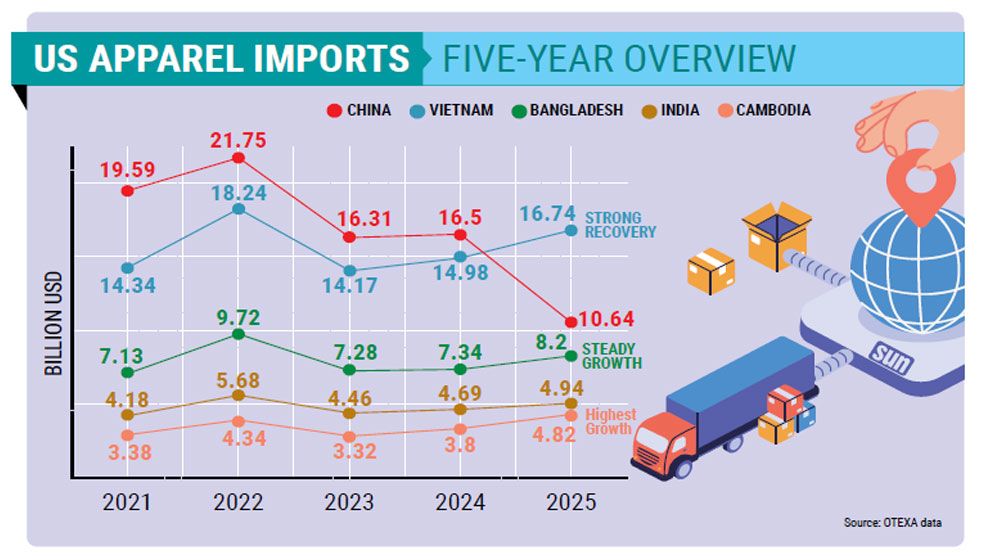
Bangladesh’s garment exports to the United States grew by nearly 15% over the past five years, supported by low labour costs, large-scale production capacity, and the ongoing US-China tariff tensions.
However, competitor countries expanded faster, with Cambodia posting a 42.6% increase, followed by India (18%) and Vietnam (16%) over the same period.
Trade analysts and industry insiders say Bangladesh remains well-positioned to strengthen its foothold in the US apparel market, provided it ensures supportive policies, strategic negotiations with Washington, and continued industry upgrades.
They also urged the government to engage effectively with US authorities, as Washington has launched a fresh trade investigation into Bangladesh and several other economies to examine policies, production practices, and labour conditions.
Experts further stressed the importance of strengthening the domestic market, warning that the ongoing geopolitical tensions in the Middle East could significantly disrupt global trade and economic stability.
Export growth, but rivals move faster
Bangladesh’s apparel exports to the US rose by 14.9%, from US$7.1 billion in 2021 to $8.2 billion in 2025, according to data from the Office of Textiles and Apparel (OTEXA).
The country is now the third-largest apparel exporter to the US, after Vietnam and China.
Unit prices of Bangladeshi garments increased by 12.65% during the period. However, export volumes showed a slight decline, falling from 2.66 billion square metre equivalents (SME) in 2021 to 2.61 billion SME in 2025.
Meanwhile, Cambodia recorded a 42.58% rise in export value, followed by India (18%), Vietnam (16%), Indonesia (12.42%), and Pakistan (8.04%).
Unit prices also increased across competitors, by 12.41% in Cambodia, 5.77% in India, 8.54% in Vietnam, 7.74% in Indonesia, and 13.84% in Pakistan.
In contrast, China’s apparel exports to the US declined sharply by 45.69% over the same period, with export value dropping from $19.6 billion in 2021 to $10.6 billion in 2025. Unit prices of Chinese products also fell by 10.72%.
Strategic negotiation key to export boost
Mohiuddin Rubel, managing director of Denim Expert Ltd and a former director of the Bangladesh Garment Manufacturers and Exporters Association (BGMEA), said Bangladesh’s performance in the US market has been moderate over the past five years.
“Owing to reciprocal tariffs imposed during Donald Trump’s presidency, exports faced pressure. Otherwise, shipments could have grown further. In fact, exports have shown a negative trend over the past six months due to tariffs and the broader economic situation in the US,” he told Daily Sun.
He noted that Bangladeshi exports currently face a 10% tariff in the US market under 122 section, and the ongoing US investigation under the section of 301 has created additional uncertainty.
“However, the outcome of the investigation could be either positive or negative, depending on Bangladesh’s negotiation strategy. Smart and effective negotiations could help reduce tariffs and boost exports,” he added, urging the government to take carefully calibrated decisions in light of evolving trade dynamics.
On 20 February, the US Supreme Court struck down tariffs imposed in 2025, prompting the administration to introduce a temporary 10% tariff for 150 days while reviewing its trade policy.
Earlier, on 12 March, the US initiated forced labour investigations covering 60 trading partners, including Bangladesh.
Bangladesh and the US also signed a trade agreement on 9 February, 2026, under which the reciprocal tariff on Bangladeshi exports was reduced slightly to 19% from 20%.
Domestic market gains importance
Rubel said Bangladesh had been aiming to expand exports to non-traditional markets, including the Middle East, but ongoing conflicts have disrupted those plans.
“We now need to explore alternative markets such as Russia, Africa, and Latin America. The conflict will have global repercussions.
“At the same time, we must strengthen our domestic market. China’s resilience largely comes from its strong local market, and Bangladesh also has that potential,” he said.
According to OTEXA, US apparel imports declined in January 2026, with total import value falling by 13.51% year-on-year to $6.22 billion. Import volumes dropped by 17.09%, although average unit prices rose by 4.31%.
Imports from Bangladesh also saw a slight decline, falling by 0.9% to $791.77 million in January 2026. Unit prices of Bangladeshi products dropped by 2.06% during the same period.
Rising costs add to industry pressure
Industry leaders warn that rising costs and global instability are compounding challenges for Bangladesh’s garment sector.
BGMEA President Mahmud Hasan Khan said export earnings fell by 3.73% in the first eight months of the current fiscal year, while back-to-back letters of credit (LCs) for raw material imports declined by 6.79%. Average garment unit prices also dropped by 1.76%.
“Volatility in global energy markets, rising transportation costs, and supply chain uncertainty have made the situation more complex. Ongoing tensions in the Middle East pose additional risks for export-oriented industries like ours,” he said.
Domestic challenges are also mounting. Over the past five years, gas prices have increased by 286% and electricity prices by 33%, yet uninterrupted energy supply remains elusive.
High interest rates, a liquidity crunch in the banking sector, and shortages of working capital are further straining the industry.
Need for reforms and industry discipline
Jillur Rahman, deputy director of Research and Policy at RAPID, noted that Bangladeshi exporters receive, on average, more than 10% lower prices in the US market compared to the European Union, reflecting differences between preferential and non-preferential trade regimes.
He emphasised the need for Bangladesh to prepare for its post-LDC transition by strengthening institutional capacity, ensuring compliance, adopting advanced technologies, and developing a skilled workforce.
Rahman also called for improving bargaining capacity and eliminating unhealthy practices within the industry to ensure long-term sustainability.
“Exporters to the US, operating under a non-preferential tariff regime, may be more inclined to retain exchange-rate gains rather than pass them on as lower export prices,” he added.
According to the Export Promotion Bureau, bilateral trade between Bangladesh and the US reached $10.9 billion in 2024, with Bangladesh exporting goods worth $8.78 billion.