


 For all latest news, follow the Daily Sun's Google News channel.


Fuel dealers blame policy decisions for supply disruptions
They say the situation worsened after BPC introduced strict fuel distribu-tion policies without consulting stakeholders
Daily Sun Report, Dhaka
Published: 13 Mar 2026, 12:00 AM
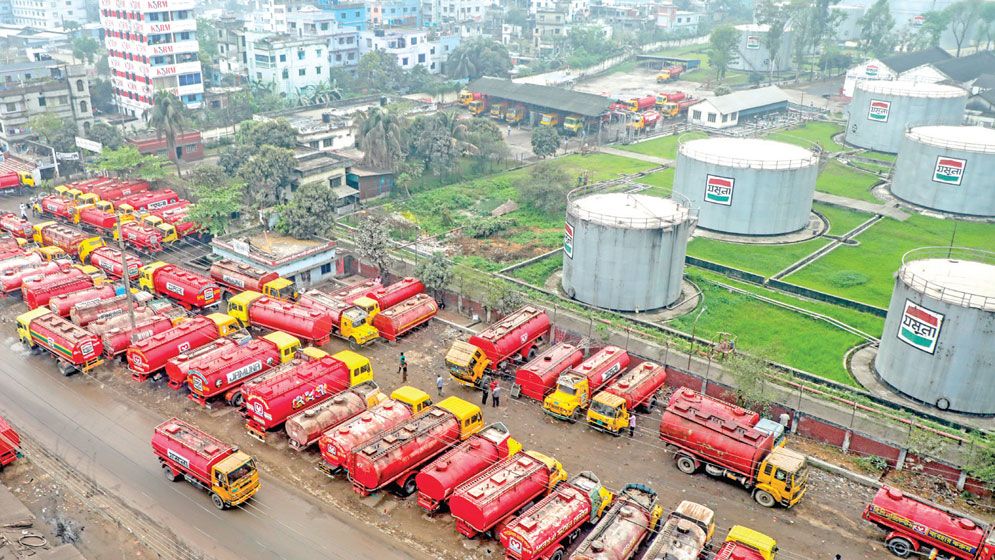
Fuel dealers have blamed bureaucratic complications and restrictive pol-icy decisions for the recent disruptions in fuel supply across the country, saying the situation stems from administrative mismanagement rather than an actual shortage of fuel.
Leaders of the Bangladesh Petroleum Dealers, Distributors, Agents and Petrol Pump Owners Association made the allegation at a press conference in Dhaka on Thursday.
The association said the country currently has adequate fuel stocks but recent policy decisions by the Bangladesh Petroleum Corporation (BPC) have created supply bottlenecks and disrupted the distribution system.
Speaking at the event, the association’s convenor Syed Sazzadul Karim Kabul said there is no shortage of fuel in the country at present.
“Bangladesh has sufficient fuel stocks right now. However, we do not have enough storage capacity to keep additional reserves for emergencies,” he said.
Kabul said several fuel-laden ships are currently waiting outside depots due to limited storage facilities, making it difficult to unload cargo.
“Depot storage facilities are almost full. Therefore, there is no reason for panic regarding fuel availability,” he added.
According to the association, pressure on the supply system began after rumours triggered panic buying among consumers, leading to an unusual surge in demand at petrol stations.
However, dealers said the situation worsened after BPC introduced strict fuel distribution policies without consulting stakeholders.
Kabul said the corporation imposed a quota-based supply system on petrol pumps from last Sunday, cutting fuel allocations by 25% based on previous withdrawal averages.
While the policy may have been intended to conserve national reserves, he argued that it does not reflect the country’s actual demand patterns.
According to the association, BPC calculated the reduction based on the average fuel withdrawals between March and June. Dealers say this benchmark is inappropriate because fuel demand typically declines after the irrigation and dry seasons end.
“In reality, fuel demand is usually higher between January and April. Therefore, using the March-June average to determine current supply is not realistic,” Kabul said.
Dealers also criticised the method used to determine daily quotas. Petrol pumps usually collect fuel from depots up to five days a week, or around 20 to 22 days a month.
However, BPC reportedly divided allocations over 30 days when setting daily limits. As a result, dealers say the effective reduction in supply has been signif-icantly higher than the announced 25%.
They also alleged that supply to agents and pack points has been reduced by about 20%, meaning the total volume of fuel entering the market has effectively declined by around 45%.
The association further claimed that BPC imposed daily supply limits not only on petrol pumps but also on the country’s state-run oil marketing companies, Padma Oil Company, Meghna Petroleum and Jamuna Oil Company.
Dealers said strict daily limits have made it difficult to meet peak demand during certain days of the week, particularly Sundays and Thursdays.
Transportation costs have also become a challenge, they said. Many petrol pumps have been allocated volumes too small to fill standard tanker trucks, which typically carry between 5,000 and 9,000 litres.
To restore stability, the association urged authorities to withdraw or relax the depot-based daily quota system and replace it with a weekly quota mechanism that would allow supply adjustments based on demand fluctuations.
They also called for greater operational flexibility for the oil marketing companies to manage supply more effectively.