



 For all latest news, follow the Daily Sun's Google News channel.


Bangla QR can drive Bangladesh’s digital payment shift
Interoperability, convenience and trust could help bring more small businesses and consumers into the country’s formal digital payment ecosystem

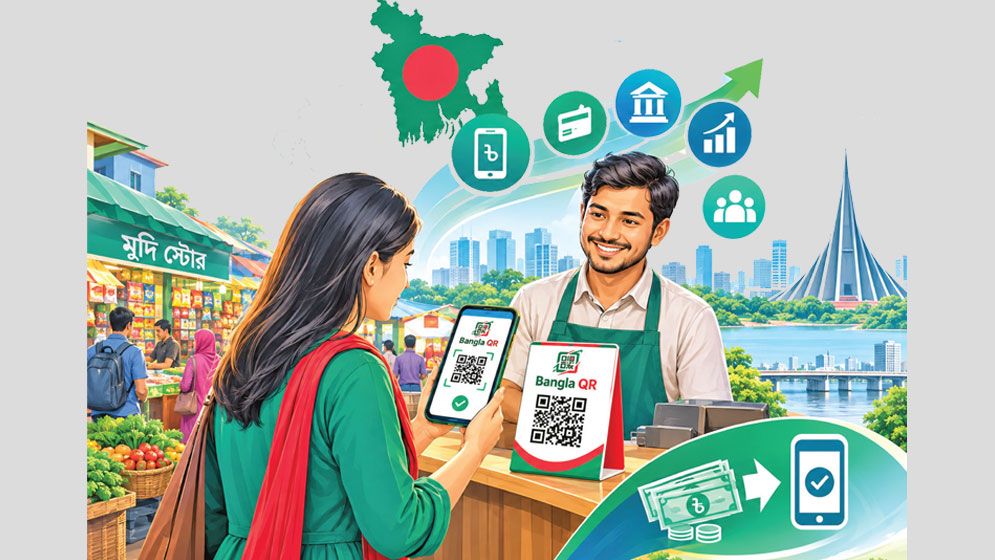
Bangladesh is steadily moving towards a digital payment economy, with Bangla QR emerging as an important tool in that transition.
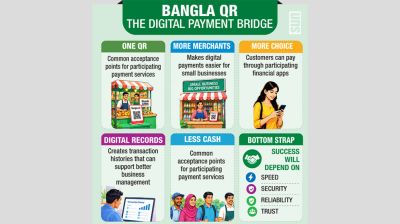
The interoperable QR payment system allows customers to pay through participating banks, mobile financial services (MFS) and other payment service providers using a common QR code. For merchants, it eliminates the need to display separate codes for different platforms, making payment collection simpler.
The shift is particularly relevant for small businesses, where cash remains dominant. Grocery shops, restaurants, pharmacies, clothing stores and other retailers handle millions of low-value transactions every day, many of which are still settled in cash.
With Bangla QR, a merchant can display a single code while customers use an eligible banking or financial services app to complete a payment. The model gives consumers greater choice while reducing the complexity of dealing with multiple payment networks.
Beyond convenience
Bangladesh has seen rapid growth in mobile financial services, internet banking and card payments, but cash remains deeply embedded in everyday commerce. Changing that habit will require digital payments to be reliable, secure and easy to use.
For merchants, QR payments can reduce the need to count, store and transport physical cash. Digital transactions also create an electronic record that can help businesses monitor sales, reconcile accounts and track cash flow.
A consistent transaction history could eventually help small businesses demonstrate their financial activity when seeking formal financial services. While a digital record does not automatically guarantee access to credit, it can provide lenders with useful information for assessment.
This gives QR payments a potential role in advancing financial inclusion, particularly among small and informal businesses.
Opportunity for small businesses
Small and micro enterprises could become a major driver of Bangla QR adoption. Unlike larger companies, many small retailers have limited resources and may be reluctant to manage complicated payment arrangements.
A single QR code offers a relatively simple solution. Shopkeepers, market vendors, restaurants, pharmacies, home-based businesses and individual service providers can accept payments from customers using different participating financial services.
However, registration, settlement and dispute resolution must be straightforward. When a payment fails or is delayed, merchants need quick confirmation and an accessible channel for support.
The system’s reach will also depend on adoption outside major cities. Rural Bangladesh has millions of small traders, farmers, transport operators, retailers and service providers who could benefit from digital payments as smartphone use and financial connectivity expand.
Yet connectivity and digital literacy remain uneven. Awareness programmes therefore need to focus on practical issues such as receiving payments, checking transaction status and handling failed transactions.
Trust is critical
Greater use of digital payments also brings new risks. Fraudsters may replace genuine QR codes, redirect customers to fraudulent accounts or use fake calls, messages and links to obtain sensitive information.
Customers should verify recipient details before confirming a payment and never share PINs, OTPs or passwords. Merchants should regularly check that displayed QR codes have not been tampered with.
Financial service providers, meanwhile, need effective fraud monitoring, customer protection and dispute-resolution mechanisms.
Trust will ultimately determine whether people move from occasional QR payments to regular use. Repeated transaction failures, poor connectivity, unclear confirmations or slow refunds could quickly undermine confidence.
Wider applications
Bangla QR’s potential extends beyond retail. Educational institutions, hospitals, clinics, transport operators, government agencies and other service providers can use digital payment channels to collect fees and charges.
Wider acceptance at public and private service points would make QR payments part of everyday life while reducing reliance on cash counters. Electronic records could also simplify payment verification and reconciliation.
The system could further support entrepreneurs selling through social media and online platforms. For small online sellers and home-based businesses without sophisticated websites or payment gateways, QR payments offer a relatively simple way to collect payments.
Building an ecosystem
Interoperability can also encourage competition among banks, MFS providers and payment service providers. As customers gain the ability to transact across networks, service quality, security, pricing and customer support could become stronger differentiators.
But technology alone will not create a less-cash economy. Regulators, financial institutions, payment providers and merchants need to ensure common technical standards, reliable connectivity, secure transactions and efficient settlement.
Bangla QR should therefore be viewed not simply as another payment method, but as infrastructure connecting different parts of Bangladesh’s digital financial ecosystem.
Its success will ultimately be measured not by the number of QR codes installed, but by how regularly people use them.
If payments are reliable, merchants find collection simple and customers feel secure, Bangla QR could become a familiar part of everyday commerce, gradually bringing more consumers and businesses into Bangladesh’s formal digital payment network.
The writer is a journalist and media professional.