


 For all latest news, follow the Daily Sun's Google News channel.


GARMENT WAGE BOARD
Workers seek Tk32,000 minimum wage; owners yet to table plan
Daily Sun Report, Dhaka
Published: 10 Nov 2026, 12:00 AM
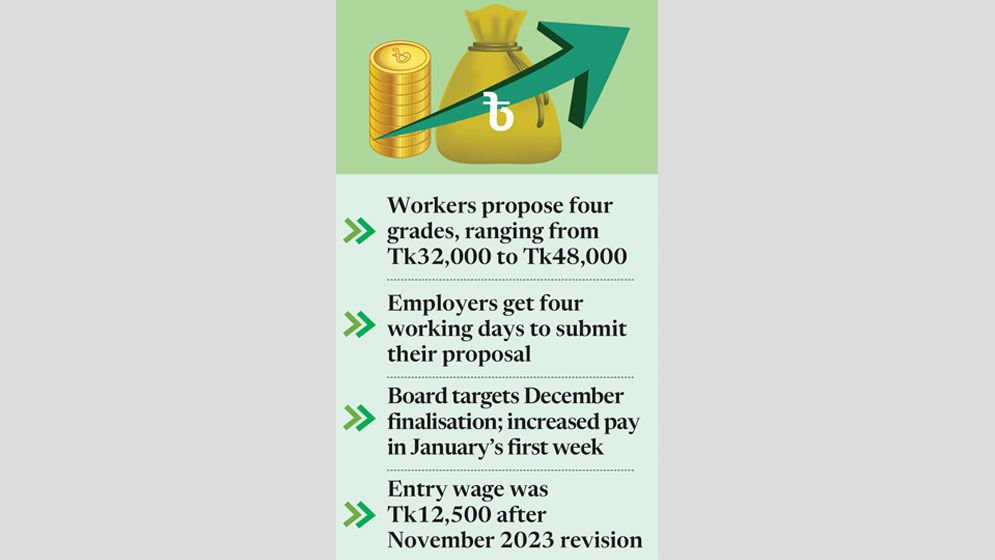
Garment workers’ representatives proposed a minimum monthly wage of Tk32,000 for entry-level workers, a 156% rise from the current Tk12,500, while employers failed to submit a proposal at the Minimum Wage Board on Monday.
The proposal was tabled at the board’s second meeting at its Segunbagicha office in Dhaka. Details were disclosed at a joint briefing after the meeting, which ran for more than three hours.
Worker representative Babul Akhter, general secretary of the Bangladesh Garment and Industrial Workers Federation, said the Tk32,000 comprises Tk19,200 in basic pay, Tk9,600 in house rent (50% of basic) and Tk3,200 in other allowances, including medical, transport and food.
The workers propose four grades. Grade 1 would receive Tk48,000, Grade 2 Tk43,000, Grade 3 Tk38,000 and Grade 4 Tk32,000. Apprentices would be paid Tk30,000, including Tk18,000 in basic pay.
Babul said the figure accounts for market prices, inflation, living costs, housing rent, healthcare and children’s education.
By those measures, he said, a family of four would need Tk45,000-60,000 a month, but workers had scaled back their demand in recognition of the industry’s limited capacity.
Employers’ representatives sought seven working days to submit their proposal. The board granted four.
ABM Shamsuddin, a director of the Bangladesh Garment Manufacturers and Exporters Association (BGMEA) and chairman of Hannan Group, said owners had to devote more attention to running their factories because of the disorderly situation in industrial areas around Dhaka.
Board chairman Syed Azad Subhani said the process would not stall.
“Even if the employers’ side fails to submit its proposal at the next meeting, we will move forward with the decision-making process. We will not wait for their proposal,” he said.
He said the meeting had taken two decisions unanimously. The third meeting will be held next week, and board members will visit several garment factories in the meantime. The sector employs about 4 million workers.
Independent member Mosleh Uddin Ahmed, a Dhaka University professor, has been tasked with reviewing international indicators for wage-setting. He may seek opinions from the university’s Institute of Business Administration, as well as economists and experts.
“We will finalise the new wage structure by December. And it will take effect from December, and workers would receive their increased wages in the first week of January,” Subhani said.
Babul said workers who understood their own interests had already returned to work, while those still absent may have other grievances stemming from strained relations between owners and workers.
He said it was for the government and its intelligence agencies to determine whether external or political forces were influencing the unrest.
Various individuals, parties and labour organisations might be pursuing their own agendas, he added, and even factory owners could be encouraging or opposing the protests.
The board also comprises Asif Ayub, joint secretary of the Bangladesh Employers Federation, for employers, and Anwar Hossain, president of Bangladesh Jatiyatabadi Sramik Dal, for workers.
The last revision was made in November 2023, taking effect that December, when the entry-level wage rose from Tk8,000 to Tk12,500. Recent amendments to the labour law have cut the revision cycle from five years to three.
The minimum wage was Tk1,662.50 in 2006, Tk3,000 in 2010, Tk5,300 in 2013, Tk8,000 in 2018 and Tk12,500 in 2023.