


 For all latest news, follow the Daily Sun's Google News channel.


Iran firm to fight intense war as Tehran hit hard
Agencies, Dubai/Jerusalem
Published: 09 Mar 2026, 12:00 AM
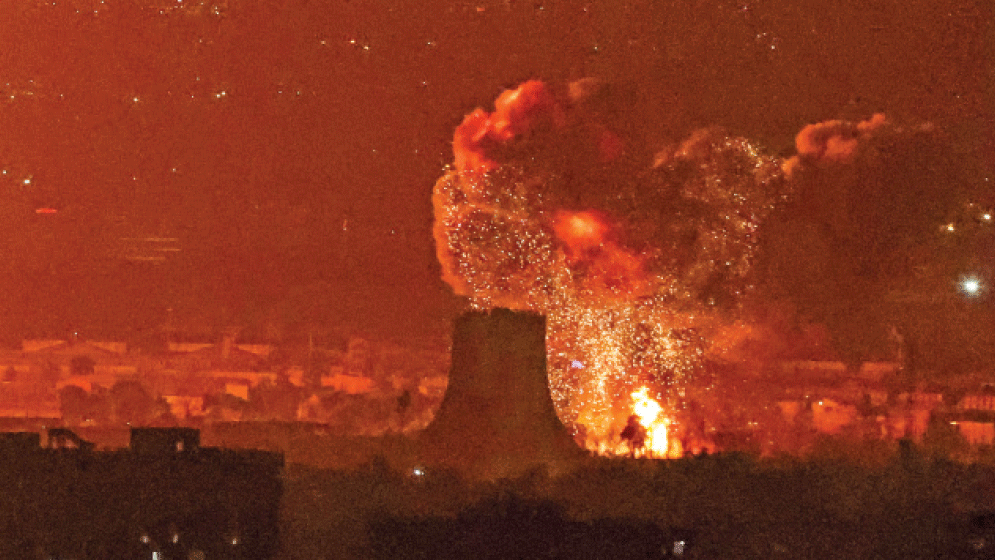
An explosion erupts following strikes near Azadi Tower close to Mehrabad International Airport in Tehran on Sunday.-AFP PHOTO
Israeli forces expanded their bombardment of Iran overnight on Sunday, striking fuel depots near Tehran, while Bahrain said an Iranian attack had damaged one of its desalination plants, signalling a widening assault on vital infrastructure across the region.
Israel struck southern Lebanon, Beirut and an oil storage facility in Tehran as the war in the Middle East keeps escalating, and Israeli Prime Minister Benjamin Netanyahu promised “many surprises” for the next phase of the conflict.
Iran's Revolutionary Guards said they had launched missiles towards the Israeli cities of Tel Aviv and Bersheeva, as well as an airbase in Jordan.
"The 28th wave of the Operation Honest Promise 4 was launched by the next-generation missiles of the Guards aerospace force against the areas of Beersheva, Tel Aviv, and the Al-Azraq airbase," the Guards said in a statement, according to state TV. 
Saudi Arabia, the United Arab Emirates, Qatar, Kuwait and Bahrain all reported new attacks.
In Kuwait, two border guards were killed while on duty, the interior ministry said. The military said fuel tanks at the country's international airport were targeted in a drone attack.
Saudi Arabia's defence ministry reported intercepting 15 drones, including an attempted attack in the diplomatic quarter of the capital Riyadh.
Bahrain said three people were wounded by falling missile debris and that a water desalination plant was damaged.
Iran can fight an intense war against the United States and Israel for at least six months, the Islamic Revolutionary Guard Corps said in a statement carried by the Fars news agency on Sunday.
“The Armed Forces of the Islamic Republic of Iran are capable of continuing at least a 6-month intense war at the current pace of operations,” said Guards spokesperson Ali Mohammad Naini, according to Fars. A Revolutionary Guards’ spokesman said more advanced missiles would be used in the coming days.
The IRGC, Iran’s elite force, also said it had targeted “more than 200” locations related to American and Israeli bases and facilities across the region.
Iranian President Masoud Pezeshkian said his country “will be forced to respond” to any attack or invasion attempt from a neighbouring country.
“Responding does not mean we have disputes with that country or wish to harm its people -- we would be responding out of necessity,” he said in remarks broadcast on state TV. Earlier Sunday, Iran’s Foreign Minister Abbas Araghchi said a US airstrike damaged an Iranian desalination plant on Qeshm Island, warning that in doing so “the US set this precedent, not Iran.” Such infrastructure is critical for drinking water supplies in the parched deserts of the Gulf. An Israeli attack on an oil storage facility in Tehran sent up pillars of fire that could be seen in Associated Press video as a glow against the Saturday night sky. It appeared to be the first time a civil industrial facility has been targeted in the war.
The war, which erupted on 28 February after joint US-Israeli strikes hit Iran, has so far killed more than 1,300 people in the Islamic Republic, more than 300 in Lebanon and around a dozen in Israel, according to officials.
Meanwhile, Iran’s Assembly of Experts has reached a consensus on who will replace Supreme Leader Ayatollah Ali Khamenei - but they said some “obstacles” remain in the appointment. Israel’s military has threatened to target any successors of Khamenei.
Saudi Arabia has told Tehran that while it favours a diplomatic settlement to Iran’s conflict with the United States, continued attacks on the kingdom and its energy sector could push Riyadh to respond in kind, four sources familiar with the matter told Reuters.
The message was conveyed before a speech on Saturday in which Iranian President Masoud Pezeshkian apologised to neighbouring Gulf states for Tehran’s actions -- an apparent attempt to defuse regional anger over Iranian strikes that hit civilian targets. Two days earlier, Saudi Foreign Minister Prince Faisal bin Farhan spoke to Iranian Foreign Minister Abbas Araqchi and set out Riyadh’s position with clarity, the sources said.
Iran’s foreign minister Abbas Araghchi on Sunday underscored Tehran’s relationship with Moscow, as reports that Russia is providing the Middle Eastern country with intelligence have surfaced amid the US military campaign in the region.
“A military cooperation between Iran and Russia is not something new. It’s not a secret. It has been in the past, and it’s still there, and will continue in the future,” Araghchi told NBC News’s Kristen Welker on “Meet The Press,” describing the relationship as “a very good partnership.”