


 For all latest news, follow the Daily Sun's Google News channel.


Jamaat unveils manifesto, promises safe and humane Bangladesh
Daily Sun Report, Dhaka
Published: 05 Feb 2026, 12:00 AM
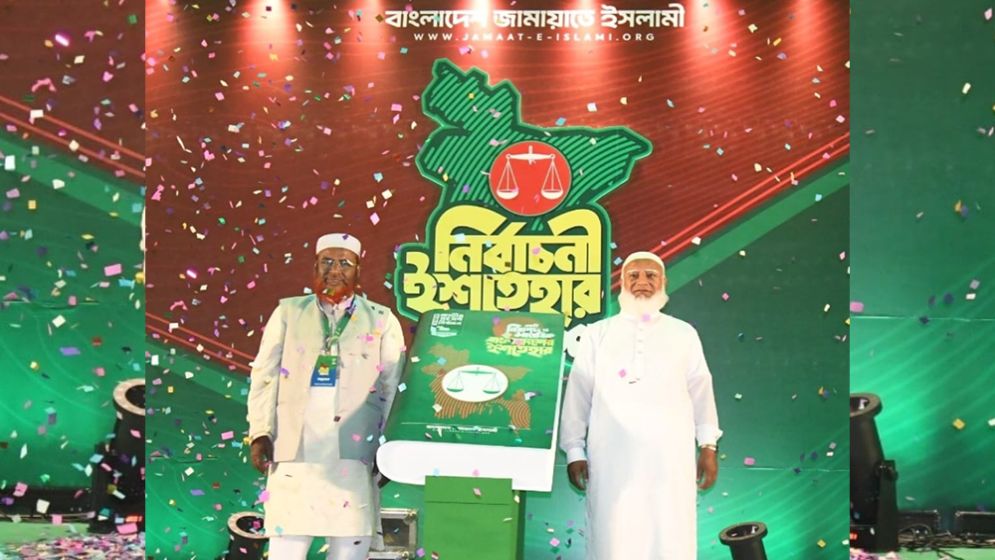
Bangladesh Jamaat-e-Islami on Wednesday unveiled its election manifesto ahead of the 12 February parliamentary election and set out 26 priority areas aimed at building a safe, humane and justice-based Bangladesh.
Jamaat Ameer Dr Shafiqur Rahman formally launched the manifesto at a hotel in the capital’s Banani and pledged an uncompromising commitment to protecting national sovereignty and security, while ensuring social justice and equality.
He also promised youth and women’s empowerment, anti-corruption measures and a technology-driven, inclusive economy.
Jamaat, contesting the election as part of an 11-party alliance, opened the event with a video presentation outlining its 26 commitments in 10 broad points. The 90-page document details plans across 41 sectors, which the party said reflect the spirit of the July uprising.
Leaders of different political parties, business leaders, diplomats, professionals, including teachers, lawyers, and doctors, as well as party leaders and activists from its alliance partners, attended the programme.
Reading out the manifesto, Shafiqur said Bangladesh’s fertile land, natural resources and vast young workforce were among the nation’s greatest assets.
He noted that the country was the world’s eighth most populous and the third-largest Muslim-majority nation.
He said that although the people achieved independence twice, in 1947 and 1971, its benefits had yet to reach every household due to a lack of patriotic, honest and efficient leadership.
Saying that 15 years of “fascist misrule” had weakened state institutions, he said students and the masses envisioned a new Bangladesh through the July uprising.
Shafiqur said Jamaat was committed to building a safe and humane society through the 12 February election, based on the aspirations of that movement.
The manifesto pledges to establish the rule of law, ensure a corruption-free administration, create jobs and reform education through moral integration. It also promises healthcare at people’s doorsteps, control of commodity prices, support for farmers, protection of women and children, and an independent judiciary.
Other priorities include electoral reforms, safeguarding expatriate remittance earners’ rights, promoting small and medium enterprises, preserving communal harmony, improving roads and transport, ensuring energy security, addressing climate challenges, protecting human rights, promoting industrialisation and exports, strengthening social safety nets, fostering sports and culture, boosting tourism, modernising land management, building a strong defence system, pursuing a foreign policy based on mutual respect and achieving the Sustainable Development Goals (SDGs).
The party said it would rebuild a discrimination-free Bangladesh inspired by the July uprising and ensure transparency and accountability at all levels. It pledged to amend “undemocratic provisions of the constitution” to empower the people.
It also said politics of vengeance would be replaced with consensus and tolerance, and democratic practices within political parties would be encouraged. Parliament would be made the focal point of state activities, with a code of conduct for MPs and proper recognition of the opposition.
The manifesto further promises a strong and neutral Election Commission (EC) so voters can exercise their rights without fear or interference. It also pledged complete separation of the judiciary from the executive, with a permanent policy for appointing judges to the higher courts.
Shafiqur said the Anti-Corruption Commission (ACC) would be made truly independent and effective, and government officials would be required to submit asset statements.
On foreign policy, Jamaat said it would follow the principle of “friendship with all, malice toward none”, prioritising equality and national interest while strengthening relations with the Muslim Ummah. The armed forces would be equipped with modern weapons and technology, and defence intelligence agencies would be kept above political influence.
The party pledged sustainable economic growth and broad-based employment, including steps towards an interest-free economy in line with Islamic principles. It promised strict measures to recover looted funds and defaulted loans, protect domestic industries, diversify exports and establish special economic zones to attract foreign investment.
Jamaat also promised subsidies, improved seeds and fertilisers for farmers, the establishment of agro-based industries and greater exports of fisheries and livestock products. It further promised measures to curb pollution, promote alternatives to plastic, strengthen afforestation, prevent river erosion and expand dredging.
The manifesto says the education system would be unified and employment-oriented, integrating religious education with modern science, while enhancing teachers’ dignity and salary structures. It also promises advanced health centres in every union and medicine prices within reach of ordinary people.
The party also pledged high-speed internet expansion, training to accelerate freelancing, and stronger cybersecurity for transparent digital connectivity. It committed to strengthen civil aviation and tourism, improve local government and rural development, and integrate housing, public works and land management into a broader infrastructure plan.
Modernisation of railways and waterways and proper implementation of megaprojects were promised to ease traffic congestion in the capital.
The manifesto places emphasis on youth-led technological development, further support for sports, ICT and telecommunication sectors, and inclusive development for all, including the Chattogram Hill Tracts.
It also pledges to uphold the spirit of the Liberation War, preserve the history and ideals of the July uprising, strengthen disaster management and relief systems, and ensure workplace safety for women, maternity benefits, the elimination of child labour, and religious freedom and security for people of all faiths.
Recommended Stories