


 For all latest news, follow the Daily Sun's Google News channel.


Russia deems it unacceptable to meddle in internal affairs: Ambassador Khozin
Daily Sun Report, Dhaka
Published: 24 Feb 2026, 11:45 PM
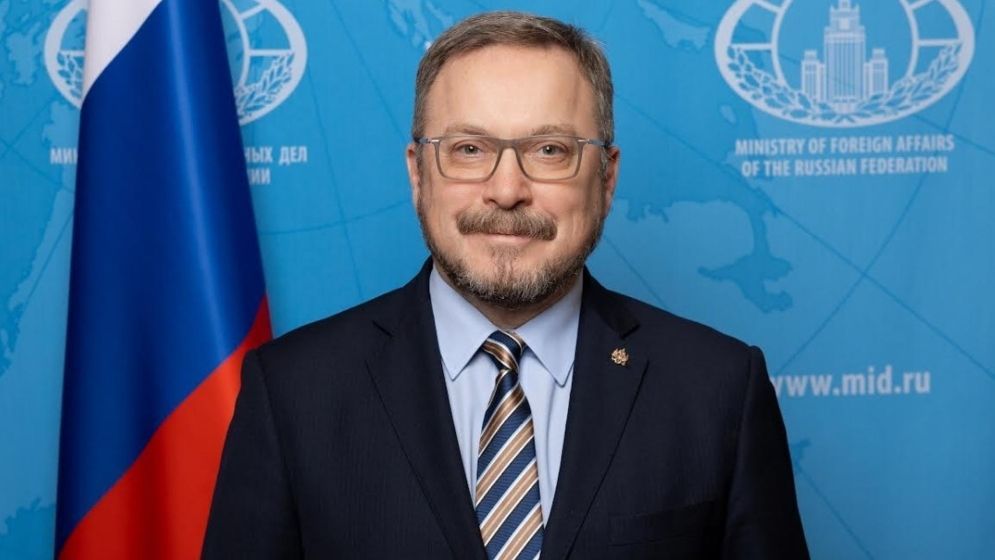
Ambassador Alexander Grigoryevich Khozin. Photo: Courtesy
Born in 1962, Alexander Grigoryevich Khozin graduated from the Military Red Banner Institute in Moscow and joined the Russian diplomatic service in 1992. He has held various positions within the Russian foreign ministry and abroad, including as head of department in the Second Asia Department and Counselor at Russian embassies in Nepal and Pakistan. On 30 October 2024, Khozin was appointed ambassador of the Russian Federation to the People’s Republic of Bangladesh.
In a recent exclusive interview with the Daily Sun, he discussed various issues from his country’s perspective.
How was the election? What have you found special this time?
Observers from the Russian Central Election Commission and the Embassy in Bangladesh monitored more than 40 polling booths across eight polling centres in Dhaka and Narayanganj. They were present at every stage of the electoral process, from opening to the start of vote counting.
The observers noted strong preparedness among election officials for the combined voting process and keen voter interest. At every station visited, commission members followed a well-rehearsed procedure in line with national laws and Election Commission directives. A friendly, constructive atmosphere prevailed. Polling officers, along with party polling agents present at all sites, collaborated to ensure transparency and oversight of the voting process. Political rivalries played out solely through the ballots.
Security was robust, with over 900,000 police and army personnel deployed. Organisers succeeded in holding a calm and secure vote in line with the law. Isolated incidents did not mar the atmosphere or affect proceedings.
For many voters—based on their comments—this felt like a long-awaited event. Some brought children along. The overall mood was peaceful, even festive. Election officials reported turnout exceeding past years.
Referendum was a new addition. People were not used to it. What was their response?
According to the observers, the voters showed a particular engagement with the process and a remarkable discipline. As I said, many of them were excited to cast their votes, and understood the importance of the occasion.
The voting was well organised and transparent. Election officials demonstrated competence and a high level of preparedness in order to guide the voters at every stage of the process. Thanks to the efforts of the officials, there was no confusion about the referendum procedure.
There has been a discussion in Bangladesh that Russia tried to negotiate with the then prime minister Sheikh Hasina before the 2024 national polls to ensure the participation of major opposition parties, which Hasina reportedly ignored. Did Russia make any approach to the interim government this time to promote an inclusive election?
Throughout the electoral campaign, Russia underlined its readiness to cooperate with the future government of Bangladesh that comes to power as a result of the 13th parliamentary election.
Our country deems it unacceptable to meddle in the internal affairs of a sovereign nation such as Bangladesh. The only thing we can do to support an inclusive election is to emphasise our openness to continued cooperation with the officials elected through the free expression of the Bangladeshi people’s will.
Bangladesh is developing close ties with the US. On 9 February, it signed a trade agreement with the country, which will boost imports of food grains. It is believed that this will reduce imports from Russia. How do you view this development?
Let us compare. While there are cheaper options, but of lower quality, and, in contrast, more expensive and with a higher percentage of proteins, Russian wheat is both of excellent quality and attractively priced. That is why grain from Russia is a preferable option for commercial consumers.
American grain is expensive, and it is primarily purchased to improve the qualities of ordinary wheat. Although under the Agreement on Reciprocal Trade, American wheat will enter the local market in increased volumes, Russian suppliers still have an advantage in terms of price.
Bangladesh has been a buyer of Russian weapons and defence materials. Now, it is looking to China, the US, Turkey, and Pakistan for such purchases. How would Russia view this shift?
It is up to Bangladesh’s military command to choose the suppliers of weapons and defence materials. Russia is not going to exert pressure on the government of a sovereign nation, such as Bangladesh, to decide in favour of our country.
At the same time, I consider that stronger defence cooperation is in our mutual interest. From the Russian side, we stand ready for new initiatives and agreements in this field if Bangladeshi partners are interested.
Russia is one of the world’s top producers of weapons and defence materials. Our country has competitive advantages in this market and can offer unique products. Moreover, Russia is a reliable partner that has always responsibly implemented concluded agreements.
With Bangladesh, we have an established mechanism for consultations in the defence sphere, the working group on military and technical cooperation. We hope that under the new government, the work of this body will be revitalised for the benefit of our two nations.
The Rohingya issue is at the forefront of Bangladesh's priority list of international affairs. Russia has long been an ally of Myanmar. Despite being a trusted partner of Bangladesh, Russia's role in pushing Myanmar to take back its nationals has been largely absent. Will Russia change its stance and work for a safe and dignified repatriation of the Rohingyas?
We are convinced that external actors, including Russia, should confine their role to facilitating dialogue and mutually acceptable bilateral agreements. Some external actors are using involvement in this issue to exert pressure on one of the parties and to interfere in its internal affairs. This approach is counterproductive, and only increases the potential for conflict and tensions in the region.
Russia does not support one or the other party in this controversy, nor does it create obstacles for a safe and dignified repatriation of Rohingyas. Our country stands for a balanced depoliticised approach, as well as consultations between those directly involved in this conflict. It is through bilateral dialogue between Myanmar and Bangladesh that a sustainable solution can be found to the issue of Rohingya refugees.
The Rooppur Nuclear Power Plant has marked a significant shift in Bangladesh-Russia relations after all these years of independence. Will Russia support Bangladesh in implementing more such mega projects in the changed context, if the country wants?
Since the early 1970s, Russia-Bangladesh energy cooperation has always been the backbone of economic relations between our countries. The Soviet Union provided financial and technical assistance in the construction of Ghorashal and Siddhirganj power plants, which was an important contribution to the revitalisation of Bangladesh’s economy after the Liberation War.
The Rooppur project is the continuation of these good traditions of cooperation in the energy sphere. At the moment, the work is focused on the commissioning of Unit No 1 of Rooppur NPP, which is at the final stage of readiness. At the same time, the construction of the second unit is underway. Once completed, the Rooppur NPP will contribute to the stability of national energy security, providing an additional 2,400MW to the grid.
We have a number of other projects – no less important in terms of their impact on people’s lives and the economic prosperity of Bangladesh. Russian company “Gazprom International” stands ready to continue its operations in Bangladesh by participating in drilling, seismic surveys, and gas transportation projects.
Besides, Russian companies engaged in renewable energy are ready to share their expertise with the Bangladeshi partners, as well as to invest in this sector and open joint ventures. For example, the Russian company “Unigreen energy” is interested in developing solar plant projects in Bangladesh.
Bangladesh's strategic location has made it a focal point for many international actors. What does Russia expect from the country, as a friend since the Liberation War?
The modern world is facing fundamental geopolitical transformations. Russia is committed to maintaining both global and regional stability and security. Under the current geopolitical circumstances, the relevance of President Vladimir Putin’s 2015 initiative to create the Greater Eurasian Partnership cannot be underestimated. In short, this initiative aims to combine the potential of all the states and integration structures located on our continent for the common good. Given its economic and geographical assets, Bangladesh could benefit a lot both economically and politically as part of the Greater Eurasian Partnership.
South Asia occupies a significant place in Russia’s foreign policy due to its economic potential, pragmatic international relations, accelerated growth, and promising young population. The countries of the region play an increasingly important role in the emerging multipolar order, and Bangladesh is no exception.
That is why, taking into account the relevance of the region, Russia expects our bilateral ties to expand across various spheres, including trade, energy, technologies, education, and manpower exchange. We also hope to maintain and increase our interaction in multilateral formats, including the Conference on Interaction and Confidence-Building Measures in Asia, the Asia-Europe Meeting, the ASEAN Regional Forum, and the Indian Ocean Rim Association (IORA), as well as within broader initiatives such as the Greater Eurasian Partnership mentioned above.