


 For all latest news, follow the Daily Sun's Google News channel.


Visa powers Bangladesh’s Farmers Card to advance financial inclusion, digitisation of economy
Daily Sun Report, Dhaka
Published: 14 Apr 2026, 04:47 PM
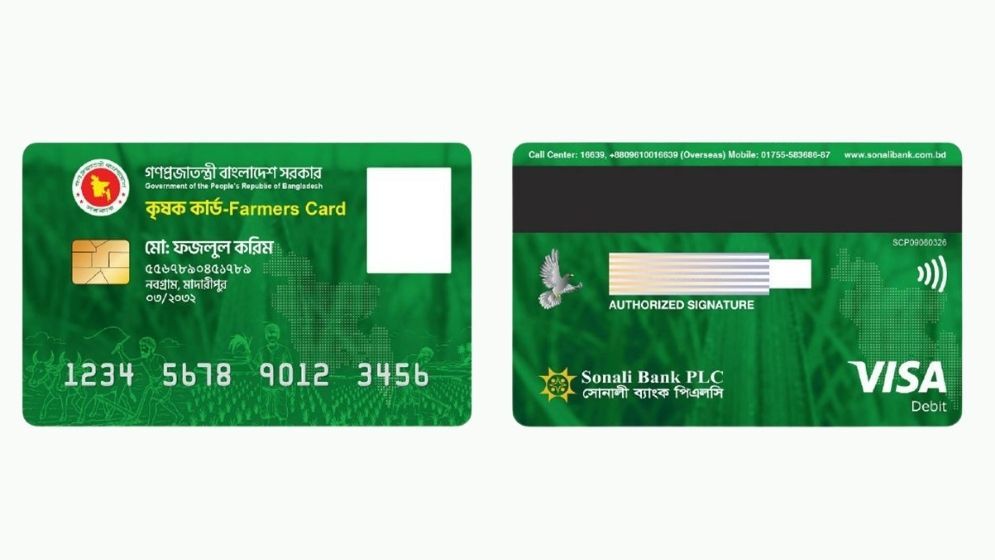
Visa, a global leader in digital payments, on Tuesday welcomed the Bangladesh government’s flagship Farmers Card launch by Prime Minister Tarique Rahman.
The Farmers Card is exclusively on the Visa
card network. This marks a significant step toward strengthening financial
inclusion and digitising subsidy disbursement for farmers across the country.
Developed under the guidance of the Ministry of Agriculture, in collaboration
with Sonali Bank PLC, the Visa-powered Farmers Card integrates farmer
identification with secure digital payment capabilities to facilitate more
efficient access to government services and benefits.
Launched on the occasion of Pahela Baishakh,
the Farmers Card reflects the government’s continued focus on modernising
agricultural support systems, as part of its broader national development
priorities. Designed primarily as a farmer identity credential, the card facilitates
authenticated access to subsidies and services, with Visa’s trusted payments
technology enabling a seamless and secure cashless ecosystem.
Sabbir Ahmed, Visa Country Manager of Bangladesh,
Nepal and Bhutan, said, “This is a proud moment for Bangladesh, as the Farmers
Card initiative brings together identity, access, and digital payments to serve
the farming communities better in Bangladesh. By empowering them with a more
transparent and efficient system, it opens new opportunities for farmers to participate
in the growing digital economy. Visa is honored to support the Government of
Bangladesh in partnership with Sonali Bank PLC in advancing the critical
national priority of digitising the economy.”
In its pre-pilot phase, the programme enrolls
around 22,065 farmers across selected upazilas, where the government’s
financial assistance is being disbursed directly into bank accounts linked to
the card.
On the same day, 20,671 farmers, fishers,
livestock rearers, and salt cultivators from 11 upazilas in 10 districts will
receive the cards. At this stage, eligible farmers are receiving initial
support of approximately Tk2,500 as direct financial support to meet essential
agricultural input needs. This would enable farmers to use the card to purchase
essential agricultural inputs such as seeds and fertilizers, supporting a more
efficient and targeted subsidy utilization.
Highlighting the importance of strengthening
financial access for farmers, Md Shawkat Ali Khan, Managing Director and CEO of
Sonali Bank PLC, added, “Through the Farmers Card initiative, we are
strengthening how financial support is delivered to farmers across Bangladesh.
By linking banking services directly with government programs, the process
becomes more efficient, transparent, and accessible for farming communities.
This partnership reflects our continued commitment to supporting national
development and expanding access to formal financial services.”
The programme is being introduced across 11
selected upazilas, including Tangail Sadar, Shibganj (Bogura), Panchagarh
Sadar, Boda, Islampur (Jamalpur), Shailkupa (Jhenaidah), Nesarabad (Pirojpur),
Juri (Moulvibazar), Cumilla Sadar, Goalanda (Rajbari), and Teknaf (Cox’s
Bazar). Through this scheme, cardholding farmers will receive 10 types of
benefits. These are: agricultural inputs at fair prices, irrigation facilities
at fair prices, agricultural loans on easy terms, access to agricultural
machinery at low cost, government subsidies and incentives, weather forecasts
and market information via mobile phone, agricultural training, advice on
controlling crop diseases and pests, agricultural insurance facilities, and the
opportunity to sell agricultural products at fair prices.
Visa, as the exclusive international payments
network supporting this high-priority national programme, brings global
expertise in secure digital payments to help strengthen Bangladesh’s financial
infrastructure. The Farmers Card initiative represents a scalable model for
integrating identity and payments in public sector programmes with potential
applications across other emerging markets.