


 For all latest news, follow the Daily Sun's Google News channel.


Govt eyes investment-driven growth to boost jobs, public financing: Titumir
Need to move away from aid story to investment story, says Ashik Chowdhury
UNB, Dhaka
Published: 30 Mar 2026, 09:24 PM

File Photo
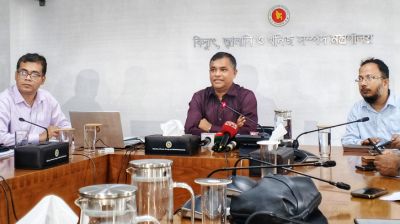
Prime Minister’s Adviser on the Ministry of Finance and Planning Prof Rashed Al Mahmud Titumir on Monday said the government aims to ensure that investment translates into production, production into employment, and employment into a stronger tax base capable of financing public goods.
“We would like to see improvement in terms of
Japanese average investment per country. If you really look at, there is a
scope for improvement in case of Bangladesh,” he said, noting that official
development assistance (ODA) has increasingly become intertwined with
geopolitics.
The economist said they have seen evolving strategy
around ODA. “Our government wants to see a change in the model. That's where Japan can play an active role,”
he said, adding that they want to see that Japan is moving from ODA.
The adviser made the remarks while speaking at a
commemorative event for Economic Partnership Agreement (EPA) with Bangladesh.
Executive Chairman of the Bangladesh Investment
Development Authority (BIDA) Ashik Chowdhury, Japanese Ambassador to Bangladesh
Saida Shinichi, Head of the Economic Section at the Embassy of Japan in
Bangladesh Yutaro Mochida, Deputy Director-General (Ambassador) at the Ministry
of Foreign Affairs of Japan Izuru Kobayashi (online) also spoke at the event.
The event was hosted by the Embassy of Japan in
Bangladesh and Japan External Trade Organization Dhaka Office (JETRO Dhaka)
while it was supported by Japanese Commerce and Industry Association in Dhaka
(JCIAD/Shoo-Koo-Kai) and Japan Bangladesh Chamber of Commerce & Industry
(JBCCI).
Titumir said they need collaboration and cooperation
from the private sector joint venture companies and the government officials.
“I am expecting that in the future summit meeting
between the Japanese prime minister and the prime minister of Bangladesh, we
would see an epoch-making doable but future oriented steps,” he said.
The adviser said they have seen Japan helping South
Korea, Singapore, China and that collaboration is unique. “That's what we
really want to have beside the official development assistance.”
He said they would like to increase the trade
between the two countries but they would really like to see that Japan is
investing in manufacturing.
The adviser said everything has become geo-economics
and geopolitics and there are discussions and there are narratives and Japan
could lead Bangladesh in that area where they can see that risk are shared.
Ashik said they feel very confident that the
implementation of the Economic Partnership Agreement (EPA) between Bangladesh
and Japan will still become a benchmark for the country.
“At the same time, now we will be able to negotiate
multiple EPAs in the next three to five years. But for the Japanese investors,
I hope that the EPA really shows our intent that we are open to business and we
really believe in the Japanese investment story,” he said.
Ashik said they really need to move away from the
aid story to investment story. “We've always been talking about the aid story
but now it's about investment and we generally want to show our intent that we
are open to business to our Japanese friends.”
Japanese Ambassador Saida appreciated the new
government’s ‘well-conceived plan’ which, in his interpretation, consists of a
reconciliation to break the old time cycle, restoration of law and order, and
economic growth through enhanced investment.
“All these will positively affect investors' minds
and the prerequisite of accelerating economic growth through more FDIs,” he
said, reiterating Japan’s ‘true appreciation’ for the peaceful elections which
Bangladesh has achieved February this year and new administration's
well-conceived plan.
The ambassador said Bangladesh and Japan have shared
a long-standing friendship since your independence. “As your faithful and
dedicated development partner, Japan has consistently supported Bangladesh as a
nation irrespective of its ruling party.”
He said this cooperation has evolved into today's
strategic partnership founded on trust and shared values.
The ambassador recalled that before signing the EPA,
some critics were seen in the Bangladesh press. “I thought in my mind at the
time that they might be looking at as long as three years, maybe a little bit
short cycle.”