


 For all latest news, follow the Daily Sun's Google News channel.


Nearly half of solar home systems non-functional: CPD
Think tank warns of a ‘retention failure’ in the country’s off-grid solar programme and urges policy reforms to accelerate rooftop solar adoption
Daily Sun Report, Dhaka
Published: 24 Jun 2026, 12:00 AM
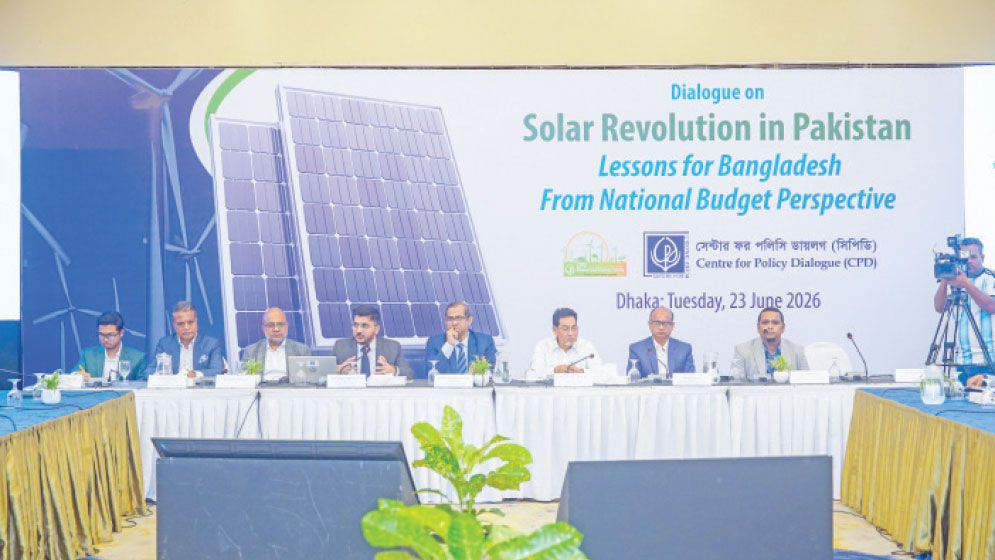
Nearly 47% of Bangladesh’s installed Solar Home Systems (SHSs) are now non-functional, highlighting a growing sustainability challenge in one of the country’s most celebrated renewable energy programmes, according to a new study by the Centre for Policy Dialogue (CPD).
The findings were presented at a policy dialogue titled “Solar Revolution in Pakistan in the Eyes of Country’s Leading CSO: Lessons for Bangladesh from National Budget Perspective.”
Researchers warned that without urgent reforms, Bangladesh risks a “retention failure” in its off-grid solar sector despite its earlier success in expanding rural electrification.
Chief Whip of the Jatiya Sangsad Nurul Islam Moni attended the event as chief guest and reaffirmed the government’s commitment to expanding renewable energy to strengthen energy security, reduce reliance on imported fuels and support sustainable economic growth.
The session was moderated by CPD Research Director Dr Khondaker Golam Moazzem.
He said the country must urgently align its energy policy framework with evolving regional and global trends to create a more efficient, investment-friendly and sustainable renewable energy ecosystem.
Presenting the Bangladesh perspective, CPD Research Associate Atikuzzaman Shazeed said the country is undergoing a transition from the off-grid SHS model to grid-connected solar and net metering systems.
While the SHS programme helped bring electricity to around 20 million people, the model has reached saturation as grid electricity expanded across rural areas, he said.
According to the study, nearly half of the installed SHSs are currently non-functional, largely due to battery degradation and the absence of a structured maintenance and transition mechanism.
The report showed a dramatic decline in SHS deployment over the past decade. Annual installations peaked at 8.53 lakh units in 2013 but fell to just 3,455 by 2018, representing a 99.6% decline as rural electrification through the national grid accelerated.
On the grid-connected side, Bangladesh currently has 4,551 rooftop solar installations under net metering, with a combined capacity of 213.3 megawatts (MW).
However, adoption remains heavily concentrated in urban areas, with Dhaka division accounting for more than 60% of installations. CPD identified several structural barriers slowing rooftop solar expansion. These include import duties ranging from 27.5% to 33.6% on key equipment, limited access to long-term financing and stringent collateral requirements that discourage banks from financing projects under leasing or OPEX models.
The think tank also cited the lack of recognition of power purchase agreements and solar assets as bankable instruments, along with regulatory hurdles such as system size caps and inconsistent net metering approvals.
In agriculture, continued subsidies for diesel-powered irrigation were found to be undermining the competitiveness of solar alternatives.
To accelerate renewable energy adoption, CPD recommended rationalising import duties, introducing a unified digital platform for net metering approvals and establishing a Renewable Energy Service Company framework that would recognise long-term solar contracts as bankable security.
The organisation also called for extending net metering to solar irrigation systems and creating a national coordination body under the Sustainable and Renewable Energy Development Authority (SREDA) to monitor system retention alongside new installations.
Keynote speaker Muhammad Basit Ghauri, manager of Special Initiatives and China Programme at Pakistan’s Renewables First, highlighted Pakistan’s recent solar expansion, driven largely by high electricity tariffs and simplified net metering policies.
He noted that much of the investment in Pakistan’s solar sector has been financed directly by consumers seeking to lower their electricity bills.
Speakers at the dialogue said Bangladesh is at a critical juncture in its energy transition.
While the SHS programme remains a globally recognised success story in rural electrification, they argued that the next phase of growth will depend on shifting policy priorities from installation targets to long-term system performance and sustainability.
Drawing lessons from Pakistan’s experience, CPD said regulatory clarity, innovative financing and stronger incentives could help unlock Bangladesh’s untapped rooftop solar potential.