



 For all latest news, follow the Daily Sun's Google News channel.


Tk68,250cr liquidity support to banks remains unrecovered
Experts say the approach is failing to address the root causes of the crisis

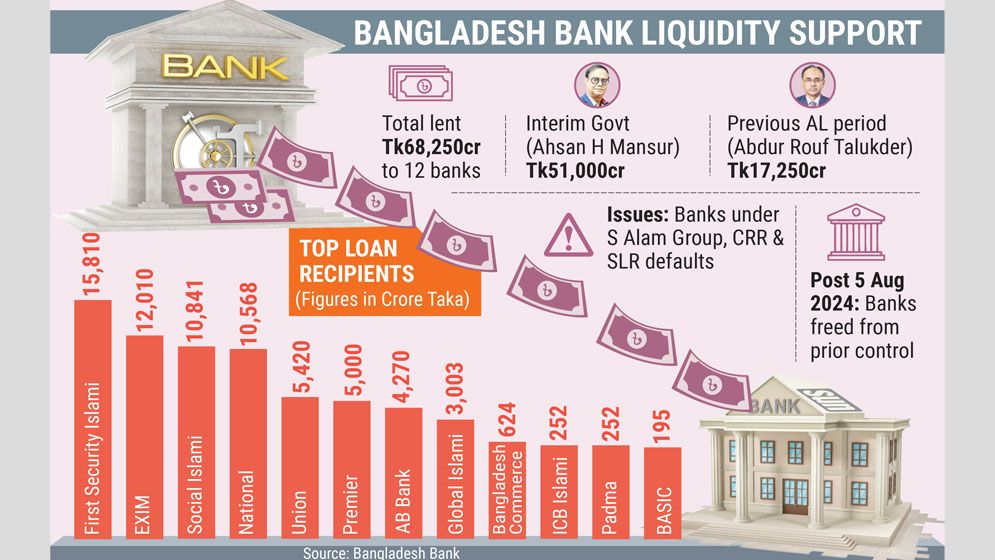
During the tenure of the interim government, former Bangladesh Bank (BB) governor Dr Ahsan H Mansur injected Tk51,000 crore in freshly printed money as liquidity support to several struggling banks.
Although the funds were extended as short-term loans for three months, the central bank has yet to recover the amount.
A similar pattern was seen under the previous Awami League administration. During the tenure of former governor Abdur Rouf Talukder, Tk17,250 crore was disbursed under the same short-term arrangement.
More than a year later, those funds also remain unpaid, according to central bank sources.
In total, BB printed and lent Tk68,250 crore to 12 banks across the two periods.
The recipients include First Security Islami, Social Islami, Union, Global Islami, Bangladesh Commerce, ICB Islami, EXIM, National, Padma, AB Bank, BASIC, and Premier Bank.
Although several other banks had sought similar assistance, the central bank later discontinued the facility.
Crisis rooted in past irregularities
During the Awami League government, which was ousted following a mass uprising on 5 August 2024, more than a dozen banks were allegedly looted while underlying weaknesses in the sector remained concealed.
Several banks, including First Security Islami, Social Islami, Union, Global Islami, and Bangladesh Commerce Bank, were under the control of the controversial S Alam Group. Following the fall of the Awami League government, these banks were freed from that control.
EXIM Bank was controlled by former Bangladesh Association of Banks (BAB) chairman Nazrul Islam Mazumder, while Premier Bank had long been under the control of the HBM Iqbal family.
In late 2022, reports of large-scale loan fraud in banks linked to S Alam Group triggered a withdrawal rush by depositors, pushing these institutions into a severe liquidity crisis.
Many failed to maintain required reserves, including the Cash Reserve Ratio (CRR) and Statutory Liquidity Ratio (SLR). Despite this, the central bank at the time allowed various irregular facilities to keep them operational.
Officials said banks typically maintain current accounts with Bangladesh Bank through which CRR, SLR, interbank settlements, and refinancing transactions are conducted.
Even in cases of reserve shortfalls, these accounts are not supposed to turn negative.
However, under controversial arrangements introduced in late 2022, five Shariah-based banks were allowed to continue transactions with negative balances, an unprecedented measure.
After the change in government, new governor Ahsan H Mansur initially withdrew these facilities and announced that no further money would be printed to support banks.
However, worsening liquidity shortages and mounting withdrawal pressure forced the central bank to resume printing money and extending fresh loans.
Breakdown of support
The largest share of liquidity support went to First Security Islami Bank, which received Tk15,810 crore. EXIM Bank received Tk12,010 crore, Social Islami Bank Tk10,841 crore, and National Bank Tk10,568 crore.
Under provisions of the Bangladesh Bank Order, these funds were provided for 90 days at an interest rate of 11.5% under the “overnight-OD” facility. Banks submitted demand promissory notes of equivalent value, with the central bank holding priority claims in case of liquidation.
Despite repeated requests from these banks, no additional liquidity support has been extended.
‘Money printing not a solution’
Former BB chief economist Dr Mustafa K Mujeri said the current approach is failing to address the root causes of the crisis.
“While banks are in trouble due to large-scale irregularities and looting, injecting money is not yielding the desired results,” he said, questioning how long such support can continue.
He likened the policy to a temporary life-saving measure, adding that banks require structural reforms rather than short-term liquidity injections.
“Strict measures are needed to recover defaulted loans and hold those responsible accountable, including recovering looted assets. Without punitive action, the crisis will persist,” he said, warning that continued money printing could also fuel inflation.
BB spokesperson and executive director Arief Hossain Khan said such support cannot continue indefinitely.
“The central bank is compelled to provide assistance to protect depositors’ interests. Without it, confidence in the banking system could erode further,” he said.
He added that with a new governor now in office, decisions regarding the future of these banks are yet to be finalised.