


 For all latest news, follow the Daily Sun's Google News channel.


Govt-funded urban health model to be finalised in six months: State Minister
Daily Sun Report, Dhaka
Published: 11 Nov 2026, 07:21 PM
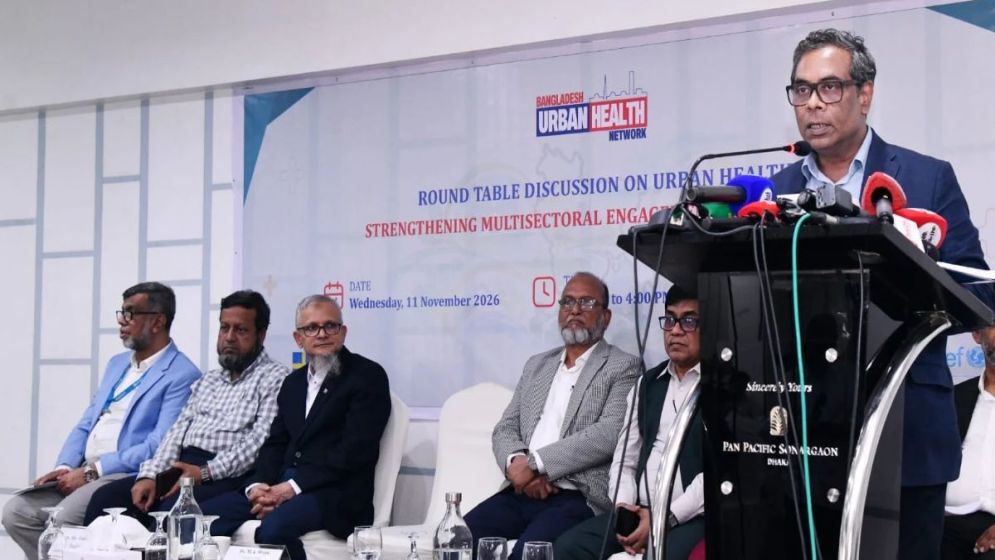
Photo: Collected
The government would unveil a new urban health model within
the next six months aimed at enhancing existing capacity with full public
funding and safeguarding the health of nearly six crore urban citizens.
State Minister for Health Dr MA Muhith outlined the plan in
this regard while speaking at a meeting held at a hotel in Dhaka on Wednesday.
The discussion, titled “Urban Health: Enhancing
Multisectoral Engagement”, was jointly organised by the Bangladesh Urban Health
Network (BUHN) and “Eminence,” with support from the Swedish Embassy and
UNICEF.
The government will finalise a sustainable, multi-sectoral
urban health model within six months, and in the meantime the existing urban
health centres would continue operating under the current partnership framework,
he said.
Muhith said that while rural communities have an established
network of upazila health complexes, the Health Ministry previously had no
formal direct responsibility for providing healthcare to the country's large
urban population. The government has now taken a final decision to address that
gap by assuming responsibility for urban healthcare.
He said existing urban health centres would continue
operating under the previous partnership arrangement for the next six months to
prevent disruption to services. Necessary policy and financial approvals have
been granted, and the interim period will be used to finalise a comprehensive,
sustainable and affordable model.
On health financing, Muhith said the country had allocated
its highest-ever budget for the health sector this year. The government also
has a political commitment to gradually raise health spending to 5% of the
national budget over the next five years.
He called for a broader approach to urban healthcare that
goes beyond hospitals and medicines to include housing, safe water, sanitation,
employment, mental health and prevention of non-communicable diseases.
Rather than replicating the rural healthcare structure in
cities, he said, the government should assess the specific needs of urban
residents, introduce electronic health cards and establish an effective
referral network involving public and private healthcare providers.
Noting that the urban health project has already received
preliminary inclusion in the Planning Commission, the state minister urged
public health experts, researchers and development partners to quickly prepare
a practical, cost-effective and multisectoral action plan.
Others who spoke at the meeting included Bangladesh Doctors'
Association President Prof Dr Harun Al Rashid, Health Economics Unit Director
General Dr Md Enamul Haque, NIPSOM Director Prof Dr Nasrin Sultana, UNICEF
Bangladesh Health Manager Imadul Haque, World Health Organization
representative Dewan Emdadul Haque, World Bank representative Wameq Raza and
Bangladesh Medical Research Council Director Kazi Saifuddin Bennur.
Officials from the Health Ministry and its directorates,
development partners, public health experts and other sector stakeholders also
shared their views.