



 For all latest news, follow the Daily Sun's Google News channel.


Govt decides to disclose national data to rebuild public trust
The workshop was organised under the KOICA-supported Capacity Building of Statistics Service based on Platform (CBSSP) Project
Daily Sun Report, Dhaka
Published: 22 Jun 2026, 02:23 PM
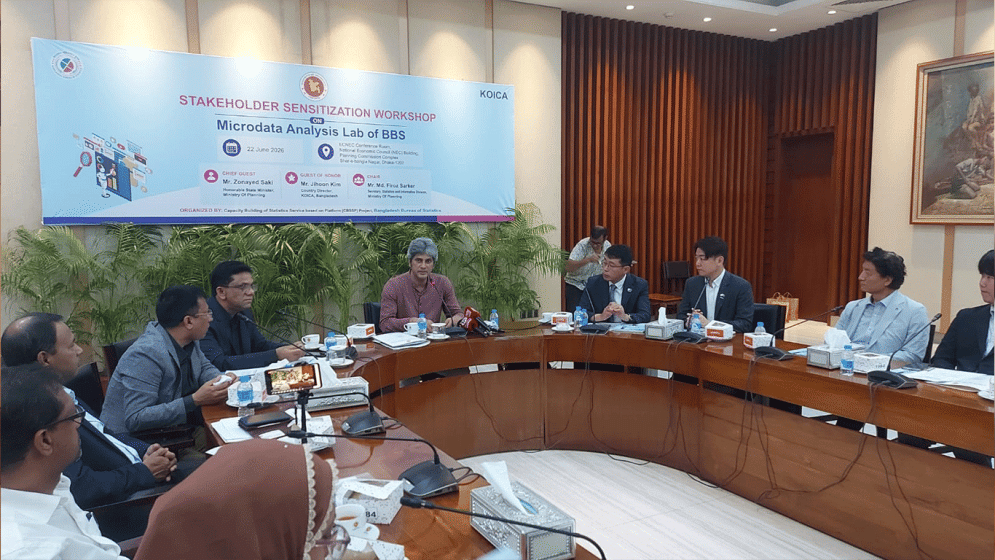
State Minister for Planning Zonayed Abdur Rahim Saki attending a workshop on disclosure of national statistical data. Photo: Daily Sun
The government is moving to make national statistical data more accessible to researchers, academics and policymakers as part of a broader effort to restore public confidence in official information and strengthen evidence-based decision-making.
The initiative was highlighted on Monday at a
stakeholder sensitisation workshop on the newly established Microdata Analysis
Lab of the Bangladesh Bureau of Statistics (BBS), held at the ECNEC Conference
Room in Sher-e-Bangla Nagar, Dhaka.
Speaking as chief guest, State Minister for Planning
Zonayed Abdur Rahim Saki said the government is committed to improving
transparency in data collection and dissemination after years of public
scepticism regarding official statistics.
He acknowledged that confidence in national data had
been undermined by questions surrounding the accuracy of various economic and
social indicators, including poverty rates, population figures and income
statistics.
“Reliable data is essential for measuring progress,
assessing policy outcomes and making necessary course corrections,” Saki said.
“The government wants to be transparent in terms of data and information so
that researchers, universities, development partners and citizens can
independently analyse and evaluate national realities.”
He noted that without credible baseline data, it
becomes difficult to accurately assess whether government interventions are
improving living standards, reducing poverty or strengthening social protection
programmes.
The workshop was organised under the KOICA-supported
Capacity Building of Statistics Service based on Platform (CBSSP) Project and
brought together representatives from government agencies, universities,
research institutions, development partners and the media.
Officials said the newly established Microdata
Analysis Lab will provide approved users with access to complete census and
survey microdata in a secure environment. Previously, only limited portions of
census datasets were publicly released.
According to BBS, the facility has been designed to
balance wider data access with strict safeguards for privacy and
confidentiality. Researchers will be able to analyse anonymised data on-site,
while raw datasets will not be allowed to leave the laboratory.
Only outputs such as tables, graphs, codes and
analytical results cleared by a review committee will be released to users.
Saki said the government's objective is not only to
increase transparency but also to encourage independent research that can help
improve public policy and strengthen accountability.
He added that opening access to quality data would
enable universities, students and research organisations to conduct deeper
analysis, generating insights that could support national development planning.
The minister also indicated that while online access
to sensitive microdata is not currently possible due to privacy concerns, the
government plans to gradually expand access and capacity as safeguards improve.
Statistics and Informatics Division Secretary Md
Firoz Sarkar described the laboratory as a major milestone in modernising
Bangladesh's statistical services, stressing the importance of clear operating
procedures, transparent application processes and efficient user support.
BBS acting director general Mohammad Obaidul Islam
said the facility would create a secure and well-governed framework for the use
of government microdata by students, economists, researchers and policymakers.
KOICA Bangladesh Country Director Jihoon Kim said ongoing
cooperation with BBS was helping modernise the country's statistical
infrastructure through data platforms, data warehouses and international data
dissemination standards.
Officials said that by 2027 BBS plans to introduce
additional services, including a microdata catalogue, metadata systems,
SDMX-based data dissemination and online application facilities to further
simplify access to government statistics.
The government hopes the initiative will promote higher-quality research, strengthen evidence-based policymaking and ultimately help rebuild public trust in official statistics.