


 For all latest news, follow the Daily Sun's Google News channel.


What does Islam say about three-way distribution of Qurbani meat?
Daily Sun Report
Published: 27 May 2026, 05:21 PM

Photo: Collected
The long-standing practice of dividing Qurbani meat into three portions during Eid-ul-Azha is supported by Islamic teachings but is not a religious obligation, according to Islamic scholars.
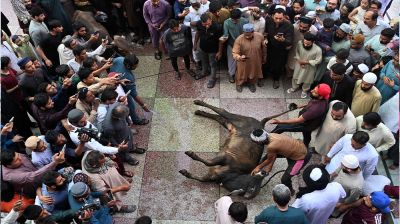
Each year, Muslims across the country sacrifice cattle, goats, buffaloes and other livestock during Eid-ul-Azha, with the distribution of the meat often prompting discussion about the proper Islamic practice.
A widely observed tradition involves dividing the meat into three parts — one for the donor’s family, one for relatives and friends, and one for the poor and needy. Religious scholars say this practice is rooted in the Quran and Hadith and is considered commendable, but not compulsory.
Mufti Anisur Rahman Sikdar, a director at the Islamic Foundation, said Islam encourages the distribution of Qurbani meat among family members, relatives and the less fortunate. However, he stressed that there is no requirement to divide the meat in a fixed manner.
“Dividing the meat into three portions is supported by Islamic sources and is encouraged, but it is not mandatory. A person may keep all the meat for personal use or donate all of it if they wish,” he said.
Scholars note that the Quran encourages believers to eat from the sacrificial meat and share it with those in need, while traditions from the Prophet Muhammad indicate that he distributed the meat among his family, neighbours and the poor.
Religious researcher and author Sharif Muhammad said Eid-ul-Azha, like Eid-ul-Fitr, carries a strong social dimension aimed at ensuring that disadvantaged people can also take part in the celebrations.
He added that while distributing meat to the poor is highly recommended, it does not carry the same obligatory status as certain other acts of worship in Islam.
The issue of so-called “social shares” of Qurbani meat, a custom practised in some rural areas, has also attracted attention. Under the tradition, those offering sacrifices contribute a portion of their meat to a communal fund for distribution among poorer members of society.
Islamic scholars say such arrangements are permissible if they are made voluntarily. However, they emphasise that no individual or community leader has the authority to compel people to surrender a fixed portion of their Qurbani meat.
“If people willingly contribute meat for the benefit of the poor, there is no problem,” Sharif Muhammad said. “But making such contributions compulsory would not be consistent with Islamic principles.”
Religious experts therefore view the three-way division of Qurbani meat and voluntary community sharing as recommended practices that promote social welfare, while maintaining that neither should be regarded as a binding religious requirement.
Source: BBC Bangla