


 For all latest news, follow the Daily Sun's Google News channel.


EU observers call 2026 polls credible, urge reforms on finance and inclusion
Daily Sun Report, Dhaka
Published: 28 Apr 2026, 03:07 PM
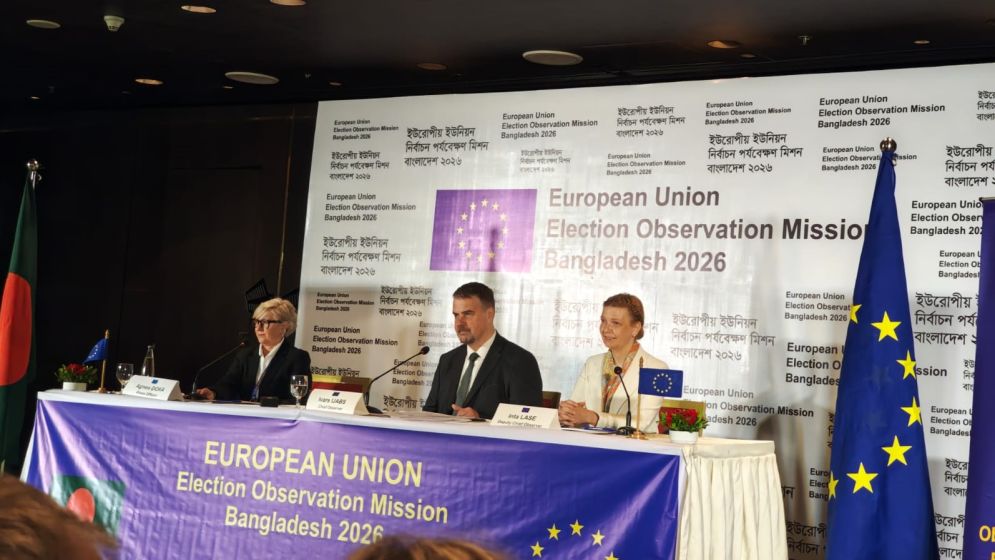
Photo: Collected
Chief Observer of the European Union Election Observation Mission to Bangladesh, Ivars Ijabs, said on Tuesday that the 2026 parliamentary elections were credible and competently managed, marking a pivotal step towards restoring democratic governance and the rule of law.
“For the first time since 2008, elections were genuinely competitive, with fundamental freedoms broadly respected. However, sporadic localised political violence and a persistent fear of mob attacks—often triggered by manipulated online narratives—undermined the democratic process,” he said.
The EU mission made the remarks while presenting its final report on the 13th parliamentary elections at the InterContinental Hotel in Dhaka.
“We noted that, despite a limited political space, the Bangladesh Election Commission worked independently and transparently, maintaining the confidence of stakeholders and upholding the integrity of the polls,” he added.
Responding to a question on irregularities, Ijabs said: “There is no such thing as a completely flawless election in any country. However, all issues must be addressed transparently and in accordance with legal procedures. This is what we have observed, as our mission continued its work beyond 12 February.”
On campaign financing, he stressed the need for greater transparency. “This is one of the key recommendations in our final report—campaign spending must be declared, and the rules should be clear, transparent and enforceable,” he said.
“Currently, there are no sufficiently strict rules that can be effectively enforced. One of the fundamental principles of democracy is to limit the influence of excessive spending on election outcomes. Campaign finance regulations must be clearly defined in law and properly implemented,” he added.
Ijabs also highlighted concerns over women’s participation. “Bangladesh must honour its commitments regarding women’s representation. This includes international obligations, such as conventions against discrimination, as well as domestic commitments—particularly the requirement for political parties to ensure at least 33% representation of women in their internal structures,” he said.