


 For all latest news, follow the Daily Sun's Google News channel.


Toxic haze over Aminbazar
Landfill fires raise alarm
SM Mostafijur Rahman, Dhaka
Published: 24 Feb 2026, 12:00 AM
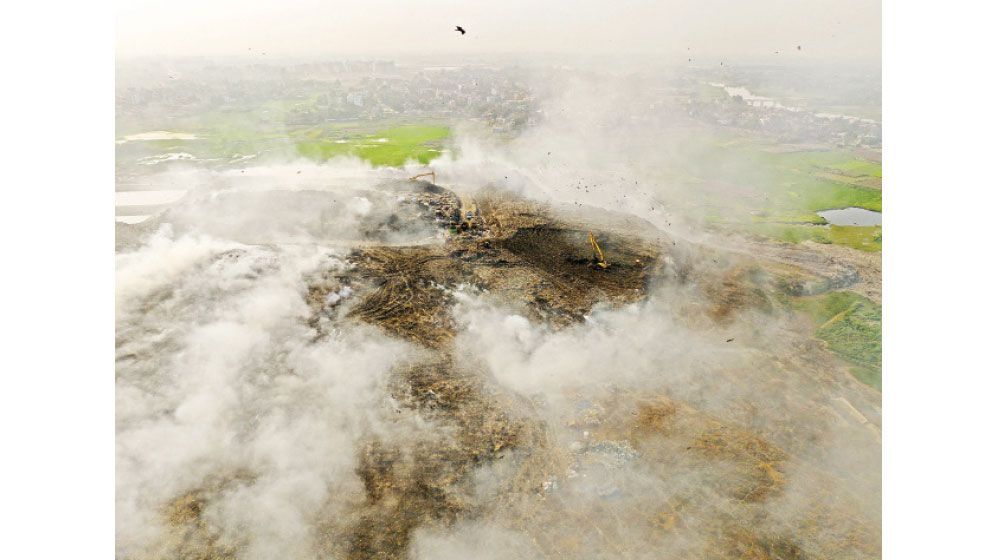
A drone photograph captures the sheer scale of the Aminbazar dumping ground, where toxic fumes blanket the landscape. SM Mostafijur Rahman
Persistent fires at the Aminbazar landfill are sending plumes of toxic smoke into Dhaka’s air as locals and experts allege environmental violations and administrative failure.
Despite the Air Pollution Control Rules, 2022 prohibiting open waste burning, at least 20 active fire spots were identified this week at the Dhaka North City Corporation (DNCC)-run site.
While DNCC officials attribute the blazes to spontaneous methane combustion, the scale of the fires has fueled claims that waste was being intentionally burned to manage the overburdened landfill.
The facility has reportedly been operating without a valid environmental clearance certificate since its permit expired in 2017.
Residents of Uttara Diabari, Gabtoli and Mirpur-11 have long complained of foul odours, which they say originate from toxic gases released by fires at Aminbazar and spread across northern Dhaka.
According to Swiss air monitoring firm IQAir, Dhaka’s Air Quality Index (AQI) stood at 177 on 20 February, 2026, categorising the air as “Unhealthy”. High levels of particulate matter (PM2.5 and PM10) have made outdoor activities hazardous.
Although construction projects and industrial emissions remain major contributors to pollution, experts say open waste incineration at Aminbazar has added a severe new layer of contamination.
A visit to the 52-acre landfill last Saturday found fires burning at 20 separate locations, with thick smoke visible from surrounding areas.
Waste workers and local stakeholders alleged that trash was deliberately set on fire to reduce its volume, particularly plastic waste. Some also claimed that burning helps avoid the cost and effort of transporting waste elsewhere.
Contacted, DNCC officials denied the allegations and said methane gas accumulation beneath the waste, highly flammable in nature, triggered the fires.
SM Shafiqur Rahman, supervising engineer (additional charge) of the DNCC Waste Management Department, said the authorities were continuously spraying water to extinguish the fires.
“We are constantly spraying water to put out the fires, which causes smoke to spread. The City Corporation does not burn waste; we are working to extinguish the flames. The situation may improve once the rains arrive,” he said.
The Daily Sun’s monitoring conducted on 20 and 21 February identified multiple active burn sites. Access to the landfill was restricted by security personnel, though heavy smoke was visible from outside.
The landfill is reportedly under immense pressure, with waste piles reaching up to 90 feet high. Although a Tk1,272 crore waste-to-energy project was approved in late 2023 to modernise management at the site, implementation has yet to begin despite a 2026 target.
Razinara Begum, director (waste and chemicals management) at the Department of Environment, said waste burning was strictly prohibited.
“The policy clearly states that waste cannot be burned under any circumstances. The ministry has issued directives banning such practices,” she said.
Rejecting explanations related to methane or plastic reduction, she added, “No matter what they claim, this is unacceptable. Plastic waste should not even be ending up there.”
She urged greater attention to the issue and said the department was continuing efforts to curb pollution and calling on journalists to highlight the matter to higher authorities.
Read More